Agriculture Minister Salem al-Soqatri urges a One Health national framework at FAO conference in Rome
 Yemen Herald News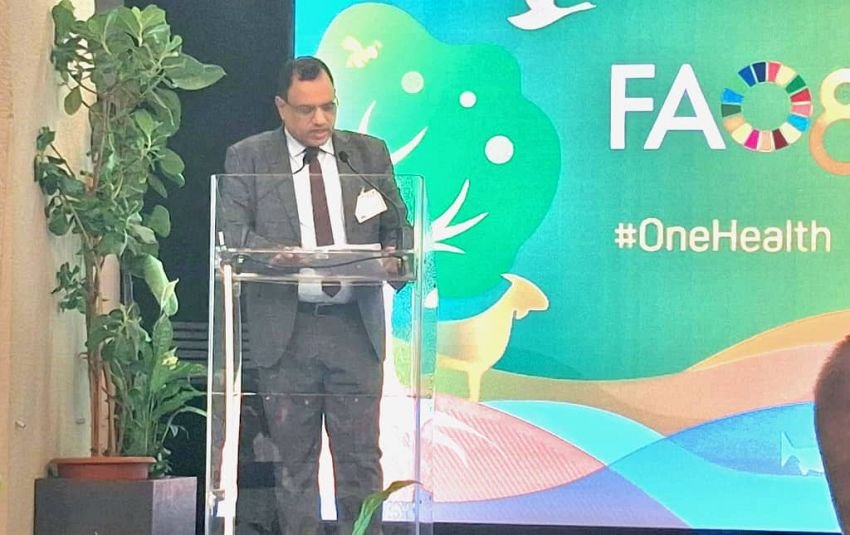
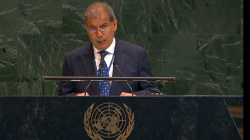
ROME, Italy — Yemen’s agriculture minister asked for the One Health approach to be adopted as a national framework, at the close of a three-day conference at FAO headquarters.
Salem al-Soqatri, the Minister of Agriculture, Irrigation and Fisheries, said the approach should be used to raise food and health security, according to the state news agency Saba.
He named water scarcity, climate change and the deterioration of livelihoods as the pressures such a framework would have to manage, Saba reported.
Yemen Herald could not independently confirm the minister’s remarks. The account of what he said rests on Saba alone, and no second report of his intervention has been published.
The conference itself is documented. The Food and Agriculture Organization held its Global Conference for Actions on One Health in Agrifood Systems at its Rome headquarters from 21 to 23 September, the organisation said.
FAO Director-General Qu Dongyu opened the meeting on 21 September.
“One Health is a farmer’s agenda, a scientist’s agenda, and a Minister’s agenda,” Qu said in his opening statement.
One Health treats the health of people, animals, plants and ecosystems as interconnected, FAO said. It applies that to emerging diseases, antimicrobial resistance, climate change and food safety.
Qu said pests and diseases destroy an estimated 20 to 40 percent of global crop production each year. He said degraded soil can weaken crops and animal feed, and that poor water quality can carry pathogens between animals and people.
The stated aim of the conference was to move countries from dialogue to practical action, FAO said. Sessions covered cooperation between sectors, knowledge sharing, priority actions and investment opportunities.
Al-Soqatri thanked FAO and development partners for their support, Saba reported. He asked for the partnership to be widened and for One Health to be folded into Yemen’s recovery and development priorities.
The conference closed with recommendations to tie the health, agriculture and environment sectors together, to link national and international monitoring and early warning systems, and to secure sustained financing, according to the same report.
FAO used the meeting to launch the Sustainable Livestock Transformation and One Health Intelligence and Knowledge Hub. The platform gathers livestock data, dashboards and analytical tools in one place.
Users can look up livestock production figures, animal health risks, antimicrobial resistance and climate interactions through it, FAO said. It carries a Livestock AI Assistant to help navigate the material.
The hub is organised as dashboards by theme and geographic area, FAO said. It also links to the organisation’s livestock projects at country, regional and global level.
FAO also presented a global framework to accelerate action on avian influenza on the opening day. It did so with the World Health Organization, the World Organisation for Animal Health and the Convention on the Conservation of Migratory Species of Wild Animals.
The One Health in Agrifood Systems framework the conference was built around was requested by FAO’s Committee on Agriculture in 2024.
Mwigulu Lameck Nchemba, the prime minister of Tanzania, attended the opening session alongside ministers responsible for agriculture, health, livestock, fisheries and the environment.
The high-level segment carried video messages from Djuro Macut, prime minister of Serbia, and Guy Parmelin, president of the Swiss Confederation.
Ministers taking part included Annie Genevard of France, Martin Heydon of Ireland, Abdul Awal Mintoo of Bangladesh and Mustapha Ferjani of Tunisia. Yu-Kyoung Oh, South Korea’s minister of food and drug safety, sent a video message.
Xia Gang, deputy director general of China’s National Disease Prevention and Control Administration, also attended.
Saba did not say whether al-Soqatri held bilateral meetings in Rome.
The ministry has run a series of technical engagements this month. Al-Soqatri reviewed a Pandemic Fund veterinary project with its implementing team on 23 September, Saba reported at the time.
The food security picture the minister described is set out in the UN’s own planning documents. More than 22 million people in Yemen need assistance, according to the humanitarian needs and response plan published in March 2026.
That plan recorded 18.3 million people as acutely food insecure.
It counted more than 2.2 million children under five as acutely malnourished, of whom 516,157 were severely malnourished.
It also recorded 5.2 million internally displaced people, and sought 2.16 billion US dollars to reach 12 million of those in need.
Yemen has been divided since 2014 between the Houthis in the north and the internationally recognised government in the south, now organised as the Presidential Leadership Council. The Houthis hold Sanaa and control the territory where most Yemenis live.
Aid delivery in the north has been constrained. The Houthis have detained staff from several aid agencies, including the UN, and the UN moved its resident coordinator’s office to Aden in September 2025.
Fighting resumed at scale in 2026 after four years in which frontlines were largely frozen, according to a House of Commons Library briefing published on 11 September.
That briefing recorded the first changes in frontline control since the 2022 ceasefire. The conflict began in 2014, when the Houthis captured Sanaa, and widened the following year when a Saudi-led coalition intervened.
Agriculture and fisheries carry a large share of Yemen’s workforce, and both sit inside the water and climate pressures al-Soqatri named.
Ministry appeals of this kind carry no funding commitment on their own. Saba reported no pledge attached to this one.
The conference did not publish a country-by-country list of commitments.
About the Author