Abdullah al-Alimi Bawazir asks Britain to back Yemen’s coast guard in New York talks
 Yemen Herald News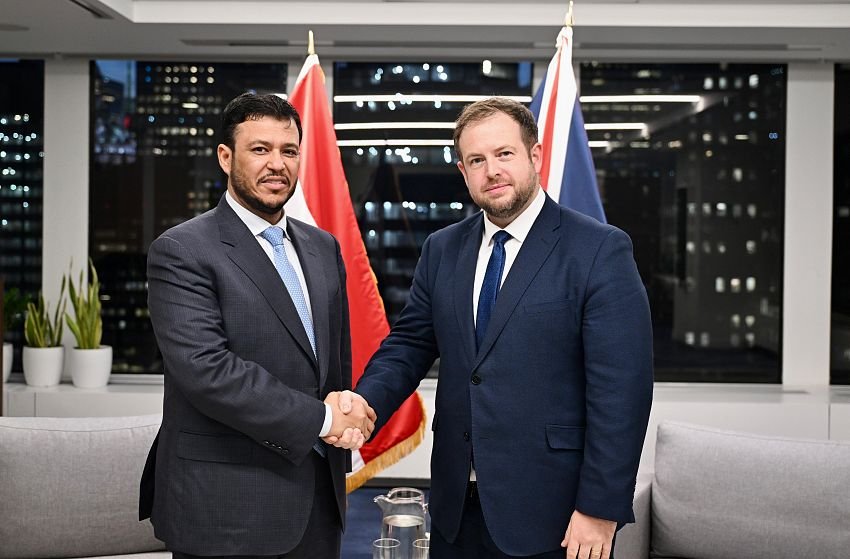
NEW YORK, United States — A member of Yemen’s Presidential Leadership Council asked Britain to help upgrade the country’s coast guard and armed forces, in talks on Thursday.
Abdullah al-Alimi Bawazir met Stephen Doughty, Britain’s minister of state for the Middle East and North Africa, in New York, the state news agency Saba reported.
The account of the meeting rests on Saba, which carries the council’s own statements. No British readout has been published, and Yemen Herald could not independently confirm what was said.
Bawazir asked London to press for enforcement of UN Security Council resolutions on Yemen, according to the agency. He also asked it to work to stop the flow of Iranian weapons to the Houthis.
He raised cooperation on maritime security, counter-terrorism and smuggling, Saba said.
Bawazir said the United Kingdom’s continued support for the Yemeni people and state institutions was greatly valued, according to the report.
He described the Houthis as terrorist militias whose threat is no longer an internal Yemeni matter. He said it now reaches the Yemeni state, neighbouring countries, the security of the Red Sea and Bab al-Mandab, and international trade.
That characterisation is the council’s own. The Houthis reject it and present their campaign as a response to the blockade on their air and sea ports.
Doughty took the Middle East brief on 20 July 2026. His portfolio covers the Middle East, North Africa, Afghanistan and Pakistan.
He had held the Europe, North America and Overseas Territories portfolio since July 2024.
Britain is the penholder for Yemen at the UN Security Council, meaning it drafts and leads council work on the file.
The talks followed a video conference between Doughty and Yemeni Prime Minister Shaya al-Zindani on 23 September. Doughty said in that call that his country was ready to assist in line with the government’s priorities, according to Saba.
The meeting came during the General Assembly’s high-level week, when Yemeni officials have held a run of bilateral sessions in New York.
Bawazir raised Bab al-Mandab with the European Union’s foreign policy chief Kaja Kallas on the same visit, Saba reported this week. He also asked UNICEF to widen its child protection work in Yemen.
The military position he described has changed this month. A House of Commons Library briefing published on 11 September recorded the first changes in frontline control since the 2022 ceasefire.
It said the Houthis had reportedly taken what it called strategic ports and islands in the Bab al-Mandab strait.
The group announced a naval blockade on Saudi Arabia in July, and an air blockade after it. It had declared a new phase in the conflict in June, centred on lifting the blockade on its own ports.
Saudi Arabia has launched a maritime coalition in response and has carried out air strikes, according to the briefing.
Hans Grundberg, the UN special envoy for Yemen, told the Security Council in August that intensifying fighting carried a more serious risk of a return to large-scale conflict.
The Houthis are subject to a UN arms embargo.
Iran has increased military support for the group over time, the briefing said. Tehran denies arming it.
The Security Council condemned Houthi attacks on Saudi Arabia this month and called for an end to the escalation.
G7 foreign ministers issued their own condemnation and urged Iran to stop arming the group. Arab foreign ministers warned separately that the Houthi advance threatens shipping through Bab al-Mandab.
Kallas said this month that the European Union’s Aspides naval mission had raised its alert level in the Red Sea.
The Presidential Leadership Council was formed in 2022 as an eight-member body, taking power from President Abdrabbuh Mansour Hadi. Its members are figures backed by Saudi Arabia or the United Arab Emirates.
Saudi Arabia has disengaged militarily from the conflict over time while continuing to back the council, the briefing said. Britain and the United States had supported the Saudi-led coalition from 2015.
The Southern Transitional Council was removed from it this year after a failed offensive in the south, and has relaunched under a new name.
Britain and the United States both called for a return to dialogue during that episode. Their ambassadors restated support for a negotiated settlement and for Yemen’s territorial unity.
Analysts have described the council as fractured, which the briefing said has limited its effectiveness.
The United Arab Emirates withdrew its remaining forces from Yemen in January.
Yemen’s conflict began in 2014, when the Houthis captured Sanaa, and widened the following year when a Saudi-led coalition intervened in support of Hadi. Frontlines were largely frozen after a ceasefire in 2022.
The Houthis hold the capital and control the territory where most Yemenis live.
Aid access in the north remains constrained. The Houthis have detained staff from several aid agencies, including the UN, which moved its resident coordinator’s office to Aden in September 2025.
Mediation is run by the UN special envoy, with Omani involvement. A prisoner exchange planned for July did not go ahead.
Saba did not say what Doughty told Bawazir. It gave no British commitment, no figure and no timetable.
It did not say whether the two men discussed the special envoy’s roadmap.
About the Author