UAE Says Air Defences Downed Nine Ballistic Missiles and 33 Drones in a Single Day
 Yemen Herald News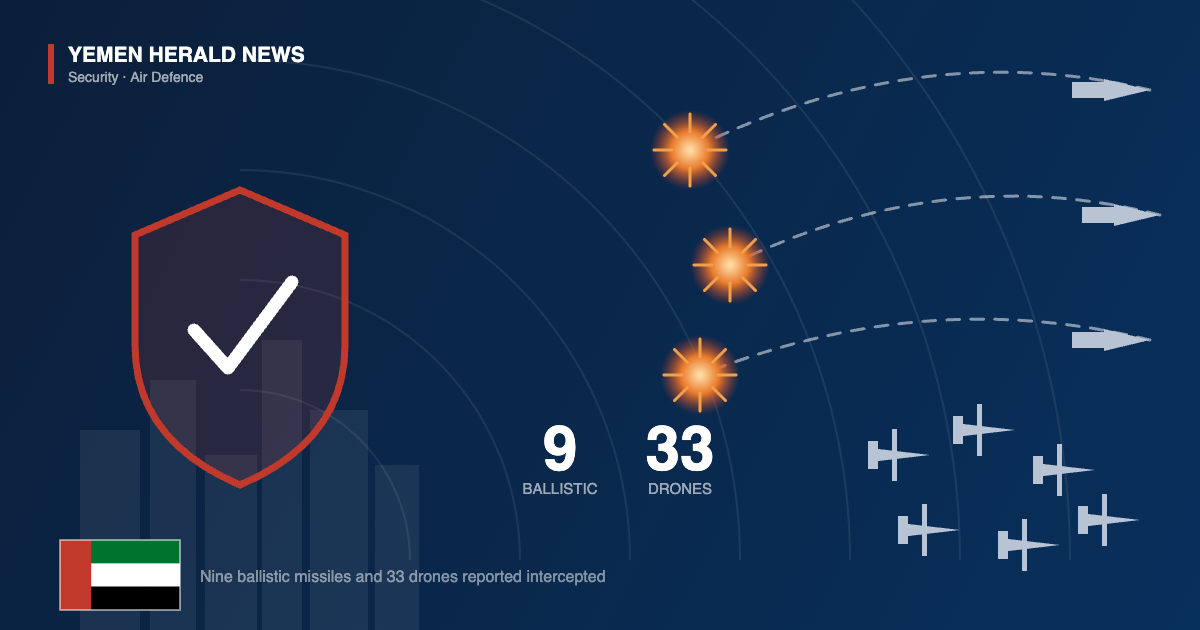
The United Arab Emirates defence ministry said its air defence systems had intercepted nine ballistic missiles and 33 drones launched from Iran during a single day in mid-March 2026. The announcement, published on the ministry’s official account on X, described the launches as part of what it called Iran’s blatant aggressions against the country.
The ministry put the running total for the campaign at 294 ballistic missiles, 15 cruise missiles and roughly 1,600 drones engaged since the attacks on the UAE began. Those cumulative figures rose steeply over the following fortnight: by the end of March the ministry was reporting totals of 414 ballistic missiles, 15 cruise missiles and 1,914 unmanned aerial vehicles, an increase that reflects how sharply the tempo of launches climbed in the final week of the month.
Daily tallies published by the ministry through March varied widely. Some days brought three or six ballistic missiles alongside well over a hundred drones; others, including the day covered by this report, saw fewer drones but a heavier ballistic component. The pattern suggests alternating salvo compositions rather than a steady rate of fire, with drone-heavy nights interspersed with concentrated missile launches.
Ballistic missiles and drones pose quite different problems for a defending network. Ballistic missiles arrive fast and on steep trajectories, giving defenders seconds rather than minutes and requiring high-end interceptors. Drones are slow and low, but arrive in numbers designed to saturate radar coverage and exhaust the crews tracking them. Handling both in the same night, as Emirati crews were doing repeatedly through March, requires layered systems and sustained readiness across the whole network.
The ministry also reported the human cost. Deaths recorded at that stage included Emirati nationals alongside citizens of Pakistan, Nepal and Bangladesh, and it put the number of people injured at 141, spanning residents of many nationalities. By late March the ministry’s figures had risen to include two members of the UAE armed forces, a Moroccan civilian contracted by the armed forces and eight foreign nationals killed, with 178 people injured.
The breadth of nationalities in the casualty lists reflects the composition of the Emirati population, in which foreign residents form the large majority of the workforce. Ministry statements listed injured people from across South Asia, the Arab world, Africa, Southeast Asia and Europe. Yemeni nationals were among those recorded as injured, one of the few direct and documented links between this phase of the Gulf conflict and Yemeni citizens abroad.
The breadth of nationalities in the casualty lists reflects the composition of the Emirati population, in which foreign residents form the large majority of the workforce. Ministry statements listed injured people from across South Asia, the Arab world, Africa and Southeast Asia. Yemeni nationals were among those recorded as injured.
Interception claims of this kind are difficult to verify independently. The figures come from the defence ministry itself, and outside analysts had limited means of confirming either the number of projectiles launched or the proportion successfully engaged. On some days the ministry acknowledged that a small number of projectiles had fallen inside the country rather than being destroyed in flight, which lent the reporting a degree of credibility it would not have had if every claim were a clean sweep.
Debris was a persistent secondary hazard. Even successful interceptions send fragments to the ground, and across the Gulf and Jordan the clearing of fallen wreckage became a routine task for police and military engineering teams. In early April the UAE suspended operations at the Habshan gas facility after debris from an interception fell on the site, an illustration of how defensive success can still impose economic cost.
The ministry framed each statement as evidence of readiness, saying it would respond decisively to any threat and reaffirming its commitment to safeguarding the country’s sovereignty, security and stability. It did not, at this stage, announce offensive action against Iran, keeping to the defensive posture Emirati officials maintained publicly throughout the conflict.
The attacks formed part of the wider war that had opened in late February 2026, when the United States and Israel launched a joint offensive against Iran and Tehran began striking American and allied targets across the region. Saudi Arabia, Kuwait, Qatar, Bahrain and Jordan reported comparable attacks over the same period, and each published its own interception figures.
Sustaining this rate of interception carried its own costs. Modern interceptors are expensive and stocks are finite, and a campaign measured in hundreds of ballistic missiles and thousands of drones puts pressure on magazines that cannot be replenished quickly. The economics of defending against cheap one-way attack drones with costly interceptors became a recurring theme in analysis of the war.
Sustaining this rate of interception carried its own costs. Modern interceptors are expensive and stocks are finite, and a campaign measured in hundreds of ballistic missiles and thousands of drones puts pressure on magazines that are difficult to replenish quickly. The economics of defending against cheap one-way attack drones with costly interceptors became a recurring theme in analysis of the conflict.
The fighting ran for roughly three more weeks. The United States and Iran agreed a ceasefire on 7 and 8 April 2026 that also covered Israel, ending more than five weeks of open conflict, though Gulf states reported drone activity within hours of the announcement and the truce frayed repeatedly in the months that followed.
About the Author