Yemeni envoy in Damascus and Syrian Diplomatic Institute discuss training memorandum
 Yemen Herald News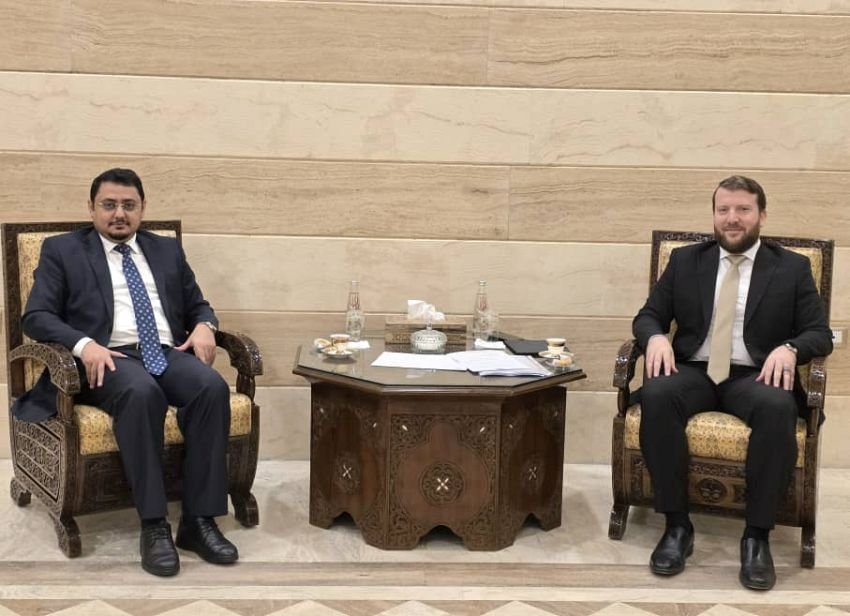
DAMASCUS, Syria — Yemen’s chargé d’affaires in Damascus and the head of Syria’s diplomatic institute discussed arrangements on Saturday for signing a training memorandum between the two countries’ institutes.
Mohammed Baaker met Yasser al-Jundi at the institute’s headquarters in the Syrian capital.
Saba, the news agency of Yemen’s internationally recognised government, reported the meeting. The account of it rests on that agency. No independent confirmation has been published.
The two reviewed the steps and the main areas of the proposed memorandum of understanding, Saba said.
It would cover the exchange of expertise between the two institutes. It would also cover training and capacity-building programmes for diplomatic and administrative staff.
Those programmes would run through joint courses and discussion sessions, according to the agency.
Baaker said the Syrian institute prepares and trains staff and gives them the knowledge needed to keep pace with international and political developments, Saba reported.
Al-Jundi said his institute was ready to open broader avenues for joint cooperation, the agency said. He said it would work to make training resources available to both countries.
Nothing has been signed. Saba said the two sides discussed arrangements for a signing and gave no date for one.
The meeting follows an earlier contact in the Syrian capital. Baaker met Dima al-Mousa, director of the agreements and treaties department at Syria’s foreign ministry, on 18 August, Saba reported at the time.
They discussed draft bilateral agreements and memorandums due to be signed in the following period, the agency said then. Those covered academic, health, economic and diplomatic cooperation.
The institute Baaker visited on Saturday was established in 2016 and sits under Syria’s Ministry of Foreign Affairs and Expatriates, according to the Syrian outlet Enab Baladi.
It trains diplomats and ministry staff in diplomatic sciences, foreign policy, public diplomacy, international law, protocol and communication skills, the outlet reported. It was restructured in 2019.
The institute has signed comparable memorandums with other states over the past year.
It signed one with Azerbaijan’s Institute for Development and Diplomacy in Baku on 18 June, the Syrian state news agency SANA reported. Al-Jundi signed for the Syrian side and Fariz Ismailzade for the Azerbaijani institute.
That text covers the exchange of expertise in diplomacy and international relations, capacity building, diplomatic training and research, according to SANA.
Al-Jundi met the head of Germany’s Foreign Service Academy, Andrea Berdesinski, in Berlin on 26 April, SANA reported. The two institutes agreed to widen joint programmes and professional training for Syrian diplomats.
It signed another with Saudi Arabia’s Prince Saud Al-Faisal Institute for Diplomatic Studies on 14 September 2025, Enab Baladi reported. Mushabbib bin Ayed al-Qahtani, the Saudi institute’s director general, signed for Riyadh.
That memorandum covers shared expertise, joint curriculum work in diplomatic studies and training programmes, the outlet said.
Yemen is represented in Damascus at chargé d’affaires level rather than by an ambassador.
Syria handed the Yemeni mission in Damascus to the internationally recognised government in October 2023, Asharq Al-Awsat reported at the time. The Syrian authorities removed the Houthi group’s representative from the premises.
Ahmed Awad bin Mubarak, then Yemen’s foreign minister, said the Syrian side had informed his government of the decision. Faisal Mekdad, Syria’s foreign minister at the time, conveyed it.
The handover came as Damascus rebuilt ties across the region. Syria had returned to the Arab League months earlier, after a suspension that had run for 12 years.
Yemen’s foreign ministry has commented on Syria’s internal settlement since then. It welcomed an agreement between the Syrian government and the Syrian Democratic Forces on 20 January.
The ministry said the agreement, which covered a ceasefire and the integration of forces, was a step towards security and stability in Syria and towards building state institutions and the rule of law.
It said in the same statement that it supported Syria’s unity and sovereignty. It rejected what it called attempts to undermine the unity of the Syrian state or to impose arrangements outside the framework of the legitimate government.
Yemen’s foreign ministry is led by Afrah al-Zouba, who was appointed on 23 July. She is the first woman to hold the post.
Al-Zouba was minister of planning and international cooperation from February until that appointment, according to Al Jazeera. She was first deputy secretary-general of the National Dialogue Conference between 2013 and 2015.
Al-Zouba worked as a programme officer for the United States Agency for International Development and advised Prime Minister Maeen Abdulmalik on humanitarian relief in 2019, Al Jazeera reported. She ran the Executive Bureau for Accelerating Aid Absorption from 2021.
She holds a bachelor’s degree in pharmacy from Sanaa University and a master’s degree in community health and health economics, according to Al Jazeera. She also holds a master of business administration from the University of Science and Technology in Yemen.
She was in New York on Saturday for the 81st session of the UN General Assembly. Saba said she met the president of the International Committee of the Red Cross there.
Yemen’s war began in 2015, when the Houthis took the capital and a Saudi-led coalition intervened on the government’s side. The government has operated from Aden since.
Yemen’s humanitarian response plan for 2026, published in March, records more than 22 million people in need of assistance. It puts 18.3 million people in acute food insecurity.
The plan seeks 2.16 billion dollars to reach 12 million people.
About the Author