State Department says it has moved to deny the Houthis weapons and funding
 Yemen Herald News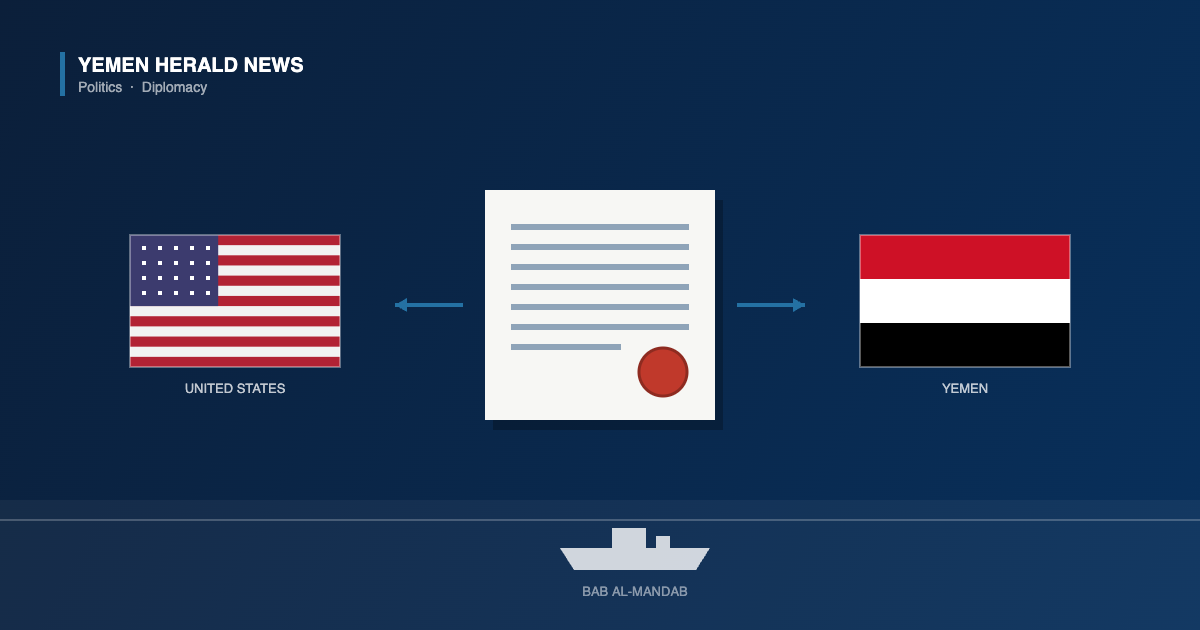
WASHINGTON, United States — The United States has worked to deny the Houthis access to weapons and funding wherever possible, a State Department spokesperson said, citing sanctions on more than 200 entities.
The spokesperson was answering a question about the threat the group poses to shipping in the Bab al-Mandab Strait. Yemeni outlets carried the remarks on 27 September.
Freedom of navigation in the Red Sea and preventing the export of terrorism are core American interests in the Middle East, the spokesperson said.
The Trump administration has demonstrated its commitment to defending those interests against what the spokesperson described as aggression emanating from Iran and its proxies.
The spokesperson characterised the Houthis as Iranian-backed. The group says it acts on its own account rather than at Tehran’s direction.
Asked about support for the Yemeni government, the spokesperson said Washington communicates regularly with allies and regional partners on Yemen.
“We remain focused on achieving our shared counterterrorism goals, confronting the Houthis and other terrorist groups that sow chaos throughout the region,” the spokesperson said.
The account of the exchange rests on the State Department’s response as relayed by Yemeni outlets. Yemen Herald found no independent publication of the full text of the questions and answers.
The measures the spokesperson referred to are on the public record. President Donald Trump signed Executive Order 14175 in January 2025, directing that the Houthis be re-designated as a foreign terrorist organisation.
The State Department had already designated Ansarallah, the movement’s formal name, as a specially designated global terrorist group on 16 February 2024. It used Executive Order 13224, the main American counterterrorism sanctions authority.
The foreign terrorist organisation designation took effect on 5 March 2025, according to the department.
A foreign terrorist organisation designation makes it a federal crime to knowingly provide material support to the group, according to the Congressional Research Service.
It also allows American financial institutions to block assets in which the group has an interest, the service says.
Sanctions actions have continued since. The department announced measures against Houthi financial facilitators, and in September 2025 against what it called illicit trade and shipping facilitators.
On 16 January 2026 it designated further networks under Executive Order 13224. They included front companies and facilitators in Yemen, Oman and the United Arab Emirates, the department said.
Those networks supported the Houthis through oil transfers, weapons procurement and financial services, according to the department. It said the proceeds funded attacks in the Red Sea.
The department described that action as the tenth in a series targeting Houthi personnel and operatives.
A separate action named a network the department said was procuring weapons and commodities from Russia.
The department has not said whether the figure of more than 200 entities counts designations issued by the Treasury Department alongside its own.
The spokesperson’s comments followed a request from Yemen’s internationally recognised government for more American help.
Rashad al-Alimi, chairman of the Presidential Leadership Council, spoke to Trump by telephone on Sunday 20 September. He asked for United States support for his government against the Houthis, Reuters reported, citing four people familiar with the call.
Trump made no direct pledge of military support during the conversation, two of those people told the agency. One was Yemeni and one Western, Reuters said.
The White House and Yemen’s information minister did not immediately respond to the agency’s requests for comment.
Trump has said publicly that the United States is in contact with the Houthis, and that the group has told him it will not target American shipping.
He has also rebuffed Saudi requests for military support against the group, according to Reuters.
The exchanges follow a Houthi advance on Yemen’s Red Sea coast. The group took areas along the Bab al-Mandab strait this month in what Reuters described as a lightning offensive.
Al-Alimi called on Yemenis to mobilise against the Houthis on 25 September.
Bab al-Mandab links the Red Sea to the Gulf of Aden. Vessels sailing between Asia and the Suez Canal pass through it.
The Houthis have said the campaign against shipping they began in November 2023 was mounted in support of Palestinians in Gaza.
Traffic through the Suez Canal in the first week of 2026 remained 60 per cent below the equivalent week of 2023, the shipping association BIMCO said on 7 January.
Carriers had by then been routing vessels around the Cape of Good Hope for two years, according to the association.
BIMCO recorded the last Houthi attack before that assessment as the strike on the cargo ship Minervagracht on 29 September 2025.
Lloyd’s List reported a further disruption to Red Sea container traffic in July 2026, which it attributed to a Houthi blockade.
More than 22 million people in Yemen need humanitarian assistance, according to the United Nations humanitarian needs and response plan published in March 2026.
The plan records 18.3 million people as acutely food insecure and 5.2 million as internally displaced. It records more than 2.2 million children under five as acutely malnourished, 516,157 of them severely.
The appeal seeks 2.16 billion dollars to reach 12 million people.
The State Department did not say in the exchange whether any change to American posture in Yemen is under consideration.
About the Author