Egypt says eight sailors seized off Yemen on the tanker Eureka have been freed
 Yemen Herald News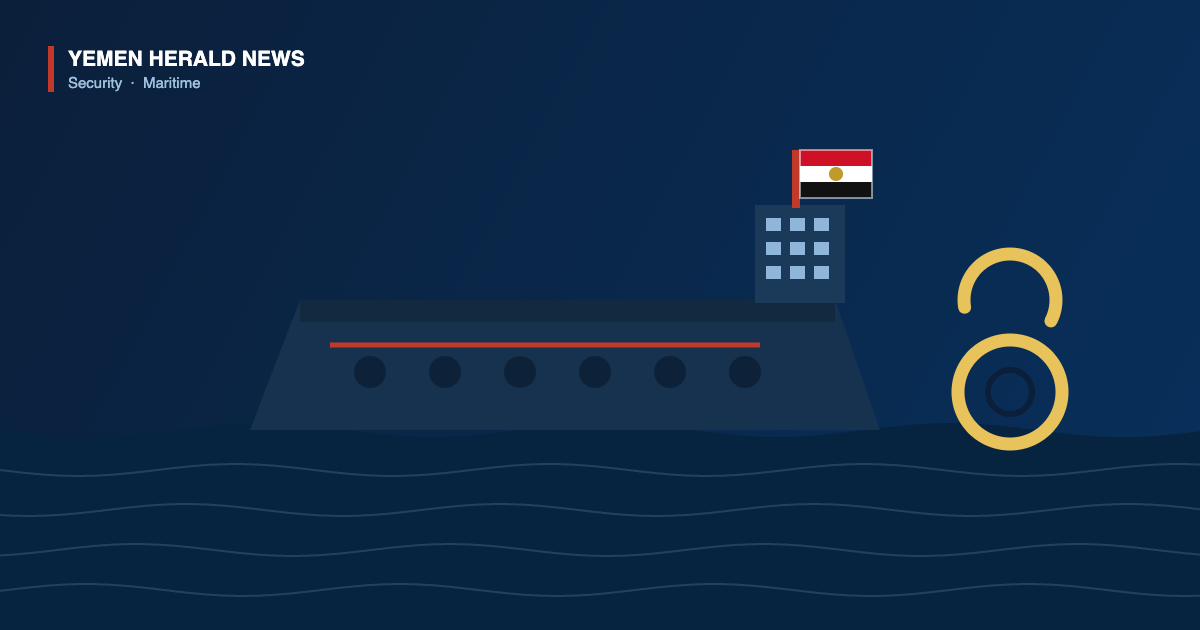
CAIRO, Egypt — Egypt’s foreign ministry said on Wednesday that eight Egyptian sailors held by pirates since May aboard the tanker Eureka have been released.
The ministry said the men were free and would be flown home.
Foreign Minister Badr Abdelatty announced the outcome after contacts with Somali and Yemeni officials, The National reported.
Nader Zaki, the ministry’s spokesman, said Abdelatty had instructed Egypt’s embassy in Mogadishu to receive the sailors, check on their wellbeing and arrange their return on the earliest available flight.
The ministry did not say how the release was secured. It set out no terms. It named no intermediaries, and it did not say whether a ransom was paid.
The account of the release rests on the Egyptian foreign ministry’s statement. No party to the negotiations has published an independent account of how it was reached.
The Eureka was hijacked on May 2 while anchored off Qana port in Shabwa province, on Yemen’s southern coast, the maritime news outlet gCaptain reported.
The vessel carried 12 crew, eight of them Egyptian and four Indian, according to an investigation by the Arab Reporters for Investigative Journalism network.
The ministry’s statement addressed the eight Egyptians. It did not say what had become of the four Indian crew members.
The tanker is registered in Togo and carries the IMO number 1022823, that investigation found. It is operated by Gulf Marine Shipping, a company registered in the Marshall Islands.
The European Union naval mission Operation Atalanta confirmed the seizure at the time. “Operation ATALANTA assets have confirmed the hijacking of tanker vessel EUREKA,” the mission said.
Yemeni coast guard officials told Reuters they were trying to track the vessel and ensure the crew’s safety.
The tanker was steered towards Somali waters after it was taken, gCaptain reported.
The crew were held for almost five months.
They were confined together in a single cabin while the pirates took better quarters, the investigative network reported. Water and medicine ran low.
Some of the men had diabetes or high blood pressure and went without adequate medication, according to that account.
A video circulated on May 18 showed three bound sailors as armed men fired overhead, the network said.
Ransom demands opened at $3 million, rose to $10 million and settled near $2 million by mid-June, it reported. Talks then stalled over how the money would be handed over.
The pirates issued a 72-hour ultimatum and threatened to kill crew members, according to the same investigation.
Negotiations collapsed at one stage after the pirates asked for more money, said Capt El Sayed El Shazly El Naggar, head of Egypt’s Maritime Officers Syndicate.
Egypt’s embassy in Mogadishu kept the sailors in contact with their families while they were held, The National reported.
The hijacking came during a return of piracy in the waters between Yemen and Somalia.
Six commercial vessels have been hijacked since late April, Christopher Hockey, a senior research fellow at RUSI Nairobi, wrote in a commentary for the institute. Four were still in pirate hands when he wrote, with more than 60 seafarers aboard.
At least four fishing vessels and dhows have also been taken since the start of the year, according to that commentary.
Three of the hijackings happened near Yemen’s coast, Hockey wrote, and some involved Yemeni nationals.
None of the six hijacked ships carried armed guards, he wrote, after owners cut costs.
Warships have been moved from the Somali coast to the Strait of Hormuz and Bab al-Mandab since 2021, the commentary said, leaving less deterrence in the waters where the Eureka was taken.
Hockey wrote that unconfirmed reports suggest the Houthis have supplied training and financing to Somali pirate groups. He described the evidence as circumstantial.
AFP counted at least 15 attacks since the start of 2026 in an analysis of International Maritime Organization data, eight of them in the Gulf of Aden since May.
The Joint Maritime Information Center raised its threat assessment for the area to severe after a surge of attacks in April and May.
Mostafa Elbanna of the United Nations Office on Drugs and Crime said piracy remained below its earlier peak.
Somali pirates accounted for well over half of all piracy attacks recorded worldwide in 2011, and a World Bank study counted 218 successful hijackings between 2005 and 2012.
Ransom payments over that period were estimated at between $315 million and $385 million, according to the same study.
Somalia’s inflation rate reached 9.2 per cent in March, and the International Monetary Fund ranks the country among those with the smallest financial buffers.
Abdurrahim Muhammad Ali of the Djibouti Maritime Authority said pirate groups were exploiting the distraction of maritime forces elsewhere.
Afyare Elmi, of City University in Mogadishu, said solutions based on shore were more sustainable than naval patrols alone.
A separate hijacking ended this week. Puntland’s maritime police force retook the tanker Honour 25 on Tuesday, and five crew members were killed before the ship was recovered, authorities in the semi-autonomous Somali region told the Associated Press.
Those killed were three Pakistanis, a Myanmar national and an Indian, according to that account. The Honour 25 was seized in April.
Qana, where the Eureka was anchored, is an oil export terminal on the Shabwa coast.
About the Author