Yemen tells UN Human Rights Council that Houthi escalation killed more than 250 civilians
 Yemen Herald News
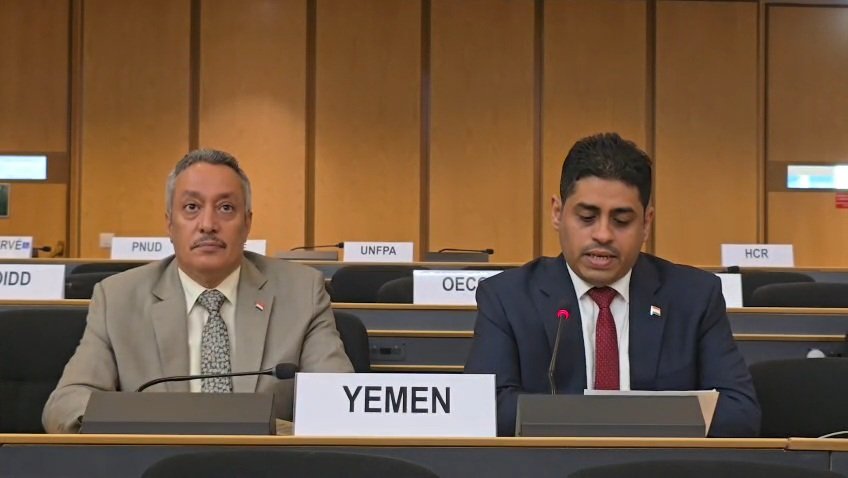
GENEVA, Switzerland — Yemen’s human rights minister told the UN Human Rights Council that the latest Houthi escalation had killed more than 250 civilians and wounded more than 360.
Mashdal Omar presented the government’s statement at the council’s 63rd session, the state news agency Saba reported on Saturday.
He said the figures were preliminary and covered the period to Sept. 30.
Omar said around 200,000 people had been displaced by the escalation. He said about 3,000 of them had been evacuated to Djibouti.
The minister held the Houthi movement responsible for the deterioration in the humanitarian and human rights situation, and for violations against children.
He said the ministry had documented 50 people killed or injured when convoys of displaced families were shelled on the road from Hays to Khokha.
Omar said three children were killed in an attack on Al-Tarira village in Taiz on Sept. 17. One of them was a girl younger than 18 months, he said.
Yemen Herald could not independently verify the casualty figures. They rest on the ministry’s own documentation, and no second organisation has published a matching toll.
The UN human rights office has published a lower count. Volker Turk, the UN high commissioner for human rights, told the council on Sept. 24 that his office had documented 32 civilians killed since August and 125 killed or wounded in the latest fighting.
The Houthi authorities reject the government’s accounts of civilian casualties and had made no public comment on the statement at the time of writing.
Omar said 26 health facilities supported by UNICEF had been disrupted in Taiz, Hudaydah, Marib and along the western coast.
He said 243 schools had closed or suspended classes since Sept. 3, affecting more than 140,000 students. A further 29 schools had closed in Jabal Habashi district, he said.
UNICEF gave the same school figure in late September, counting 243 closures over three weeks and nearly 140,000 students affected.
The minister said the Houthis had used schools and summer centres for mobilisation, indoctrination and recruitment.
He said 73 UN employees had been held by the Houthis since June, and that one of them had died in custody.
UN agencies put the number of detained staff at 73 at a Geneva briefing on Sept. 18, saying some had been held since 2021.
The World Food Programme repeated that figure on Oct. 2 and said 38 of those detained were its own employees. It called for their release.
UNICEF said in late September that 71,000 children had been displaced in three weeks, part of nearly 130,000 people displaced in the same period.
It said most of that movement was in or from Taiz governorate.
The agency said at least 15 children had been killed since early September, with 14 injured and three reported missing.
Mobile teams screened nearly 2,900 children, UNICEF said, and found more than a quarter acutely malnourished, including 200 severe cases.
“Conflict drives hunger, and hunger makes children more vulnerable to conflict,” said Akhil Iyer, the agency’s representative in Yemen.
At the Sept. 18 briefing, the International Organization for Migration said more than 112,000 people had been displaced in two weeks across Aden, Hudaydah, Abyan and Taiz.
It said 4.8 million people were already displaced before the escalation began.
“Our resources are very, very, very limited and our stocks will be depleted very soon,” said Abdusattor Esoev, the organisation’s chief of mission in Yemen.
The migration agency said more than 3,700 people had crossed from Yemen to Djibouti by late September, a higher count than the one the minister gave.
The World Food Programme said on Oct. 2 that 18.3 million people faced acute food insecurity across Yemen.
It said 2.2 million children under five were acutely malnourished, 500,000 of them severely.
UNICEF said on Sept. 16 that renewed hostilities had pushed more than 12 million children deeper into crisis.
A count it published the following day put the number of people displaced by the fighting at more than 104,000. An earlier tally that month counted 57,000 displaced children.
The World Food Programme said about 350,000 people in Taiz and Hodeidah could not be reached because of the fighting.
It said wheat flour prices in Taiz had risen 10 percent in two weeks.
The agency said it was assisting 2.4 million people in government-held areas and needed $109 million to reach up to 1.5 million newly displaced people. A further $158 million would sustain its operations through March 2027, the agency said.
It said it had reached more than 70,000 displaced people with aid in Taiz and Lahj, and that September brought its largest distributions of ready-to-eat food this year.
The UN human rights office, the UN population fund, the refugee agency and the World Health Organization also briefed reporters on Yemen on Sept. 18.
Nyaradzayi Gumbonzvanda, deputy executive director of UN Women, said on Oct. 2 that women and girls made up more than 57 percent of those at risk of food insecurity in Yemen.
The UN humanitarian plan for Yemen, issued in March, counted more than 22 million people in need of assistance and 5.2 million people displaced inside the country.
The plan sought $2.16 billion to reach 12 million people this year.
Fighting between Houthi forces and forces of the internationally recognised government has intensified since July, according to UN briefings in Geneva.
The council’s 63rd session opened in Geneva in September.
About the Author