About 15 airstrikes hit Houthi positions in al-Jawf, military sources say
 Yemen Herald News
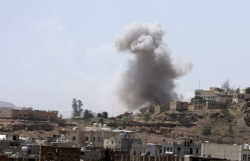
AL-HAZM, Yemen — About 15 airstrikes hit Houthi positions in Yemen’s northeastern Al-Jawf province on Sunday, military sources told the news site Yemen Monitor.
The strikes landed east of al-Hazm, the provincial capital, and in the district of Khab wa al-Sha’af, those sources said.
They named Al-Aqshaa and Al-Labanat among the areas hit.
The sources attributed the strikes to government aircraft. They described the targets as Houthi gatherings, camps and positions.
Vehicles were struck along several fronts, they said. The sources gave no assessment of what the strikes destroyed.
Houthi-affiliated media outlets reported separately that a series of airstrikes had targeted areas of Al-Jawf on Sunday.
Those reports carried no figure for the number of strikes. They gave no detail on the targets or on any damage.
Neither account reported dead or wounded.
The Houthi movement had not commented on the strikes or on the outcome of the fighting, Yemen Monitor said.
Yemen Herald could not independently establish what was hit. The two accounts come from opposing sides and agree only that aircraft struck the province that day.
Fighting was reported the same day on fronts in northern Marib province, the military sources said.
Fighting across Yemen has escalated since early September.
Government forces said on Monday that they had retaken the port of Mocha and positions near the Bab al-Mandab strait, including the district of Dhubab, Al Jazeera reported. The Houthi movement called those claims baseless.
Al Jazeera said it could not independently verify the battlefield reports.
Yahya Sarea, the Houthi military spokesman, said last week that Saudi aircraft and missiles had struck Houthi-held areas 94 times in 24 hours. He put the total since the escalation began at 1,350.
Those figures come from the Houthi authorities and have not been independently confirmed.
Government forces have claimed earlier gains inside Al-Jawf during the campaign, including the town of al-Yatma.
The province has changed hands in parts more than once since 2020. Front lines there have moved with little independent reporting from the ground.
International agencies have had limited access to Al-Jawf throughout the war. Casualty and damage reports from the province usually rest on the accounts of one side or the other.
The strikes came as Yemen’s government opened a named offensive against the Houthi movement.
Rashad al-Alimi, chairman of the Presidential Leadership Council, announced the start of military operations on Sunday to retake territory held by the group.
“Operation Dawn of Yemen has been launched to restore state institutions, liberate the capital Sanaa, and end the coup by the terrorist Houthi militias,” al-Alimi wrote on his X account.
The Houthis have held Sanaa since 2014. They describe the government as a Saudi proxy and reject its authority.
Maj. Gen. Turki al-Maliki, spokesman for the Saudi-led coalition, said on Monday that 100 fighter jets had taken part in the operation, Arab News reported.
He said 324 high-value targets had been destroyed.
Al-Maliki said the coalition was providing air cover over the Bab al-Mandab strait. He said it was giving round-the-clock support to Yemeni forces on the ground.
The coalition spokesman did not break the figures down by province, and did not say whether any of the strikes he described were the ones reported in Al-Jawf.
Al-Jawf borders Saudi Arabia to the north and Marib province to the south.
Houthi forces captured al-Hazm in March 2020. They have held most of the province since.
Government forces had concentrated much of their offensive effort on Al-Jawf before the latest campaign, Al Jazeera reported in September.
Saddam al-Huraibi, an analyst quoted by Al Jazeera, said government gains in Al-Jawf would ease the threat to Marib and require the Houthis to defend a much broader area.
He said success there could open routes north toward Saada and Amran.
Marib has been held by the government since 2014. The province produces oil and gas.
The Houthis have sought control of its oil and gas infrastructure, Al Jazeera reported.
Aid agencies told Al Jazeera that at least 194 people were killed and 880 wounded across several provinces in the two weeks to Sept. 10. Those figures could not be matched against any single official count.
The United Nations humanitarian plan for Yemen, published in March, put the number of people needing assistance at more than 22 million.
It said 18.3 million people were acutely food insecure. It recorded more than 2.2 million children under five as acutely malnourished, 516,157 of them severely.
The plan counted 5.2 million internally displaced people. It sought 2.16 billion dollars to reach 12 million of those in need.
Yemen’s war began in 2014, when the Houthis took Sanaa. A Saudi-led coalition intervened in March 2015.
The Presidential Leadership Council was formed in April 2022, when Abd Rabbuh Mansur Hadi transferred his powers to it. Al-Alimi has chaired it since.
Bab al-Mandab separates Yemen from the Horn of Africa. Shipping bound for the Suez Canal passes through the strait.
Houthi attacks on merchant vessels in the Red Sea and the Gulf of Aden began in late 2023. Much of the traffic that once used the route was diverted around southern Africa.
Government forces said in September that they had taken the military camp at Al-Labanat, one of the areas named in Sunday’s strikes.
About the Author