UAE Air Defences Intercepted Four Ballistic Missiles and 25 Drones on 22 March 2026
 Yemen Herald News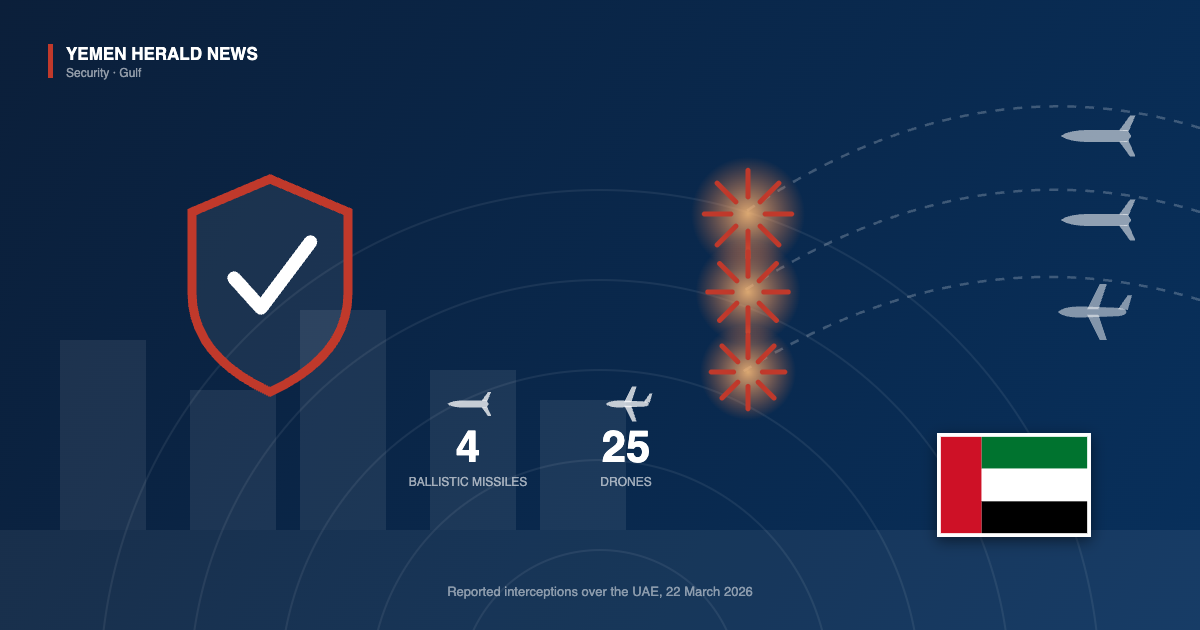
The United Arab Emirates’ Ministry of Defence said its air defence systems intercepted and destroyed four ballistic missiles and 25 drones launched from Iran on Sunday 22 March 2026. By the standards of the campaign then under way, it was a comparatively light night for the Emirates’ interceptor batteries, which had spent much of the preceding three weeks engaging launches on a near-daily basis.
The ministry said that since the start of the attacks its air defences had dealt with a cumulative total of 345 ballistic missiles, 15 cruise missiles and 1,773 drones. Those running totals had become a fixture of Emirati public communication during March 2026, issued as short statements that gave a nightly count alongside a campaign-to-date figure, and they offer one of the clearer contemporaneous measures of the tempo of the exchange.
The human cost reported at the time was concentrated among the country’s expatriate workforce. The ministry confirmed that two members of the armed forces had been killed in the line of duty. It also reported six civilian deaths, among them Pakistani, Nepalese, Bangladeshi and Palestinian nationals, and said 160 people had been injured to varying degrees. The nationalities involved reflected the demographic composition of the Emirates, where migrant workers make up the large majority of the resident population and are heavily represented in the industrial and logistics zones that lay near several of the targeted areas.
The exchanges had begun on 28 February 2026, when Iran responded to a United States and Israeli military campaign against it by launching missiles and drones at Gulf states hosting American assets. The opening barrage was the heaviest of the war. Analysts at the Foundation for Defense of Democracies’ Long War Journal estimated that Iran fired at least 247 ballistic missiles and 230 drones at the UAE, Bahrain and Qatar on that first day alone, with roughly 137 of the missiles and 209 of the drones directed at the Emirates, alongside attempted strikes on Kuwait, Jordan and Saudi Arabia.
What followed was a grinding pattern of nightly salvoes and nightly interception statements. On 5 March the ministry said it had detected seven ballistic missiles and destroyed six, with one falling inside the country, and had intercepted 125 of 131 drones detected. On 10 March it reported downing eight of nine ballistic missiles and 26 of 35 drones. On 13 March it announced seven ballistic missiles and 27 drones destroyed, and on 14 March nine ballistic missiles and 33 drones.
Those figures also make clear that interception was never complete. The ministry’s own statements acknowledged rounds that fell inside Emirati territory or into the sea, and on 23 March, the day after the engagement described here, falling debris was reported to have caused a minor injury in Abu Dhabi. Air defence at this volume is a question of attrition and leakage rates rather than an impermeable shield, and the published detection-versus-interception numbers were unusually candid on that point.
The ministry closed its 22 March statement by reiterating its commitment to national security and stability, saying it stood ready to confront any threat and would counter attempts to destabilise the country. Public guidance during this period was coordinated through the National Emergency Crisis and Disaster Management Authority, which issued advisories on shelter and on the interpretation of air raid warnings, and on at least one occasion clarified that intercepted threats had been engaged outside Emirati borders.
The campaign was not confined to military targets. On 2 March a Saudi Aramco refinery at Ras Tanura was hit in what was reported as an Iranian drone attack, and on 28 March Emirates Global Aluminium said its Al Taweelah site in the Khalifa Economic Zone Abu Dhabi had sustained significant damage, injuring six employees. Iran’s Islamic Revolutionary Guard Corps said it had targeted that plant and Aluminium Bahrain in response to strikes on two Iranian steel plants. The company later warned that restoring primary aluminium production could take up to a year.
The UAE had set out its diplomatic position early. A joint statement issued through the Ministry of Foreign Affairs on 2 March condemned the missile and drone attacks on the region, and Emirati officials pressed the argument in international forums that the Gulf states were third parties absorbing the consequences of a confrontation they were not party to.
The tallies continued to climb after 22 March. By 31 March the ministry was reporting a campaign total of 433 ballistic missiles, 19 cruise missiles and 1,977 drones, having intercepted eight ballistic missiles, four cruise missiles and 36 drones that day. Early April brought further heavy nights, including 18 ballistic missiles, four cruise missiles and 47 drones on 3 April and 17 ballistic missiles and 35 drones on 8 April.
Seen against that trajectory, the four missiles and 25 drones of 22 March 2026 represent a single data point in a sustained aerial campaign rather than an isolated incident. Its significance lies less in the night’s totals than in what the accompanying cumulative figures revealed: that within roughly three weeks, Emirati air defences had been called on to engage well over two thousand incoming munitions, at a cost in interceptor stocks, crew endurance and civilian lives that the published statistics only partly capture.
About the Author