Airstrikes hit southern and western Sanaa, residents say
 Yemen Herald News
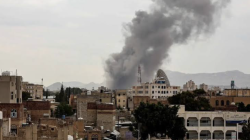
SANAA, Yemen — Airstrikes hit southern and western Sanaa on Friday afternoon, residents said, in the latest raids on the Houthi-held capital.
Residents told the Xinhua news agency they heard a series of explosions after midday. They said the strikes fell on districts south and west of the city centre.
The nature of the targets was not immediately clear.
No casualties were reported in the hours that followed. The extent of the damage had not been established, and no party published an assessment of what was hit.
Al-Masirah, the television channel run by the Houthi movement, attributed the attacks to what it called Saudi aggression.
Saba, the news agency run by the Houthi authorities in Sanaa, said Saudi aircraft carried out the strikes. The Anadolu Agency relayed that account.
There was no immediate comment from Saudi officials. Yemen’s internationally recognised government did not comment either.
Yemen Herald could not independently confirm who flew the aircraft. That identification rests on Houthi-run outlets, and the party they name has not responded to it.
The strikes themselves were reported by residents who spoke separately to Xinhua and to Yemen Monitor, a Yemeni news site, as well as by the Houthi-run agencies.
Saba said aircraft struck Haradh district in Hajjah province twice on the same day, citing a local source.
It said further strikes hit al-Zukaira, al-Masahin and al-Zaazea in the al-Shamayatayn district of Taiz province. Those accounts could not be independently verified.
Yemen Monitor described Friday’s raids as a resumption of strikes on Houthi sites after a lull of several days.
Strikes on Sunday 4 October hit Jabal Attan, Jabal al-Nahdain and the former First Armoured Division camp inside the capital, local sources told Yemen Monitor at the time.
No casualty figures were published for those raids either.
Jabal Attan is a mountain overlooking Sanaa. Jabal al-Nahdain lies to the south of the city.
Friday’s reported targets were not matched to either site.
The raids came as the Saudi-led coalition said it had begun a large-scale operation against Houthi forces. The coalition spokesman, Maj. Gen. Turki al-Malki, set out the claim in a post on X late on Friday.
He said the coalition was providing air support to Yemen’s armed forces around the clock. He said it was working to dismantle the Houthi ballistic missile network.
The coalition did not name the areas it struck in that operation, saying only that they were under Houthi control.
Yemeni government forces have intensified an offensive they call Dawn of Yemen. Its stated aim is to retake territory held by the Houthis, including Sanaa.
A Yemeni military spokesman, Brig. Gen. Majed Abdullah al-Nadhib, said government forces carried out more than 2,750 strikes on Houthi positions in 24 hours. Yemen Herald could not verify that figure.
Local media reported strikes on Houthi positions across five provinces on Thursday and Friday, Anadolu said.
The Houthi leadership disputes government and coalition accounts of the campaign.
Friday’s strikes followed a day of attacks on Saudi Arabia. Houthi forces fired missiles and drones at Saudi airports and military facilities on Thursday, Anadolu reported.
The Saudi-led coalition said it intercepted three ballistic missiles.
Saudi Arabia said three of its citizens were killed in attacks on facilities at King Khalid International Airport in Riyadh and on a Saudia aircraft. A pilot employed by the airline was among them.
Al-Malki said attacks on civilians would be met with a firm response.
The coalition said separately that it had destroyed three Houthi missile launch platforms. It did not say where.
Hans Grundberg, the UN special envoy for Yemen, told the Security Council on Friday that the country had slid back into full-scale war.
Citing UN figures, he said at least 46 civilians had been killed and more than 130 injured since August. Children accounted for a disproportionate share of those casualties, he said.
He called on the Houthis to halt attacks on Saudi Arabia, on civilian infrastructure and on the kingdom’s energy sector.
Grundberg urged Council members to keep backing mediation.
Airstrikes hit Sanaa’s international airport on 13 July, after which the Houthi movement declared an end to what it had called a de-escalation phase.
Yemen’s government said at the time that it struck the runway to prevent another Iranian aircraft from landing. The Houthis accused Saudi Arabia of taking part, and responsibility was never established publicly.
A truce brokered by the United Nations in April 2022 had held in reduced form until then.
Saudi, Houthi and UN representatives met in Jordan in April this year without reaching a breakthrough.
The Houthis began attacking Red Sea shipping after the Gaza war started in October 2023, and have exchanged periodic strikes with Israel since.
The UN humanitarian plan for Yemen, published in March, put the number of people in need at more than 22 million. It recorded 18.3 million people as acutely food insecure and 5.2 million as internally displaced.
The plan listed more than 2.2 million children under five as acutely malnourished, 516,157 of them severely. It sought 2.16 billion dollars to reach 12 million people.
Saudi Arabia formed the coalition and intervened in Yemen in 2015, a year after the Houthi movement took Sanaa.
About the Author