Water Minister Tawfiq al-Sharjabi signs agreement to strengthen Taiz city water systems
 Yemen Herald News
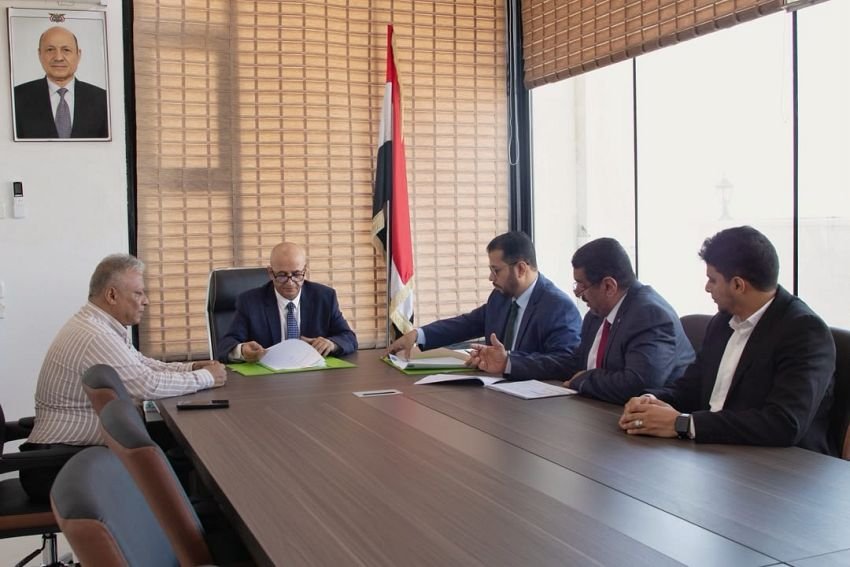
ADEN, Yemen — Yemen’s water minister signed an agreement on Tuesday to strengthen urban water systems in Taiz city, the state news agency said.
Tawfiq al-Sharjabi signed the deal with the Selah Foundation for Development, the agency, Saba, reported.
The project is funded by the Saudi Development and Reconstruction Program for Yemen.
Saba put its total cost at 3,478,000 Saudi riyals.
It is to run for twelve months.
The account of the signing rests on the state news agency. No independent confirmation of the agreement has been published.
The project aims to improve the sustainability of Taiz’s urban water system and its capacity to cope with the effects of climate change, according to Saba.
The work includes developing water sources and rehabilitating distribution networks.
It also covers expanding the use of renewable energy and building technical capacity.
Saba said the project is meant to improve the efficiency of water supply.
The agency said 67,228 people in 9,604 households are expected to benefit.
They live in the al-Qahira, al-Mudhaffar and Salh districts of Taiz city.
The agency said the project would improve access to safe water and strengthen the continuity of supply services.
The Saudi programme and the Selah Foundation have worked together before.
The two signed an agreement in 2024 on a renewable-energy water-security project in Hadramout, Arab News reported.
That project was to use solar power stations in nine areas to improve water availability, the newspaper said.
About 1.7 million people were expected to benefit from it.
Hassan al-Attas, assistant general supervisor of the Saudi programme, and Ali Hassan Bashmakh, executive director of the Selah Foundation, signed that deal.
Mohammed al-Jaber, the programme’s supervisor general, attended the signing, according to Arab News.
Al-Sharjabi also attended it as minister of water and environment.
The ministry has sought support for Taiz from several other partners.
Al-Sharjabi discussed groundwater mapping for the city with UNICEF in March, Yemen Monitor reported.
That meeting, held by video conference, also included experts from Acacia Water, the outlet said.
They reviewed a technical report on data collection and gap analysis for preparing groundwater maps in Taiz city.
The preliminary report assesses water resources in the Upper Wadi Rasyan basin to support water management planning.
Al-Sharjabi said at the time that Taiz had limited water sources and that the conflict had damaged its infrastructure.
The ministry said it would use remote sensing and carry out field verification of water levels and quality.
It also planned to develop hydrogeological models to study groundwater movement, according to Yemen Monitor.
The ministry said the work would produce a database and digital groundwater maps for the city.
Al-Sharjabi described the cooperation as a first step in a wider plan to improve water security and access across Taiz governorate.
Saba has reported ministry talks with the United Nations Development Programme on Taiz water projects.
The ministry has also signed agreements with Samaritan’s Purse for water and sanitation projects in Aden and Taiz.
It has discussed a water and sanitation resilience project in Taiz with Solidarités International.
Taiz is Yemen’s third-largest city.
The city’s governor appealed this month for action to lift what he described as a Houthi siege of the governorate.
The Houthis dispute that account of the fighting around the city.
A Yemeni delegation discussed water projects with the World Bank at its spring meetings in Washington in April, Yemen Monitor reported.
Those talks covered a programme to make water services more resilient to climate change, to be carried out in three phases.
The Central Bank of Yemen and the planning ministry held further talks with the World Bank in Bangkok on Tuesday, Saba said.
The Presidential Leadership Council has governed the internationally recognised side of the conflict since it replaced former president Abd Rabbu Mansour Hadi in 2022, according to a House of Commons Library briefing.
The Houthis declared a naval blockade of Saudi Arabia on July 20 and later an air blockade, the briefing said.
They have taken several areas along the Red Sea coast, and control of the Bab al-Mandab Strait is disputed.
The Saudi-led coalition struck energy sites in Sanaa on Tuesday after warning residents to leave the area.
The Associated Press, citing witnesses, reported several explosions in the capital.
The Houthis announced a new phase in their campaign against Saudi Arabia in June, centred on the blockade of their air and sea ports.
Houthi drone and missile attacks on Saudi territory this year were the first since 2023, the briefing said, and Saudi air strikes on Yemen the first since 2022.
Britain announced defensive support for Saudi Arabia in September, including one Royal Air Force Voyager refuelling aircraft.
Saudi authorities said a strike on Riyadh’s King Khalid International Airport on Saturday killed 13 people.
The United Nations humanitarian response plan for Yemen, issued in March, said more than 22 million people needed assistance.
The plan said 18.3 million people were acutely food insecure.
It recorded more than 2.2 million children under five as acutely malnourished, including 516,157 with severe acute malnutrition.
The plan counted 5.2 million internally displaced people and sought 2.16 billion dollars to reach 12 million of them.
The United Nations moved its main Yemen offices to Aden in September 2025.
Saba did not name the foundation officials who signed Tuesday’s agreement.
It did not say when the work would begin.
About the Author