Yemen’s Health Minister and a University of Rostock Delegation Discuss Medical Education Ties in Aden
 Yemen Herald News
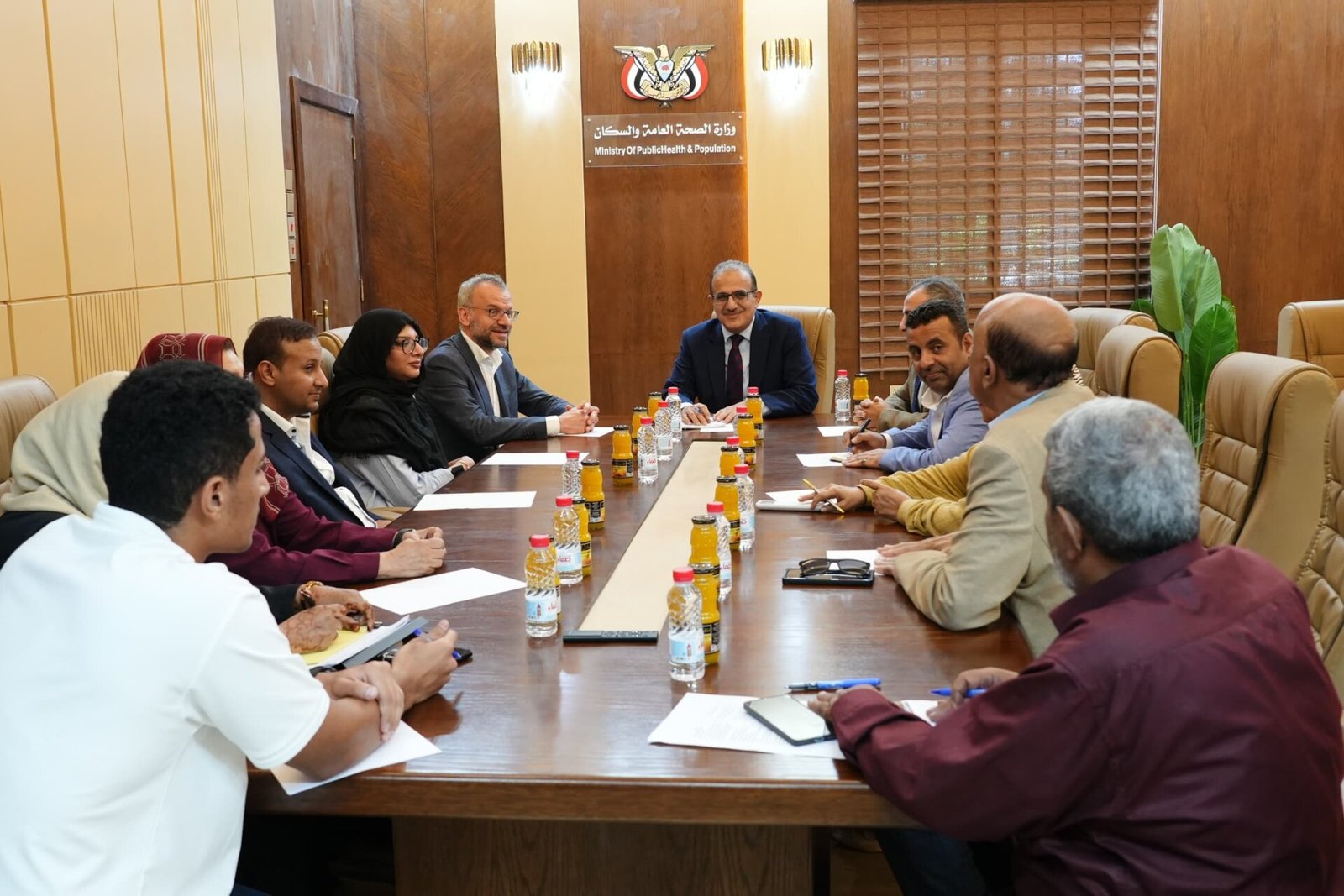
Yemen’s Minister of Public Health and Population, Dr Qassim Buhaibeh, met a delegation from the University of Rostock in the interim capital Aden in March 2026 to discuss deepening academic and medical cooperation between the Yemeni health sector and the German institution. The delegation was headed by Dr Mark Philipp, and the talks focused on how an existing partnership between the two sides might be extended into concrete programmes.
The meeting was attended by Professor Al-Khader Nasser Laswar, president of the University of Aden, and Dr Ali Al-Walidi, the health ministry’s undersecretary for primary healthcare, alongside a number of academic figures. The composition of the room reflected the subject: this was a discussion about the intersection of higher education and clinical service delivery rather than a purely diplomatic exchange.
Buhaibeh told the delegation that advancing health education is fundamental to building an efficient and sustainable healthcare system. He stressed the importance of strengthening international partnerships as a means of transferring expertise, modernising curricula and raising the capability of healthcare personnel, with particular emphasis on primary healthcare — the tier of the system that carries the heaviest share of routine demand in Yemen.
Participants reviewed strategies for improving health education outcomes and strengthening training programmes so that they align with the changing needs of the sector. The specific items on the agenda included the development of joint academic programmes between the two universities, the modernisation of medical and nursing curricula, and expanded opportunities for training and professional development for Yemeni staff.
The University of Rostock is among the oldest universities in northern Europe, founded in the fifteenth century, and maintains a substantial medical faculty and teaching hospital. For a Yemeni partner, that offers access to established curricula, clinical teaching methods and research capacity of a kind that has been difficult to sustain domestically through years of conflict.
The context for the meeting is a health system under severe and sustained strain. International assessments have repeatedly found that a large share of Yemen’s health facilities are only partially functioning or not functioning at all, that shortages of staff, medicines and equipment are widespread, and that services depend heavily on external funding. Buhaibeh himself has spoken publicly on several occasions about declining resources and falling donor support as threats to the sector.
German universities have a long record of medical cooperation with institutions in the Middle East and North Africa, often structured around staff exchange and joint supervision of postgraduate work rather than large capital projects. That model is comparatively resilient in difficult environments, because it depends on people and teaching materials more than on construction, and it can continue at reduced intensity when travel becomes harder.
Medical education has been one of the quieter casualties of that situation. Teaching hospitals lose staff to emigration and to better-paid work with international organisations; laboratories and libraries go without investment; and cohorts of students graduate into a system that cannot absorb or supervise them properly. Partnerships with foreign universities are one of the few available routes to keeping standards from slipping further, which is why the ministry treats them as a policy priority rather than a courtesy.
The emphasis on primary healthcare in Buhaibeh’s remarks is significant in its own right. Primary care is where most preventable illness is caught, where maternal and child health services sit, and where outbreak surveillance begins. Strengthening it depends less on advanced hospital technology than on trained personnel distributed across districts — precisely the constraint that education and training programmes are meant to address.
Aden has served as the seat of the internationally recognised government since the capital Sanaa fell outside its control, and the city hosts the ministries and the university that formed the Yemeni side of this meeting. Holding academic discussions there also carries a signalling function, demonstrating that the government’s institutions are functioning and capable of engaging foreign partners on technical matters.
The University of Aden’s own position gives the partnership a natural anchor. As the principal higher education institution in the government-controlled south, it trains a substantial share of the doctors, nurses and public health workers entering the system, and its medical faculty is the point at which curriculum changes would take effect. Any reform agreed at ministerial level has to pass through the university to reach students.
No timetable, funding figure or signed agreement was announced at the meeting, which was described as a discussion of avenues for cooperation rather than a conclusion of one. Partnerships of this type typically move through several stages — memoranda of understanding, faculty exchanges, curriculum review, then joint programmes — and the pace depends on funding and on conditions on the ground.
That caveat matters because announcements of international cooperation in Yemen have often outrun delivery. Security conditions, currency instability and the difficulty of moving people and equipment into the country have delayed or shrunk projects that looked firm on paper. The value of the Rostock relationship will be measurable only in whether Yemeni students and clinicians end up with different training from what they would otherwise have received.
For the ministry, meetings of this kind form part of a broader effort to rebuild the health sector’s external relationships after years in which emergency humanitarian assistance crowded out longer-term institutional development. Officials in Aden have argued consistently that Yemen needs partnerships aimed at rebuilding capacity, not only at delivering relief.
About the Author