Saudi Arabia Says It Intercepted a Ballistic Missile and 24 Drones Over the Eastern Province
 Yemen Herald News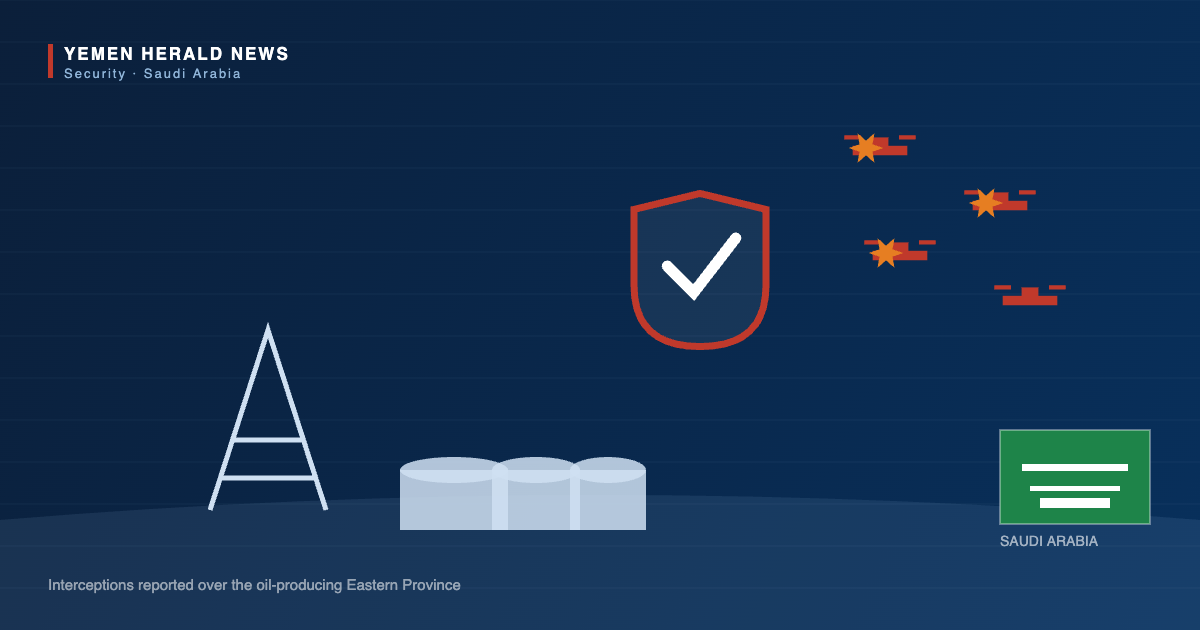
Saudi Arabia announced in March 2026 that its air defences had intercepted a ballistic missile and 24 drones aimed at the kingdom, part of a near-continuous run of engagements over the Eastern Province during a month in which Iranian launches were reaching targets across the Gulf almost daily. The announcement, issued on the evening of 17 March, gave no casualty figures and did not identify the specific sites the incoming weapons had been aimed at.
The attacks followed the opening of the wider regional conflict at the end of February 2026, when US and Israeli strikes on Iran prompted Iranian retaliation against Israel, Jordan, Iraq and the Gulf states hosting American military assets. Saudi Arabia, which hosts US facilities and sits directly across the Gulf from Iran, was among the most frequently targeted. Riyadh has itself been a party to the Yemen conflict since 2015 and has spent a decade defending against drone and missile launches from the south, so the systems and procedures used against Iranian fire in 2026 were already in routine operation.
The Eastern Province is where the kingdom’s exposure is concentrated. It contains the bulk of Saudi Arabia’s proven oil reserves and the infrastructure that turns them into exports: the Ghawar field, the processing complex at Abqaiq, the export terminals at Ras Tanura and Jubail, and the Dhahran headquarters of Saudi Aramco. A single successful strike on a processing or stabilisation facility can remove a substantial share of the kingdom’s export capacity for weeks, as the 2019 attack on Abqaiq demonstrated. That is the calculation behind concentrating air defence assets over the province, and behind the government’s decision to publicise interceptions there.
The 17 March statement was not an isolated one. Five days earlier, on 12 March, Saudi authorities said they had intercepted and destroyed 24 hostile drones, some of which had tracked across the Empty Quarter towards the Shaybah oil field near the border with the United Arab Emirates. The same announcement reported two ballistic missiles intercepted, one launched towards the Eastern Province and the other towards Prince Sultan Air Base at al-Kharj, south of Riyadh.
The pattern continued through the rest of the month. On 23 March the authorities announced the interception and destruction of three drones over the Eastern Province. On 24 March they said at least 30 drones had been downed over the same area. Further interceptions were reported in early April, including a ballistic missile and drones on 2 April and five ballistic missiles on 8 April. On another occasion in the same period Saudi air defences reported bringing down six ballistic missiles and 26 drones over Riyadh and the Eastern Province.
The mix of weapons in these reports is significant. Drones dominate the tallies in raw numbers, while ballistic missiles appear in ones and twos. That ratio reflects both cost and intent: drones are cheap, slow and launched in quantity to saturate radar coverage and force defenders to expend interceptors, while ballistic missiles are expensive, fast and reserved for targets judged worth the outlay. A defender facing both simultaneously has to decide, in seconds, which threats justify which interceptors.
Shaybah is a particular case. The field lies deep in the Rub al-Khali desert, hundreds of kilometres from the Gulf coast, and reaching it requires a long unopposed flight across sparsely covered terrain. Drones directed there were attempting to exploit exactly that gap—the difficulty of maintaining dense radar coverage over an area the size of a mid-sized European country.
Saudi Arabia’s response has largely been defensive and public. The Defence Ministry issued statements after each engagement, typically within hours, and the announcements have consistently emphasised successful interception rather than damage. Independent verification of the individual tallies is not available; these are figures published by the defending government, and they should be read with that in mind. What multiple outlets did corroborate across March and April 2026 is the pattern: repeated launches towards the kingdom, and air defences engaging them on most days.
For the oil market the significance was less about any single interception than about the persistence of the threat. Crude and gas prices moved sharply when the conflict opened at the beginning of March, and the risk premium stayed embedded for weeks. Traders were pricing not the drones that had been shot down but the possibility that one would eventually get through to a processing facility—the scenario that had produced the sharpest single-day oil price move in decades in 2019.
The campaign also revived questions the kingdom has faced since that attack about the adequacy of layered air defence against cheap mass-produced systems. Interceptors cost orders of magnitude more than the drones they destroy, and an adversary willing to launch dozens at a time can impose costs on a defender even when every single weapon is stopped. Saudi officials have not published figures on interceptor expenditure during this period.
By the end of March the kingdom had gone several weeks without a confirmed successful strike on major energy infrastructure, which by the standards of the campaign counted as a defensive success. Whether that record held depended less on the performance of any individual battery than on how long the wider Iranian campaign against Gulf states continued, and on whether the volume of fire directed at the Eastern Province rose beyond what the defences deployed there had been sized to absorb.
About the Author