Al-Zindani urges tighter control of dual-use goods at anti-smuggling committee meeting
 Yemen Herald News
ADEN, Yemen — Yemen’s prime minister called for tighter control of dual-use goods on Thursday, as a government committee reviewed progress on closing unlicensed crossings and ports.
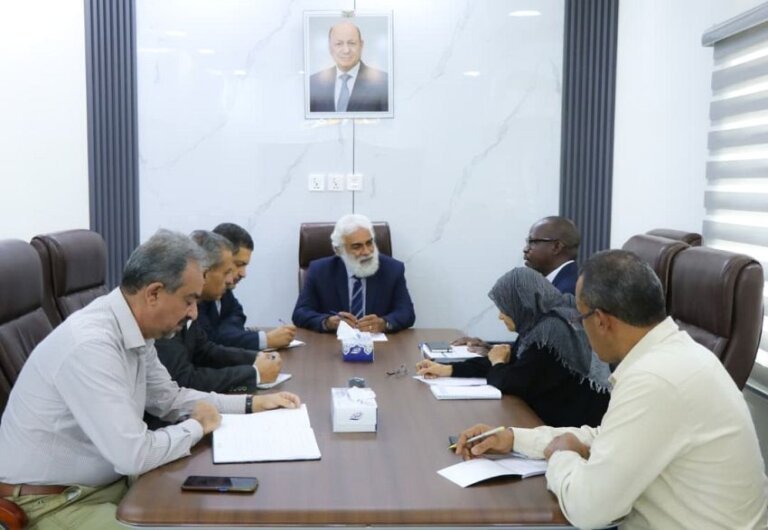
Shaya al-Zindani chaired a meeting of the Supreme Committee to Combat Smuggling in Aden, the interim capital, the state news agency Saba reported.
The committee examined a report on how far a decision by the Presidential Leadership Council to close smuggling points had been carried out.
It approved the proposals the implementing committee had put forward for those points.
Al-Zindani called for tighter control of dual-use materials, parts and equipment.
He asked for the lists regulating their trade to be updated, and for the rules on handling them to be unified across the relevant authorities.
The aim was to keep such items from reaching the Houthis, or being used in activities that threaten national security, he said.
The government says the measures are meant to cut off funding and weapons supplies to the Houthis, which it describes as Iranian-backed.
The account of the meeting rests on Saba, the agency run by the internationally recognised government. Yemen Herald found no independent report of the session.
Al-Zindani directed agencies in March to activate the laws covering smuggling, at an earlier meeting of the same committee.
That session reviewed oversight at land and sea ports and the rotation of port managers and staff.
The council decision under review dates from August.
Rashad al-Alimi, who chairs the council, announced it on Aug. 26 at a meeting of the same committee. Al-Zindani attended.
It requires any port or crossing operating outside the legal framework to be closed and brought under regulation, without selective treatment.
Ports and crossings where irregularities had been recorded were to be reassessed.
Staff, security officials and managers found to have failed in their duties were to be rotated or replaced.
Anyone shown to have protected smugglers or helped move their shipments would lose official or political immunity, the decision said.
Completed case files were to go to the public prosecution without delay.
Interventions and exemptions granted outside the law at ports and customs facilities were to stop.
Al-Alimi said at the time that state revenues belonged to the people, and that the era of leniency toward smuggling had ended.
The decision also instructed the committee to draw up a unified list of military-use and dual-use materials barred from shipment to Houthi-controlled areas.
That list is the instrument al-Zindani returned to on Thursday.
The August decision gave priority to safeguarding the national currency, gold and minerals, and to tracking the networks that trade in them.
Officials said at the time that legitimate trade, food and medicine supplies and citizens’ savings should not be disrupted.
A United Nations panel of experts reported last year that arms smuggling to the Houthis continued in breach of the embargo, with cargo concealed or misdeclared.
Detections rose after air strikes damaged Hodeidah port and vessels were diverted to Aden, the panel said.
The government seized 750 tonnes of illicit materiel and weapons in June 2025, according to the panel.
The haul included cruise, anti-ship and anti-aircraft missiles resembling Iranian-made systems, the panel said.
It said the Houthis retain the ability to manufacture weapons at home, which makes their capability hard to remove.
The panel listed Houthi revenue as taxes on income, property, fuel and cigarette sales and imports, plus customs duties.
Asset freezes had limited effect because the group works through intermediaries and front companies in the region, it said.
The panel called for strengthening the UN Verification and Inspection Mechanism, which inspects ships bound for Houthi-held ports.
Dual-use components have become the harder part of the problem, according to Wolf-Christian Paes, who served on the UN panel from 2018 to 2023.
A 2026 report by Conflict Armament Research examined parts seized from the dhow Al-Sherwa, intercepted in June 2025 on its way to Yemen from Iran.
About 5 percent of the documented components were made in Iran, the report found.
Hundreds of parts were linked to at least a dozen weapon systems and bore the marks of companies in at least 16 countries or territories.
The Wassenaar Arrangement, the main export-control forum, has 42 participating states. China is not one of them.
Most governments copy the Wassenaar control list, Paes said, and that list leaves out many items with civilian uses that also serve as missile components.
Inertial navigation systems are one example. They rely on gyroscopes and accelerometers rather than radio signals, and are used in shipping and aviation.
Some commercial models fall below control thresholds. Manufacturers asked how their products reached Yemen often said the item was not controlled, Paes said.
He said the Houthis now import nearly all their components from China, through purchasing agents in Guangzhou and Hong Kong, and that many are European parts re-exported from there.
Materials have also moved through two land crossings controlled on the Yemeni side by the internationally recognised government, Paes said.
Seizures probably account for a small share of what gets through, he said, citing corruption.
US forces boarded the dhow Yunus off Somalia in January 2024 and seized Iranian-made ballistic and anti-ship missile components and a warhead.
The Houthis deny receiving weapons from Iran.
The panel recorded at least 25 verified attacks on commercial vessels in the Red Sea and the Gulf of Aden in the year to July 2025. Two ships were sunk.
About the Author