UN Security Council condemns Houthi attacks on Saudi Arabia in first Yemen statement since 2019
 Yemen Herald News
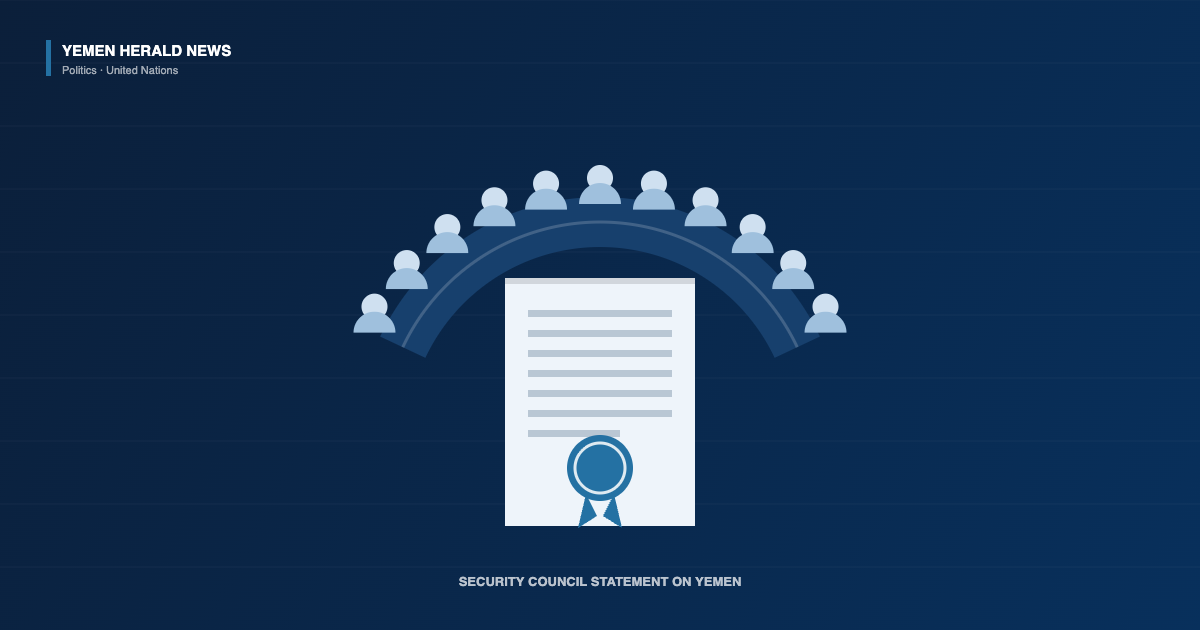
NEW YORK, United States — The UN Security Council condemned escalating Houthi attacks on Saudi Arabia and affirmed the kingdom’s right to self-defence in a presidential statement adopted on Thursday.
It was the Council’s first presidential statement on Yemen since August 2019.
The 15-member body said it strongly condemned continued and escalatory Houthi attacks against Saudi Arabia, including strikes affecting civilian aviation and energy infrastructure that caused civilian deaths and injuries.
The statement condemned what it called “the reckless strikes” on 10 and 11 October on King Khalid International Airport in Riyadh, which it said killed 13 people and wounded more than 300.
It also condemned multiple strikes on other airports and on Saudi Aramco facilities.
An earlier account of the 10 October strike on the Riyadh airport put the toll at 12 dead and more than 300 wounded, according to Security Council Report. The Council’s statement gives 13 dead for the strikes on 10 and 11 October.
Council members expressed their deepest sympathy to the families of the victims and to the government and people of Saudi Arabia.
The text will be issued as document S/PRST/2026/4. The Council adopted it at its 10244th meeting.
A presidential statement is adopted by consensus, so every member must agree to its text. Resolutions, by contrast, require nine votes in favour and no veto.
The United Kingdom, which holds the pen on Yemen at the Council, drafted the statement and circulated an initial version on 13 October, according to Security Council Report, a group that tracks the body’s work.
Only two members submitted edits, the group said. The text passed under silence procedure on the morning of 15 October.
Comments on that draft were due the following day, and a revised version taking up some of them circulated on 14 October, the group said. It described the initial draft as not contentious.
Bahrain proposed the explicit reference to strikes on Saudi Aramco facilities, according to Security Council Report.
Russia sought to soften the language on the Red Sea by removing the phrase “in the strongest terms” and the direct attribution of the attacks to the Houthis, the group said. The penholder did not take up those changes.
Russia did secure a line stating that sustainable peace in Yemen cannot be achieved through violence, coercion or the use of force, according to the same account.
On shipping, the Council reiterated its condemnation in the strongest terms of Houthi attacks and threats against commercial vessels in the Red Sea and the Bab al-Mandab, and stressed the importance of safeguarding ships and their crews.
Members stressed the importance of acting in accordance with international law, in particular the UN Convention on the Law of the Sea, and of upholding navigational rights and freedoms. They recalled the importance of respecting international humanitarian law.
The statement pressed for full implementation of resolution 2216, adopted in 2015, and subsequent resolutions. That resolution imposed a targeted arms embargo on Houthi leaders and demanded that the group withdraw from territory it had seized.
Members called for cooperation, including with the government of Yemen, to prevent the Houthis from acquiring arms and related materiel, technical assistance, training, financing and other support that could enable further attacks.
All member states must meet their obligations under the targeted arms embargo, the Council said.
The text also addressed Houthi arms acquisition in contravention of the sanctions regime established under resolution 2140, and called for practical cooperation to halt military support to the group.
The Council expressed solidarity with Saudi Arabia “in the face of attacks impacting civilians and civilian objects on its territory”.
It reaffirmed its support for Yemen’s government and its commitment to the country’s unity, sovereignty, independence and territorial integrity.
Members reiterated their support for Hans Grundberg, the UN special envoy for Yemen, in his efforts toward a negotiated, inclusive settlement that is Yemeni-led and Yemeni-owned, based on the agreed references and consistent with relevant Council resolutions.
The statement recalled press statements the Council issued on 7 August and 18 September, in which it condemned Houthi military escalation in Yemen and demanded that the group immediately cease that escalation and its attacks affecting civilians and civilian objects.
The Council held emergency meetings on Yemen on 10 and 15 September. Members discussed the conflict at a 12 October lunch with Secretary-General Antonio Guterres.
Fighting intensified from July, unravelling a truce the United Nations mediated in 2022 between the Houthis and the Saudi-led coalition.
The Houthis have declared a naval blockade on shipping linked to Saudi Arabia and have attacked commercial vessels in the Red Sea and the Bab al-Mandab.
The coalition has carried out hundreds of airstrikes across Yemen, including on oil facilities in Sanaa and Hodeidah. The Houthis say some of those strikes killed or wounded civilians.
The Houthis seized the capital, Sanaa, in 2014. Yemen’s internationally recognised government has operated from Aden since.
Houthi advances have threatened Taiz, Yemen’s third-largest city. Foreign Minister Afrah al-Zouba wrote to Guterres and the Council on 14 October asking for urgent action to lift a siege she said affects more than four million people.
The Council’s previous presidential statement on Yemen was issued on 29 August 2019.
About the Author