IOM says 139 migrants bound for Yemen died when boat capsized off Djibouti
 Yemen Herald News
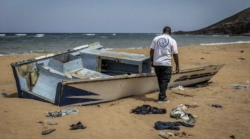
OBOCK, Djibouti — At least 139 migrants bound for Yemen drowned when their boat capsized off Djibouti’s northern coast, the International Organization for Migration said.
Eighty-four people are still missing.
The boat was carrying 305 people when it went down near Guehere, north of the port town of Obock, in the early hours of Friday 9 October, according to IOM. About 82 people survived.
The toll rose from 109 after the bodies of 30 more people were recovered, the agency said. Djiboutian authorities are continuing search and recovery operations.
Fifteen children are among the dead, IOM said. Nine girls and six boys were recovered. The survivors are Ethiopian nationals, according to the agency.
The boat sank mainly because it was overcrowded, said Alexandre Coissac, IOM’s chief of mission in Djibouti. The migrants boarded on the evening of 8 October and the vessel went down soon afterwards, close to shore.
The figure of 139 counts only bodies buried by Djiboutian authorities, IOM said. Bodies buried by the migrants themselves will be added once the authorities have verified them.
The crossing forms part of what aid agencies call the Eastern Route, which runs from the Horn of Africa across the Gulf of Aden and the Bab al-Mandab toward the Arabian Peninsula. IOM said few shipwrecks recorded on the route have killed more people.
The strait narrows to about 20 kilometres between Djibouti and Yemen.
More than 500,000 people attempted the crossing into Yemen last year, according to IOM, and at least 900 died or went missing. Movement along the route rose 18 per cent over the same period.
“No one gets into a boat like that unless they believe there is no other safe way,” said Amy Pope, IOM’s director general.
“We cannot keep treating these deaths as normal,” Pope said. “Safe and legal pathways save lives. I am asking governments and donors to act before the next boat goes down.”
Djiboutian authorities recovered the dead from the shore, Coissac said, “but they were overwhelmed with all the bodies that kept coming at once towards the shore.”
“What is terrible is that they were buried with no names, in a common grave, like in a war situation,” he said.
“They all have a mother, a father, and we may never learn what happened,” Coissac said.
Jose Barahona, the United Nations resident coordinator in Djibouti, said he was deeply saddened by the loss of at least 139 lives, among them children.
“Our thoughts are with the victims, the survivors and the families waiting for news of their loved ones,” Barahona said on social media. “We express our solidarity and welcome the ongoing search and rescue efforts.”
“Every life lost at sea is a tragedy,” he added.
Survivors are being cared for at IOM’s Migrant Response Centre in Obock, where they are being treated for the effects of swallowing seawater. The agency said its support also includes psychological counselling, food, shelter and protection services.
Traffic along the route has not slowed since fighting in Yemen intensified. IOM has recorded more than 20,000 journeys from Ethiopia since 10 September, with migrants still travelling toward Yemen in the hope of finding work in the Gulf.
Movement is running in both directions. More than 3,700 refugees reached Djibouti from Yemen in the three weeks to early October after crossing the Red Sea, the agency said, and another 539 Ethiopian migrants arrived from Yemen on their way home.
“Djibouti is therefore confronting movement in both directions,” Coissac said. “People fleeing Yemen are arriving as refugees, migrants continue travelling towards Yemen, and other migrants are returning.”
Briefing journalists in Geneva by video link on 6 October, he said the country was facing overlapping emergencies.
More than 3,000 stranded migrants were observed along migratory routes inside Djibouti between 20 and 30 September, he said, facing dehydration, exhaustion and shortages of food and water.
IOM had received reports of migrants dying in the desert near the border with Ethiopia, Coissac said. The agency is distributing food and water and helping those who ask for assisted voluntary return.
Migrants are increasingly using secondary routes, he said, which makes them harder for aid workers to reach.
Most of those heading for Yemen were unaware of conditions there as fighting between government and Houthi forces intensified, according to Coissac. Many intend to travel on to Saudi Arabia and other Gulf states.
Djiboutian authorities had responded quickly, he said, but the scale of the needs was stretching resources. He called for more support for new arrivals, for migrants in distress and for host communities in Obock.
At least 2,000 Yemenis have received aid in Djibouti as the fighting at home has escalated, according to the agency.
Conditions inside Yemen have worsened since the escalation began. More than 18 million people there face acute food insecurity, according to United Nations figures, and 2.2 million children under five are acutely malnourished.
Of those children, 500,000 have severe acute malnutrition, the most life-threatening form of the condition, the World Food Programme said this month.
The Obock centre is one of several IOM operates in Djibouti for migrants who have been intercepted, rescued or left stranded along the route.
About the Author