WFP says it can no longer reach 600,000 people in Taiz as flour stocks run out
 Yemen Herald News
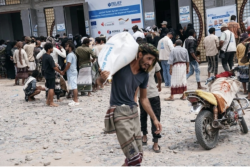
TAIZ, Yemen — The World Food Programme said it can no longer reach more than 600,000 people in Taiz who depend on its food aid.
More than 200,000 of them are women and children, the agency said.
The warning came in a statement issued on Oct. 14. WFP said 800,000 people are now beyond its reach across Yemen, a total that includes communities cut off by access losses on the country’s west coast in early September.
Ten of the 16 districts in Taiz governorate were already classified at emergency levels of food insecurity, according to the agency.
Wheat flour stocks are close to exhausted, WFP said, citing its own market monitoring. Supplies on local markets would last only a short time if present constraints continued.
“We are critically concerned about the escalating conflict, but even more so about the growing number of people we can no longer reach because of it,” said El-Khidir Daloum, the agency’s representative and country director in Yemen.
“This is the kind of situation that can rapidly spiral into a humanitarian catastrophe if assistance cannot move safely and reach those who need it most,” Daloum said.
The account of access inside Taiz rests on WFP’s own monitoring. Yemen Herald could not independently verify the agency’s access figures, and no independent confirmation of them has been published.
Across Yemen, more than 18 million people face acute food insecurity, the agency said.
It put the number of acutely malnourished children under five at 2.2 million. Of those, 500,000 are severely malnourished, according to WFP.
In areas the agency can still reach, 74 percent of households were unable to meet their basic food needs, its monitoring found.
WFP said it had reached more than 115,000 newly displaced people in districts still open to it.
The agency said it could expand assistance to as many as 1.5 million people if access allowed.
It needs $268 million to sustain its Yemen operations through 2027, WFP said. Without new funding it will reduce assistance significantly from November.
The agency also said 72 United Nations staff are being held by the Houthi de facto authorities. Thirty-seven of them are WFP colleagues, it said.
Human Rights Watch reported separately on Oct. 6 that the Houthis had begun prosecuting detained UN and civil society staff. The group has put the number of UN staff still held at 73.
The Houthis have not published a response to the agency’s account of the detentions.
Taiz is Yemen’s third-largest city. It sits in the southwestern highlands and has been split by front lines for much of the past decade.
Houthi forces cut the main supply route into the city at the start of October, France 24 reported on Oct. 4. President Rashad al-Alimi announced a counter-offensive the same day.
Food and fuel prices inside Taiz rose as the encirclement tightened, Al Jazeera reported on Oct. 10.
Hospitals in the city were near collapse, the Yemeni government said on Oct. 11. The Houthis dispute government accounts of conditions in and around Taiz.
The government said on Oct. 13 that Houthi forces had committed 43 violations in Taiz governorate and that about 172,000 people had been displaced.
Yemen’s humanitarian plan for 2026 estimated that more than 22 million people in the country need assistance. It recorded 5.2 million internally displaced people and sought $2.16 billion to reach 12 million of them.
Japan announced an emergency grant of $10 million for Yemen and Djibouti on Oct. 6. Eight million dollars of that was allocated to Yemen, including $3 million channelled through WFP for food assistance.
A further $3 million of the Japanese package goes to the International Committee of the Red Cross for health, water and sanitation work, and $2 million to the International Organization for Migration for shelter.
The remaining $2 million is for Djibouti, through the UN refugee agency.
Aid groups warned on Oct. 14 that renewed fighting risked a humanitarian catastrophe across Yemen, Al Jazeera reported.
International news agencies reported on Oct. 13 that Houthi fighters had encircled Taiz in a renewed siege.
Calls for the Houthis to lift the siege and allow food into the city were reported on Oct. 15.
The current round of fighting began on Aug. 6, when Houthi forces attacked Yemeni government positions.
Government forces advanced in Marib this month while attacks continued around Taiz, Al Jazeera reported on Oct. 13.
Human Rights Watch said in January that Houthi detentions of aid workers were halting relief operations in Yemen.
Houthi forces first laid siege to Taiz in 2015, and front lines around the city have shifted repeatedly since.
Fuel shortages inside the city have pushed up transport costs, according to the Oct. 10 report.
WFP said the figure of 800,000 combines the Taiz caseload with people cut off on the west coast.
The agency said its planned reductions from November would apply across its Yemen programme.
The Houthi authorities administer Sanaa and much of northern Yemen, including areas around Taiz.
Yemen’s internationally recognised government is based in Aden.
Emergency is the fourth of the five phases on the integrated classification scale aid agencies use to rank food insecurity.
WFP said its figures for Taiz were current as of Oct. 14.
About the Author