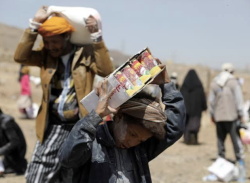
OCHA says Yemen displacement tops 281,000 as aid routes into Taiz narrow
 Yemen Herald News
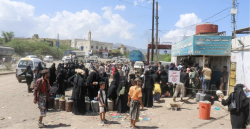
ADEN, Yemen — More than 281,000 people have fled their homes in Yemen since early August, the UN humanitarian office said, as fighting pressed closer to Taiz.
The UN Office for the Coordination of Humanitarian Affairs gave the figure this week. It covers displacement recorded from the start of August.
The account of the figure rests on OCHA’s own reporting. Yemen Herald found no origin for it independent of the agency, and no second body has published a matching count.
About 800,000 people are trapped inside Taiz city, OCHA said. The agency said time is running out to get aid to them.
Damage to a main road linking Taiz to southern governorates has pushed aid convoys onto narrow mountain routes, according to OCHA.
Access has worsened over the past three weeks, the agency said.
OCHA called on all parties to the fighting not to target civilians or aid convoys, and asked them to observe international humanitarian law.
The count has climbed through the autumn. The International Organization for Migration recorded more than 184,000 people displaced since early August in figures it released on Oct. 5, most of them after early September.
In the week to Oct. 3, IOM recorded nearly 21,800 people displaced at least once, a 26 percent increase on the week before. A further 6,474 people were displaced on Oct. 4.
By Oct. 7 the agency put the total above 200,000. Its count had stood at 76,000 in mid-September.
About 3,700 people have crossed the sea to Djibouti, IOM said.
IOM publishes its Yemen displacement counts weekly through a product it calls Rapid Displacement Tracking.
Taiz governorate has carried the largest share of the movement. Displaced families are also sheltering in makeshift camps in Hajjah.
In Marib, IOM assessed three displacement sites. Shelter was the main need there, the agency said.
Some families sleep in the open, which leaves them exposed to violence and to airstrikes, according to IOM.
Women and girls at the sites reported a shortage of suitable latrines.
About 45 percent of the households IOM assessed had been displaced at least once before. Those families had lost assets and livelihoods, the agency said.
IOM said repeated displacement raises the risk that families turn to coping strategies that harm them, among them child labour.
Amy Pope, the IOM director general, said the international community should do more to secure humanitarian access. “People are running for their lives and finding nowhere safe to go,” she said.
The World Food Programme said about three in four families in parts of Yemen are going without enough food.
WFP issued that warning on Oct. 2.
The fighting behind the displacement followed Houthi gains on the Red Sea coast in September. Government forces answered with a counteroffensive.
Rashad al-Alimi, chairman of the Presidential Leadership Council, announced on Oct. 4 an offensive to retake all remaining Houthi-held territory, including Sanaa.
Each side has given an account of the fighting that the other disputes.
Majid al-Nazili, a spokesman for government forces, told Al Jazeera those forces carried out 749 military operations in 24 hours. The Houthis have not confirmed that figure.
Houthi-run media reported more than 100 airstrikes on Sanaa and eight other governorates over the same period. The government has not confirmed that account.
Yemen Today TV reported fighting on the Al-Aqroudh and Al-Masrakh fronts on Thursday. Government forces in Taiz said they repelled attacks at Al-Aqroudh.
Fighting was also reported at Al-Rahn village in Sabir al-Mawadim district, south of Taiz.
A military source told Al Jazeera that government forces carried out three airstrikes southeast of Taiz. The Houthis did not confirm the strikes.
The Houthis advanced on Jabal Sabr, a mountain overlooking Taiz, on Sunday.
Houthi-affiliated media reported four airstrikes on Mocha, west of Taiz.
Mocha sits on the Red Sea coast and holds a port serving the area west of the city.
Flights at Aden international airport were suspended on Wednesday after a missile landed at the adjacent Al-Nasr Camp. Anadolu reported that flights later resumed.
Health services are carrying part of the strain. The World Health Organization recorded more than 5,100 casualties in Yemen since Aug. 6, among them 959 deaths.
Cholera cases tripled in about three weeks, and measles is spreading, the UN said.
Medical teams have struggled to reach wounded people in the hour after injury, when treatment does most good.
The humanitarian plan OCHA published in March put more than 22 million people in Yemen in need of assistance, and recorded 18.3 million as acutely food insecure.
That plan counted more than 2.2 million children under five as acutely malnourished, 516,157 of them severely. It put the number of internally displaced people at 5.2 million before the current escalation.
The appeal sought $2.16 billion to reach 12 million people.
Aid staff remain in detention. The World Food Programme said 72 UN personnel and five former UN personnel are still held in Yemen.
One WFP staff member was released recently.
Farhan Haq, deputy spokesperson for the UN secretary-general, said the secretary-general has called for the release of all detained UN and humanitarian staff.
Haq said the UN would pursue every avenue to secure their release, including through the Houthi de facto authorities.
About the Author