WFP says it assisted more than 1.4 million people in government-held Yemen in September
 Yemen Herald News
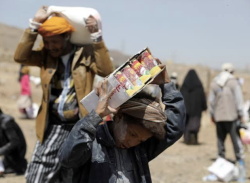
ADEN, Yemen — The World Food Programme assisted more than 1.4 million people in government-held areas of Yemen in September, the agency said in its latest monthly update.
Most of that caseload moved through a single distribution round.
The agency said 1,311,313 people received emergency rations under the sixth cycle of its Targeted Emergency Food Assistance programme for 2026. The cycle was completed by the middle of October.
Of those, 778,359 received in-kind food. Another 532,918 were reached through cash transfers worth 5.8 million dollars.
The two components sum to 1,311,277, which is 36 fewer than the total the update gave for the cycle. The update did not explain the difference.
The account of the September operation rests on that update from the World Food Programme, as reported on Oct. 28 by the news site Yemen Online. No independent confirmation of the monthly figures has been published, and the agency has not issued a separate country brief for September on its own website.
Nutrition programmes reached about 111,700 children, women and pregnant and breastfeeding mothers, the update said.
Within that figure, 98,271 people were treated for moderate acute malnutrition. A further 13,437 were enrolled in programmes intended to prevent acute malnutrition before it develops.
School feeding did not run during the month. Schools had not reopened for the new academic year, the agency said. Food commodities were dispatched in September so that distribution could resume in October.
The monthly total describes an operation the agency has said is running short of money.
The World Food Programme said on Oct. 2 that 74 percent of households in areas it can reach were unable to meet their basic food needs. It called that the highest share it had recorded this year.
It put the number of people facing acute food insecurity across Yemen at 18.3 million.
The agency said 2.2 million children under five were acutely malnourished, among them 500,000 with severe acute malnutrition.
It said it was then assisting about 2.4 million people facing severe hunger in government areas.
The agency said it needed 109 million dollars for emergency food and nutrition assistance for up to 1.5 million people. It said another 158 million dollars was required to sustain regular operations for 2.4 million people through March 2027.
The agency put its full requirement for Yemen at 268 million dollars through 2027, covering emergency food assistance, nutrition, school meals, resilience work and logistics.
Fighting has also cut the agency off from part of its caseload. It said on Oct. 16 that it had suspended operations across several districts in Al-Mokha, Turbah and Taiz, losing access to nearly 800,000 people.
It said it had scaled up food assistance to more than 120,000 people across two displacement hotspots in southern Yemen over the previous month, and planned to reach up to 1.5 million.
“Many of these families have been displaced multiple times,” said Damien Vaquier, the agency’s head of programmes in Yemen.
Prices have moved against households over the same period. Wheat flour prices rose 10 percent in two weeks in parts of Taiz, the agency said, and traders estimated that wheat stocks covered about two months of demand.
Yemen imports about 90 percent of its food.
An assessment published in June by the Food and Agriculture Organization, the World Food Programme and UNICEF found that 47 percent of the population in government-controlled areas, about 5 million people, were in crisis-level food insecurity or worse.
That assessment put 1.4 million of them in the emergency phase, the band below famine.
It projected that the emergency caseload would rise to 1.8 million between October and December.
The three agencies attributed the outlook to weak purchasing power, economic decline, high costs for agricultural inputs and a drop in humanitarian funding.
Fighting between government forces and the Houthis resumed in July after close to four years of relative calm.
The World Food Programme said on Oct. 2 that renewed fighting had displaced more than 149,000 people, citing the International Organization for Migration.
It said on Oct. 16 that more than 5 million people were internally displaced in the country.
More than 3,700 people who left Yemen because of the fighting had reached Djibouti by late September, the agency said.
The migration agency has since recorded more movement. It logged 49,388 households, or 296,328 people, displaced at least once between Jan. 1 and Oct. 24, according to its Displacement Tracking Matrix, and said 275,245 of them were displaced after Aug. 1.
The United Nations humanitarian response plan for Yemen, published in March, put the number of people needing assistance at more than 22 million. The plan sought 2.16 billion dollars to reach 12 million of them.
The Targeted Emergency Food Assistance programme is the agency’s main food pipeline in government-held governorates. It runs in cycles rather than continuously, so monthly totals track the distribution calendar as well as need.
The September round was the sixth of the year.
The update did not say when the seventh would begin.
It did not break the September caseload down by governorate.
Nor did it give a figure for areas under Houthi control, where the agency runs a separate operation.
The agency did not say how many people it had planned to reach during the month.
About the Author