Saudi-led coalition says it destroyed a Houthi drone over Madinah as the group denies the attack
 Yemen Herald News
MADINAH, Saudi Arabia — The Saudi-led coalition said Friday it intercepted and destroyed a Houthi drone over the Madinah region, an account the Yemeni group denied the same day.
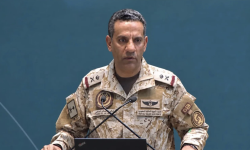
Maj. Gen. Turki al-Malki, spokesman for the Coalition to Support Legitimacy in Yemen, said air defences brought the aircraft down.
Al-Malki said the drone had been launched by what he called the terrorist Houthi militia. He reported no casualties and no damage on the ground at Madinah.
The Houthis denied launching drones toward Madinah. They also denied a separate coalition report of a drone brought down over the Makkah region the same day.
The coalition said it intercepted drones over Riyadh on Friday as well. Al-Malki said fragments from that interception caused no injuries, and that the competent authorities were dealing with the site where debris fell.
A further coalition statement said a ballistic missile fired toward the kingdom’s southern region had been intercepted and destroyed.
Yemen Herald could not independently verify the Madinah interception. The account rests on the coalition’s own statement, and no independent confirmation of the launch or of the interception has been published.
The coalition did not say what type of drone was involved, or from where it had been launched.
The coalition said on Saturday that two more drones were destroyed, one over the Eastern Province and one over southern Saudi Arabia.
Saudi civil defence issued danger warnings in Najran and Jazan provinces on Saturday. The warnings were lifted a short time later.
The coalition said on Thursday that it had intercepted a ballistic missile fired toward the Eastern Province. It reported no casualties in that case either.
On Oct. 28 the coalition said it had brought down three ballistic missiles and four drones.
The coalition says its air defences have engaged projectiles over Riyadh, Makkah, Madinah, the Eastern Province and southern Saudi Arabia during the past week.
The announcements followed weeks of launches toward Saudi cities, airports and energy installations, according to the coalition.
A missile struck King Khalid International Airport in Riyadh on Oct. 10.
The Saudi General Authority of Civil Aviation said at least 12 people were killed. They included four Saudi citizens, two Bangladeshis and one national each from the United States, Jordan, Palestine, Syria, Sudan and Egypt.
The authority said at least 309 people were wounded, some of them critically.
Airport operations were suspended while the authority assessed the damage.
Al-Malki called that attack a “full-fledged war crime” and said the coalition would respond decisively.
He also confirmed a separate projectile incident near King Fahd International Airport in Dammam.
The head of the Houthi media office wrote on X that the group had “shut down Riyadh international airport.”
U.N. Secretary-General Antonio Guterres condemned the airport attack. “These attacks must cease immediately,” he said.
Guterres said attacks on non-combatants and non-military facilities violate international law.
Hans Grundberg, the U.N. special envoy for Yemen, told the Security Council that the country had slid back into full-scale war.
The exchanges have run alongside intensified fighting inside Yemen.
The Houthis took territory from government forces along the Red Sea coast in September, prompting a counteroffensive.
Government forces began an operation on Oct. 7 to retake the Houthi-held district of al-Waziiya in Taiz governorate.
Government units reported advances in Marib governorate in the middle of the month. The Houthis dispute the government’s account of the front lines.
Government forces in Taiz said they repelled Houthi attacks on the Al-Aqroud front as they tried to break the siege of the area.
Media affiliated with the government reported fighting on the Al-Aqroudh and Al-Masrakh fronts and in Al-Rahn village, in the Sabir al-Mawadim district.
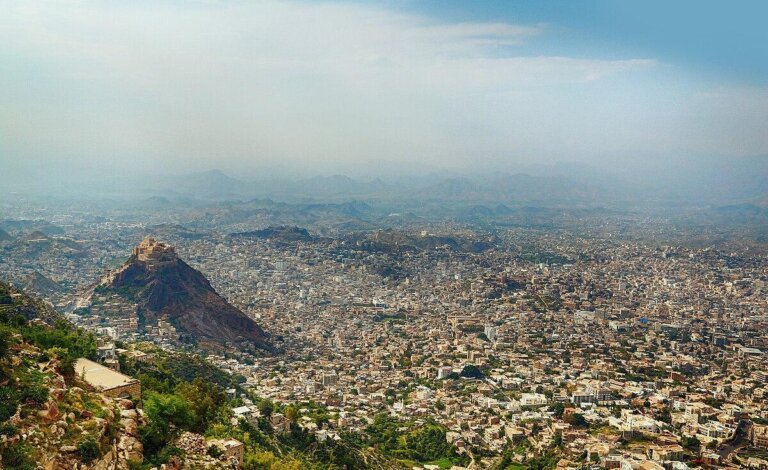
The Houthis advanced on Jabal Sabr, a mountain overlooking Taiz city.
The Houthi group said more than 100 air strikes had hit Sanaa and eight other governorates in 24 hours. It did not say who carried them out.
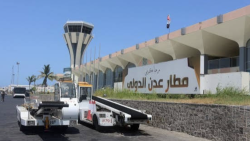
Flights resumed at Aden International Airport after a suspension that began Wednesday. Witnesses said a missile had landed on Al-Nasr Camp, next to the airport, which houses coastguard forces and the interior ministry headquarters.
The U.N. Office for the Coordination of Humanitarian Affairs said more than 281,000 people had been forced from their homes since the start of August.
OCHA said time was running out to deliver aid to 800,000 people trapped inside Taiz city.
The agency said access had become harder over the previous three weeks after damage to a road linking Taiz to the southern governorates. Aid convoys now use narrow mountain routes.
OCHA urged all parties to allow safe, sustained and unimpeded humanitarian access.
More than 250,000 people have fled rural areas of Taiz and neighbouring Lahj governorate because of shelling.
Yemen’s health ministry said 42 health facilities in Taiz governorate could close within days as supplies run out.
The World Health Organization has appealed for 31 million dollars for its Yemen operations. It said donors had provided 2.1 million dollars.
Houthi-affiliated media reported four air strikes on Mocha city and its Red Sea port, west of Taiz, on Thursday.
The coalition began operations in Yemen in March 2015 in support of the internationally recognised government.
Al-Malki said the competent authorities would examine the debris recovered at the Riyadh site.
About the Author