Yemen joins 42nd COMCEC trade session in Istanbul
 Yemen Herald News

ISTANBUL, Türkiye — Yemen joined the 42nd session of the Organization of Islamic Cooperation’s economic and trade committee on Sunday, the state news agency Saba said.
The session of the Standing Committee for Economic and Commercial Cooperation, known as COMCEC, runs from Oct. 31 to Nov. 3 in Istanbul.
Yemen is represented by Rashid Hazeb, undersecretary of the Ministry of Industry and Trade for business services, according to Saba.
The agency said the delegation would also attend ministerial meetings and hold bilateral talks on joint cooperation.
Saba is Yemen’s state news agency, and its report is the only published account of the delegation’s attendance. Yemen Herald found no independent confirmation of who Yemen sent or what it said at the session.
The dates and venue of the session itself are listed by COMCEC.
The committee brings together representatives of OIC member states to discuss economic and trade cooperation, Saba said.
The agency said the agenda covers trade financing mechanisms, export promotion, the exchange of expertise and wider economic partnerships.
Yemen’s aims are to strengthen trade and economic ties with member states, to look for trade and investment opportunities, and to draw on the organization’s programs to build the country’s economic capacity, according to the agency.
COMCEC was established in 1981 at the Third Islamic Summit Conference, held in Mecca and Taif.
Türkiye holds the permanent chair, and the ministerial session meets annually in Istanbul.
Its mandate covers trade, transport, agriculture, tourism, poverty alleviation, and cooperation between financial institutions and the private sector.
The OIC has 57 member states. It was founded in 1969 and its general secretariat is in Jeddah, Saudi Arabia.
The agenda for the Istanbul session was drafted at a preparatory meeting in Ankara on May 12 and 13, COMCEC said.
That meeting of the committee’s Follow-up Committee reviewed projects and cooperation activities carried out since the 41st ministerial session.
Its members are Saudi Arabia, Palestine, Kuwait, Azerbaijan, The Gambia, Pakistan, Qatar, Brunei Darussalam and Senegal, together with OIC institutions.
The preparatory meeting discussed the Trade Preferential System among OIC member states, the OIC Arbitration Centre and the COMCEC Project Funding mechanism.
It reported 28 completed projects under the COMCEC Al-Quds Program and 10 more due to be carried out this year.
The Follow-up Committee called on member states to keep providing humanitarian and economic support to the Palestinian cause.
The committee also welcomed the COMCEC Syria Program, adopted at the 41st ministerial session, which has five projects this year.
COMCEC said that program aims to build human and institutional capacity in Syria and revive its economy.
The committee’s agriculture working group held its 26th meeting.
Türkiye was the largest single destination for Yemeni goods exports in 2025, taking 33.3%, according to European Commission figures drawn from International Monetary Fund data.
Egypt took 29.4% and Côte d’Ivoire 11.6%.
On the import side, the United Arab Emirates supplied 19.7% of Yemen’s goods, Saudi Arabia 12.7% and China 9.5%.
Yemen’s goods trade with the European Union came to 550 million euros in 2025, the Commission said.
EU imports from Yemen were 41 million euros, up 47.2% on 2024, while EU exports to Yemen were 509 million euros, down 10.8%.
Food and live animals, chiefly fish, made up about 91% of what the bloc bought from Yemen.
Food and live animals accounted for 53.1% of EU sales to Yemen, chemicals 20.2% and machinery and transport equipment 10.4%.
Yemen ranked 151st among sources of EU goods imports and 119th among destinations for EU goods exports that year.
The bloc recorded a goods trade surplus with Yemen of 468 million euros. The Commission published the figures in May.
The delegation arrives with an economy the World Bank says is under deepening strain.
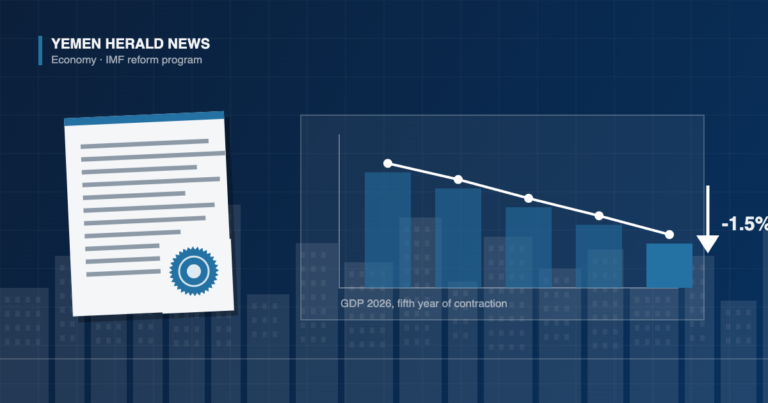
Real gross domestic product fell 1.5% in 2025, the bank said in a statement in May, and it projected a further contraction of 0.5% in 2026.
Nearly three-quarters of the population is estimated to live below the poverty line, according to the same assessment.
The bank said most essential goods are sourced abroad, which leaves the country exposed to rising global prices, supply disruption and higher shipping costs.
It said the rial in government-held areas appreciated sharply in August 2025 and has since stabilized, and that exchange rate measures had helped ease inflation.
The bank described the wider outlook as fragile.
Trade policy sits with a government seated in Aden since the Houthis took the capital, Sanaa, in September 2014.
A Saudi-led coalition intervened in March 2015.
Executive authority passed in April 2022 to the Presidential Leadership Council, chaired by Rashad al-Alimi.
The central bank and the Ministry of Industry and Trade both operate from the interim capital.
The United Nations humanitarian response plan for Yemen, issued in March, estimated that more than 22 million people need assistance.
It put the number facing acute food insecurity at 18.3 million.
More than 2.2 million children under five are acutely malnourished, the plan said, including 516,157 with severe acute malnutrition.
It recorded 5.2 million internally displaced people.
The plan sought $2.16 billion to reach 12 million of those in need.
The Istanbul session is scheduled to close on Nov. 3.
About the Author


 Adel Haddad