Magnitude 7.4 Earthquake off Ternate Kills One as Indonesia Lifts Tsunami Warning
 Yemen Herald News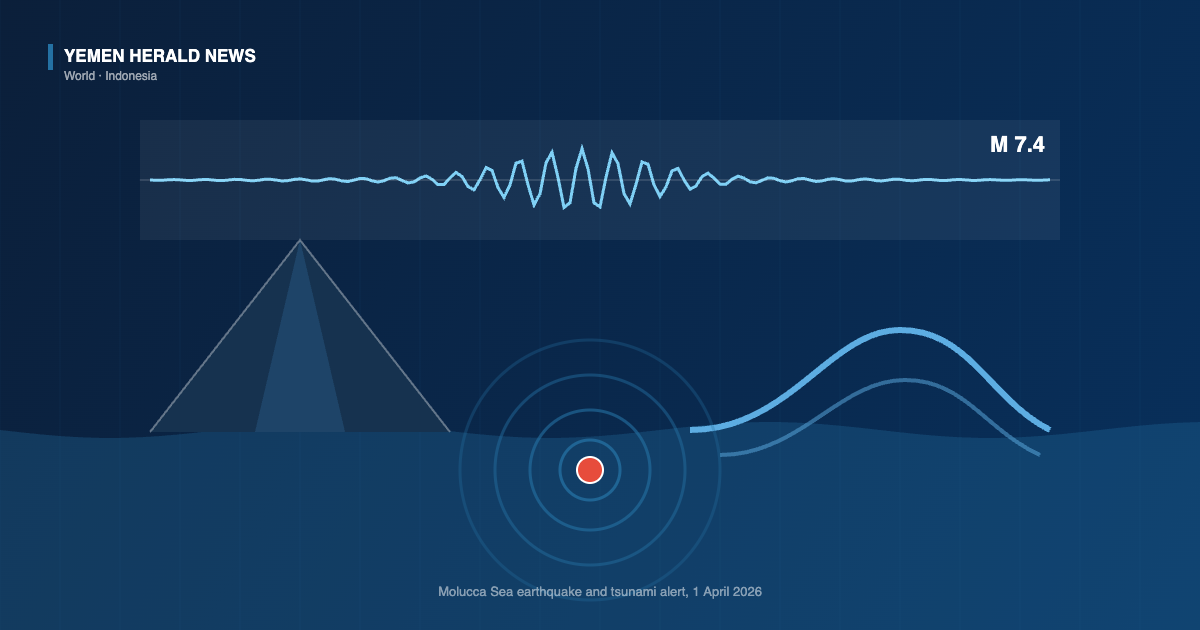
A magnitude 7.4 earthquake struck beneath the Molucca Sea off the Indonesian island of Ternate late on 1 April 2026, killing one person, damaging buildings across two provinces and prompting tsunami warnings that briefly extended to Malaysia and the Philippines before being withdrawn a little over two hours later.
The United States Geological Survey timed the rupture at 22:48 GMT and placed its epicentre roughly 126 kilometres west-north-west of Ternate, the largest city in Indonesia’s North Maluku province. The agency’s first automated bulletin put the magnitude at 7.8 and the depth at about 10 kilometres; both figures were revised within the hour to 7.4 and 35 kilometres respectively. Such corrections are routine, since early estimates are generated automatically from the first seismic waves to reach nearby stations and then refined as readings arrive from instruments further away. In this case the revision mattered, because a deeper rupture displaces less water above it and is correspondingly less likely to generate a destructive wave.
The Pacific Tsunami Warning Centre in Hawaii issued an initial advisory saying hazardous waves were possible within 1,000 kilometres of the epicentre, along the coasts of Indonesia, the Philippines and Malaysia. Sea-level gauges recorded modest run-up within half an hour: waves of up to about 75 centimetres in North Minahasa and roughly 20 centimetres at Bitung, both on the northern arm of Sulawesi. Those readings confirmed that a tsunami had been generated but that it fell well short of a destructive threshold, and the centre stood its warning down a little more than two hours after the quake.
In Malaysia and the Philippines the alerts translated into precautionary advisories rather than mass evacuation. Both countries have coastlines within the 1,000-kilometre radius flagged by the Pacific centre, and their national agencies passed the warning on to communities facing the Celebes and Molucca seas. Because recorded wave heights stayed low and no significant run-up was reported outside Indonesia, those advisories were lifted in step with the Pacific centre’s own stand-down, and no damage was attributed to the tsunami beyond Indonesian waters.
One death was confirmed. A building collapsed in Manado, the provincial capital of North Sulawesi, and a local search and rescue official said the victim was recovered from beneath the rubble. A second person was reported to have suffered a leg injury. Given the magnitude and the density of population along the affected coastlines, the casualty count was strikingly low, a consequence of the offshore epicentre, the depth of the rupture and the fact that the strongest shaking travelled across open water rather than through built-up areas.
Damage was nonetheless widespread enough to disrupt daily life. Authorities in Ternate and the neighbouring island city of Tidore told residents to be ready to move to higher ground while the warning stood, and the Indonesian broadcaster Metro TV carried footage of cracked walls and damaged buildings. Indonesia’s meteorology, climatology and geophysics agency, known as BMKG, which runs the country’s domestic warning network alongside the international centres, issued its own alerts for the surrounding coastline.
The Molucca Sea is among the most seismically complex places on Earth. It sits at the collision of the Sangihe and Halmahera volcanic arcs, the clearest documented example anywhere of two active island arcs colliding head-on, with oceanic crust being consumed on both sides at once. That geometry produces frequent large earthquakes across a wide range of depths and makes the region a persistent source of tsunami alerts throughout the eastern Indonesian archipelago and the southern Philippines.
Indonesia as a whole lies along the Pacific Ring of Fire, the horseshoe of subduction zones and volcanic belts that circles the ocean basin, and the country records more significant earthquakes than almost anywhere else. That exposure has been costly. The magnitude 9.1 rupture off northern Sumatra in December 2004 generated the Indian Ocean tsunami, which killed more than 220,000 people across a dozen countries, with Aceh province worst affected. In September 2018 a magnitude 7.5 earthquake, and the tsunami and soil liquefaction that followed it, devastated Palu in Central Sulawesi and killed more than 4,000.
Those disasters drove substantial investment in detection and warning. Indonesia built a national tsunami warning system in the years after 2004, and the international network of deep-ocean sensors and coastal tide gauges feeding the Pacific centre was expanded across the Indian Ocean. The system’s persistent weakness has been the last few kilometres rather than the underlying science: for a rupture this close to shore, waves can arrive within minutes, leaving very little time for an alert to be issued, relayed and acted upon. The events of 1 April, in which the wave proved small and the warning was lifted before evacuation became necessary, tested that chain without stressing it.
In the days that followed, local disaster agencies carried out damage assessments across North Maluku and North Sulawesi, and aftershocks continued at lower magnitudes, as is normal after a rupture of this size. For residents of Ternate, a city built around the slopes of the active Gamalama volcano and long accustomed to both seismic and volcanic hazard, the episode was a reminder of how narrow the margin can be between an alert that is stood down and one that is not.
About the Author