Hormuz Closure Turns the Iran War Into a Global Economic Shock
 Yemen Herald News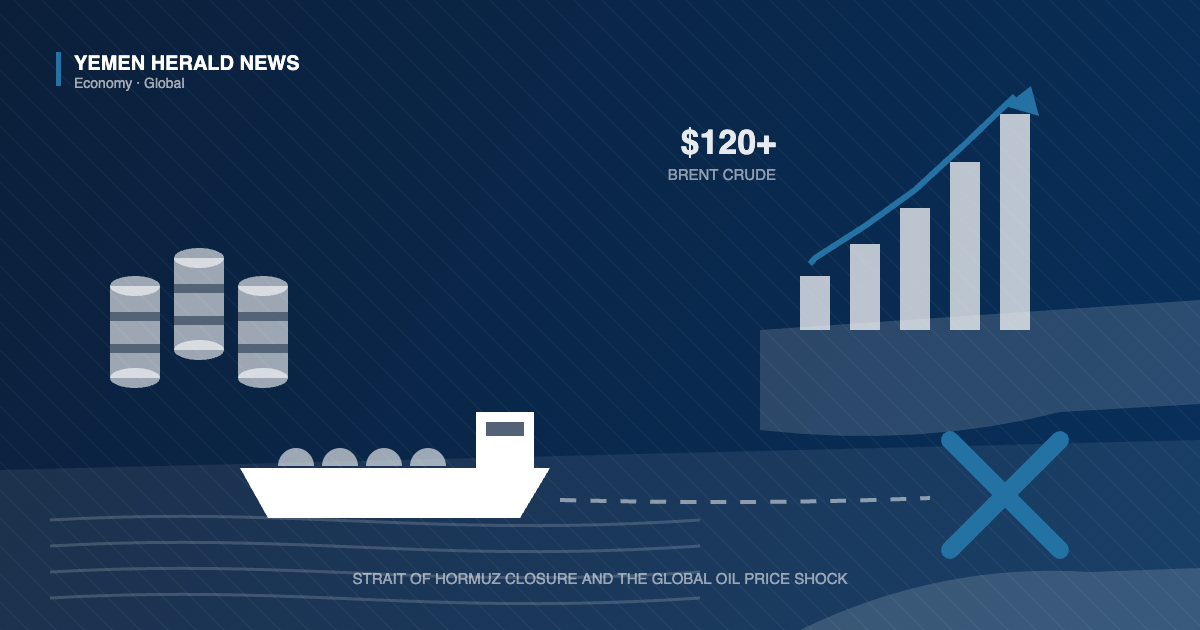
The confrontation between the United States, Israel and Iran that began on 28 February 2026 has been discussed largely in military terms, but its most consequential effects have been economic. By early April the conflict had produced what the International Energy Agency described as the largest supply disruption in the history of the global oil market, and the costs were spreading well beyond the countries doing the fighting.
The turning point was the closure of the Strait of Hormuz on 4 March 2026. The waterway between Iran and Oman is the exit route for a large share of the crude oil and liquefied natural gas produced by Saudi Arabia, Iraq, Kuwait, Qatar, the United Arab Emirates and Iran itself. With the strait shut, cargoes were stranded at loading terminals and at anchor, and Brent crude moved above 120 dollars a barrel. Some analysts went considerably further: speaking to Bloomberg on 31 March, the energy consultant Fereidun Fesharaki said prices of 150 to 200 dollars were plausible within weeks if the closure held.
Neither side is positioned for the kind of decisive result that would end the disruption quickly. The United States and Israel hold conventional military superiority, while Iran retains substantial asymmetric options — mines, fast attack craft, anti-ship missiles, drones and proxies distributed across several countries. Conflicts with that structure tend not to produce surrender; they produce attrition, and attrition in this particular geography is expensive for everyone who buys energy or ships goods.
The shipping consequences arrived almost as fast as the oil price. Vessels that would normally transit the Gulf and the Red Sea rerouted around the Cape of Good Hope, adding between ten and twenty days to voyages between Asia and Europe or the United States east coast. Ocean freight rates for American importers rose by as much as fifty per cent. Longer voyages also absorb capacity: the same fleet carries less cargo per year, which tightens the market further and keeps rates elevated even without additional attacks.
Insurance repriced alongside it. Underwriters had historically treated the Strait of Hormuz as a chokepoint that would not actually close, and priced war risk accordingly. That assumption has now failed in practice, and market participants expect a permanent premium attached to Gulf transits — a structural increase in the baseline cost of moving goods that will persist after the shooting stops.
The macroeconomic transmission is straightforward but painful. Work published through CEPR estimated that even on a cautiously optimistic path, in which the closure lasts a single quarter and exports then resume gradually, the oil price surge would add around 0.6 percentage points to United States headline inflation and 0.2 points to core inflation in 2026. At 170 dollars a barrel the estimated effect on both inflation and growth roughly doubles, producing a stagflationary shock rather than a simple price spike.
That distinction matters for policy. A demand-driven inflation problem can be addressed by raising interest rates. A supply shock that simultaneously pushes prices up and output down leaves central banks choosing between defending price stability and defending employment, with no instrument that does both. Institutions that spent 2023 to 2025 restoring credibility after the previous inflation episode now face the possibility of doing it again from a weaker starting position, with higher public debt and less fiscal room to cushion households.
The distribution of the pain is uneven and does not track the map of the conflict. Energy-importing developing economies absorb the shock most severely: fuel and food are a larger share of household spending, currencies weaken as import bills rise, and governments that subsidise fuel face budget deficits they cannot finance. Countries already dependent on humanitarian assistance, Yemen among them, are exposed twice over, since the same disruption raises the cost of imported food and fuel while squeezing the donor budgets that pay for aid.
Energy exporters are not straightforward winners either. High prices are worth little to a producer that cannot ship, and Gulf states with export infrastructure inside the conflict zone have found that the revenue upside is offset by physical risk to terminals, by insurance costs, and by the longer-term consequence of customers accelerating their search for alternative suppliers and alternative fuels.
The argument that nobody wins is not a rhetorical flourish. It follows from the structure of a chokepoint disruption: the losses are distributed across every economy that imports energy or manufactured goods, while the gains are concentrated, temporary and contingent on the ability to actually deliver cargo. Even a favourable military outcome for one side would leave behind a rebuilt risk premium, redrawn shipping routes and an inflation problem that outlasts the fighting by years.
What would change the trajectory is a reopening of the strait under credible guarantees, which requires either a negotiated settlement or a sustained naval effort capable of keeping the waterway open against a determined opponent. Neither was in prospect in early April 2026. Until one of them is, the reasonable expectation is not a return to the previous baseline but a permanently more expensive one, in which the world pays a standing charge for the possibility that the Gulf closes again.
About the Author