Research center puts Houthi revenue at about $2.5bn a year as US Treasury cites separate oil income
 Adel Haddad
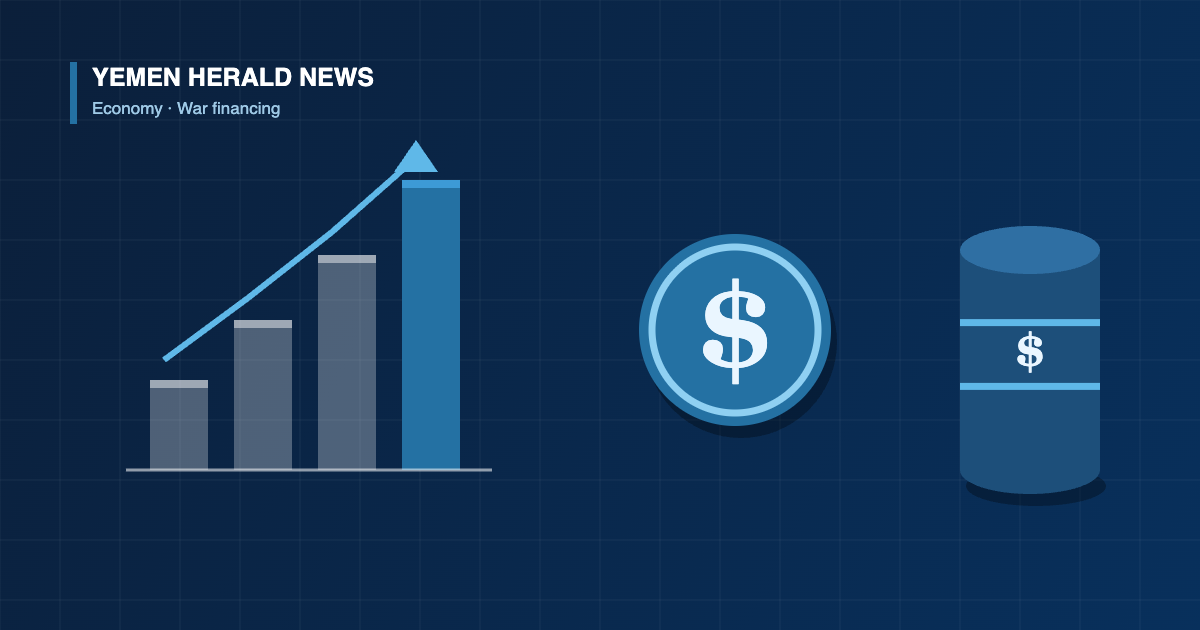
SANAA, Yemen — A Yemeni research center puts the Houthis’ annual revenue at about $2.5 billion, Al Jazeera reported on Wednesday, citing a July study of the group’s finances.
The estimate comes from the Mokha Center for Strategic Studies and covers what the center called direct and indirect financial resources, according to Al Jazeera.
The center divided the total into roughly $800 million from taxes and customs duties, $600 million from fees and levies, $300 million from cash and in-kind war contributions, and about $100 million raised at mobilization events, the broadcaster said.
A separate Mokha Center paper published in May found that close to 60 percent of the revenue collected in Houthi-controlled areas goes to security and military spending, according to the same report.
That paper examined revenue collected at customs entry points, according to Al Jazeera.
Yemen Herald did not obtain the Mokha Center studies directly. The figures above are as Al Jazeera reported them.
The United States Treasury Department gives a separate number. It says the group takes in more than $2 billion a year from illicit oil sales, Al Jazeera reported.
The two sets of figures measure different things. The Mokha Center estimates describe money raised inside Yemen through taxation and collection.
The Treasury estimate describes proceeds from oil moved and sold outside the formal system. Neither source presents the two as parts of one total, and they do not add together.
Treasury said in January that Iran’s government sold oil to the Houthis and supplied a further shipment free each month, routed through companies based in Dubai, according to Al Jazeera.
The department has issued successive sanctions packages naming vessels, captains and procurement networks it links to Houthi oil smuggling and weapons supply.
Yazeed Al-Jeddawy, research manager at the Sanaa Center for Strategic Studies, told Al Jazeera the group draws on taxes, customs duties, zakat religious levies, fuel and telecommunications.
Control over import permits, fees and access to foreign currency gives the authorities leverage over traders, he said.
“Economic control finances coercion, and coercion enables further economic control,” Al-Jeddawy told the broadcaster.
Collection also runs through public appeals. Ali Naji, a Sanaa resident, described donations solicited by text message, in envelopes and on cloth spread out at rallies, Al Jazeera reported.
Wafiq Saleh, an economic researcher and executive director of the Taiz Centre for Yemeni-Gulf Studies, said about one million public employees have gone without regular pay since 2016, according to the report.
A UN panel of experts estimated in 2024 that the Houthis field around 350,000 fighters.
Al Jazeera said UN reporting places about 80 percent of Yemenis below the poverty line, with about 22.3 million people relying on humanitarian assistance.
Al Jazeera attributed the poverty and aid figures to UN reporting without naming a specific report.
The UN humanitarian needs and response plan for 2026, published in March, put more than 22 million people in need and 18.3 million acutely food insecure, with 5.2 million displaced. It sought $2.16 billion to reach 12 million people.
The financing estimates arrive as governments move against the group’s revenue.
The UN Security Council extended Yemen’s sanctions regime for a further year on Nov. 13 and set a January deadline for work on a list of dual-use goods, including drone components.
The Arab Parliament announced a four-track plan the same day. Its economic track calls for cutting off funding and arms and for pursuing financing and smuggling networks, front companies and financial transfers, according to a statement the body posted on X.
The plan asks states and organizations that have not designated the Houthis a terrorist group to do so, naming the European Union first among them, the statement said. Arab News reported the statement on Nov. 13.
The plan’s diplomatic track calls for approaches to the parliaments of the five permanent members of the Security Council to press for measures halting Houthi attacks, according to the statement.
Its judicial track calls for a documented file on alleged war crimes falling under the International Criminal Court’s jurisdiction, to be submitted to the court’s Office of the Prosecutor under the Rome Statute. It also urges individual states to bring prosecutions, the statement said.
The political and security track names European Parliament President Roberta Metsola and the European Union’s high representative for foreign affairs, Kaja Kallas, and seeks EU listing together with expanded sanctions, including asset freezes.
Osama Ghanem Al-Obaidy, an adviser and professor of international law at the Institute of Public Administration in Riyadh, told Arab News the plan was a move in the right direction.
The European Parliament has passed a resolution urging the Council to add the group to the European Union’s terrorism list, Arab News reported.
Yemen’s parliament passed its own law designating the group a terrorist organization and criminalizing its funding, and referred the text to President Rashad al-Alimi, Saba reported on Nov. 17.
The Houthis have not published a response to the Mokha Center or Treasury estimates, and Yemen Herald found no statement from the group disputing them.
Al Jazeera based its account on interviews in Sanaa, including with a fighter it identified only by the first name Mohammed.
Currency conversions in that report reflect the exchange rate set by the Houthi authorities, under which 1,000 riyals is worth about $1.90.
About the Author