UN aid office says assistance reached 270,000 displaced Yemenis as Taiz supply routes stay closed
 Adel Haddad
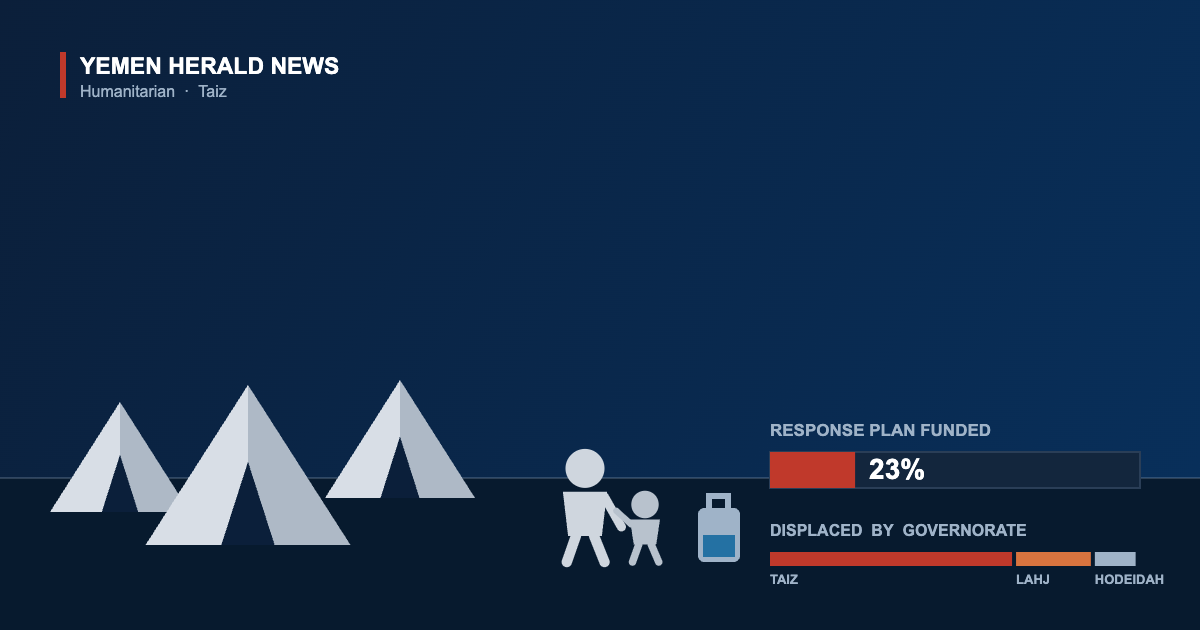
TAIZ, Yemen — Emergency aid has reached more than 270,000 people displaced by Yemen’s current fighting, the UN humanitarian office said Monday, while cooking gas has been blocked since early October.
The office, OCHA, said more than 202,000 of those people had received emergency cash.
It put the number reached at about two-thirds of everyone displaced since the escalation began in August.
“Despite the constraints, the UN and its humanitarian partners continue to deliver aid,” OCHA said.
On conditions in Taiz, it said cooking gas had “reportedly been blocked from entering since early October, alongside shortages of fuel, food and water.”
OCHA did not name the party imposing the restrictions.
It said conditions continue to worsen in Taiz City, and that restrictions on key transport routes threaten to disrupt deliveries.
Yemen’s government says the restrictions affect an estimated 1.3 million people across five districts, according to the same briefing. It did not identify the districts, and no UN agency has published a matching figure.
The displacement total behind those figures comes from the International Organization for Migration, which tracks population movement across the country.
IOM said in a statement on Nov. 13 that more than 340,000 people had been displaced by the hostilities, including more than 24,000 in less than a week.
Its breakdown placed 224,819 of them in Taiz governorate, 72,018 in Lahj and 40,782 in Hodeidah.
Those three figures account for about 99 percent of the total. Taiz alone holds roughly two-thirds.
IOM said it had reached more than 255,000 displaced people with assistance, most of them women and children.
That number and OCHA’s 270,000 are not the same measure. They come from different agencies with different cut-off dates three days apart, and the two offices have not reconciled them publicly.
Abdul Sattar Eissoyev, IOM’s chief of mission in Yemen, said hundreds of thousands of people had been forced to abandon their homes and possessions.
He said every day of delay in delivering assistance puts more families at risk.
IOM said restrictions on main transport routes were obstructing deliveries. In Taiz city it reported that supply routes from areas held by the internationally recognised government remained closed or cut off.
Neither agency named who had closed them.
IOM, citing local authorities, said about 400 sacks of wheat flour were allowed into Taiz on Wednesday. Yemen Herald found no independent account of that delivery.
The agency put Yemen’s total internally displaced population above 5.5 million as of this month.
The humanitarian response plan published in March counted 5.2 million, a figure that predates the August escalation.
IOM said the 2026 plan needs $2.1 billion and has received 23 percent of that, or about $505 million.
On that accounting, roughly $1.6 billion of the appeal is unfunded.
The March plan set an appeal of $2.16 billion to reach 12 million people.
It recorded more than 22 million people in need of assistance, 18.3 million facing acute food insecurity and more than 2.2 million children under five acutely malnourished, including 516,157 with severe acute malnutrition.
Casualty counts for the same period differ between published accounts of the UN human rights office’s tally.
A UN briefing relayed Monday put the office’s verified count at more than 300 civilian casualties since the beginning of August, including more than 70 killed, and said nearly half the deaths were children.
A write-up of an earlier statement from the same office gave 289 verified civilian casualties, including 72 deaths and 217 injuries, and said children accounted for half the fatalities.
Both accounts attribute the numbers to that office. Yemen Herald could not establish which cut-off date each figure uses, and the two have not been reconciled publicly.
The office said its count covers verified cases only and that the real toll is likely higher.
OCHA said its figures cover the period since the fighting escalated in August.
OCHA said the escalation had damaged health facilities in the affected areas. It gave no figures.
Doctors Without Borders said it had distributed more than 113,000 litres of drinking water a day in Taiz over three weeks, reaching more than 7,000 families.
The organisation also supplied medical materials to Al-Thawra Hospital in the city.
OCHA called for safe, sustained and unimpeded humanitarian access throughout Yemen, including for displaced people and refugees caught in the fighting.
It also said all parties must ensure the safety of refugees, asylum seekers and other civilians, and asked for safe passage for refugees leaving a camp it did not name.
The displacement follows a Houthi push toward Aden, the seat of the internationally recognised government.
Al Jazeera reported Tuesday that the group was 60 kilometres from the city, and that government forces had withdrawn from the Bab al-Mandab strait this week.
Saudi Arabia replaced its coalition commander on Monday. A royal decree named General Fayyad al-Ruwaili in place of Lieutenant General Fahd bin Hamad al-Salman.
France 24 reported on Nov. 15 that Houthi forces had advanced to within 60 kilometres of Aden, citing military sources, and that government troops had pulled back to defend the city.
Ali al-Dahab, a military and strategic affairs expert, told Al Jazeera that the south could not repel the Houthis without the support of the government and Saudi Arabia.
UNICEF has supported a community centre in Marib city, IOM said.
About the Author