Taiz governorate office reports 98 percent fall in vehicle entries as UN says all roads are closed
 Adel Haddad
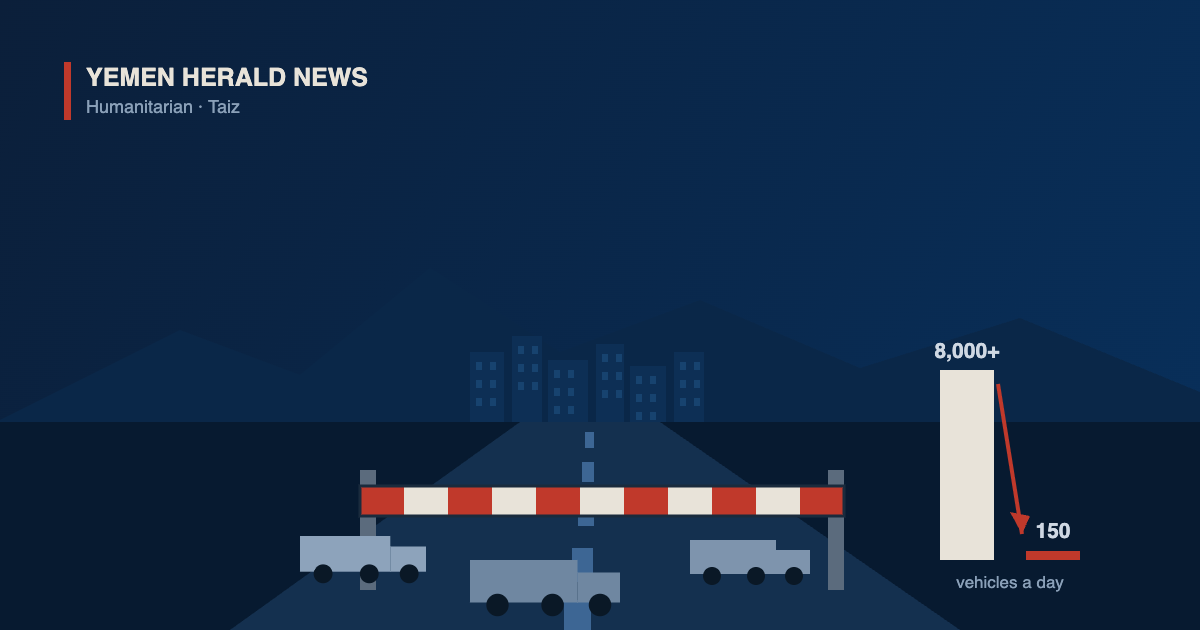
TAIZ, Yemen — A Taiz governorate office said the number of vehicles entering the city has fallen by more than 98 percent since early October.
The Siege Affairs Office put the current figure at about 150 vehicles a day, entering only during limited periods. It said 8,000 to 10,000 vehicles entered daily before the siege was tightened.
Yemen Monitor, a Yemeni news site, reported the figures on Thursday.
The office said transport fares have risen more than fourfold for passengers and goods. It gave the Taiz-to-Aden passenger fare as 80,000 Yemeni rials, against 15,000 before the restrictions.
It said inspection, interrogation and detention measures were being applied to passengers, drivers and traders, and that these had disrupted commercial activity and the movement of supplies.
The office did not publish a method for its vehicle count. Yemen Monitor did not report an independent check of the figures.
The road closures behind those figures have been stated on the record by the United Nations. Stephane Dujarric, the UN spokesman, told reporters in New York on Nov. 2 that all roads into the city were closed by the fighting and that no commercial supplies were getting through.
Dujarric called on all parties to allow safe, sustained and unimpeded humanitarian access, including passage into Taiz.
Citing the UN Office for the Coordination of Humanitarian Affairs, he said nearly 250,000 people in the city had lost access to essential healthcare. That included more than 186,000 children under five and 23,000 pregnant women.
Twelve hospitals were at risk of closing or had already cut services because of fuel and supply shortages, Dujarric said. He reported more than 1,400 cases of acute diarrhoea and suspected cholera in a single week.
He said OCHA and health partners were coordinating a 90-day emergency plan to maintain life-saving services and strengthen disease surveillance.
Al Jazeera reported from Taiz on Nov. 4 on conditions along the routes into the city. Its correspondent interviewed Ahmed al-Mikhlafi, a resident returning from Saudi Arabia by way of Aden.
Al-Mikhlafi said he paid 35 Saudi riyals, about $9.33, for each passenger on the outward journey to Aden before the fighting resumed. The return fare was 100 Saudi riyals, about $26.66, he said.
He said the group passed nearly 20 Houthi checkpoints that had recently been established. A checkpoint stopped the vehicle about 15 kilometres from the city’s last entrance and ordered it to turn back, he said.
Al Jazeera reported that the main Hayjat al-Abd to al-Turbah route was closed and that passengers were using a rough secondary road.
Al-Mikhlafi said his family had waited more than two weeks in Saudi Arabia before setting out, then two days in a rural hotel at 100 Saudi riyals a night. His wife, named in the report as Umm Adam, described a room shared with nine women and three children.
The two fare accounts are not directly comparable. Al-Mikhlafi priced a single journey in Saudi riyals; the governorate office gave a rial figure for a standard route.
The official statements in the two reports come from one body. Salah Ahmed Ghaleb al-Majidi, acting director of the governorate’s Siege Affairs Department, told Al Jazeera on Nov. 4 that the siege was the worst imposed on a Yemeni city since the war began, and that food, fuel, medical supplies and water were not reaching the city.
That is the same office that issued Thursday’s traffic figures, so the two sets of official claims are not independent of each other.
Taysir al-Samei, an information officer at the governorate health office, told Al Jazeera that access to the city’s hospital had fallen by 60 to 70 percent by the end of the siege’s second week. He gave no method for that figure.
Both officials work for the governorate authority, which is aligned with the internationally recognised government. The Houthis dispute the government’s account of conditions in Taiz.
Al Jazeera reported no Houthi comment in its account. Yemen Herald found no published Houthi response to the Siege Affairs Office figures.
The displacement figures have moved quickly. Dujarric said on Nov. 2 that displacement since August was approaching 300,000.
The International Organization for Migration reported on Thursday that nearly 357,000 people had been displaced across Yemen since August.
OCHA has said 5.2 million Yemenis were already uprooted before the current escalation, in a country of about 42 million.
Al Jazeera put the population of Taiz city at about 1.5 million, and said about 180,000 displaced people were trapped by clashes on the Lahj-Taiz road.
Houthi forces took al-Turbah, cutting the city’s main link with Aden, Al Jazeera reported.
Al-Majidi also said rubbish could no longer be taken to landfill sites outside the city, and that the siege was reaching deep into local communities.
An anonymous journalist in the city told Al Jazeera he had been unable to travel abroad for treatment for a liver condition. The report said his tests showed liver enzymes at 32 times the normal range, and he said the only exit was in the hands of the enemy.
Houthi forces reached the outskirts of Taiz in 2015, months after taking Sanaa. Access to the city has been restricted for most of the period since.
About the Author