Coalition names three Yemeni governorates in its air campaign as Houthis say strikes hit eight
 Adel Haddad
SANAA, Yemen — The Saudi-led coalition and the Houthi movement have given differing accounts of where a declared air campaign in Yemen has struck.
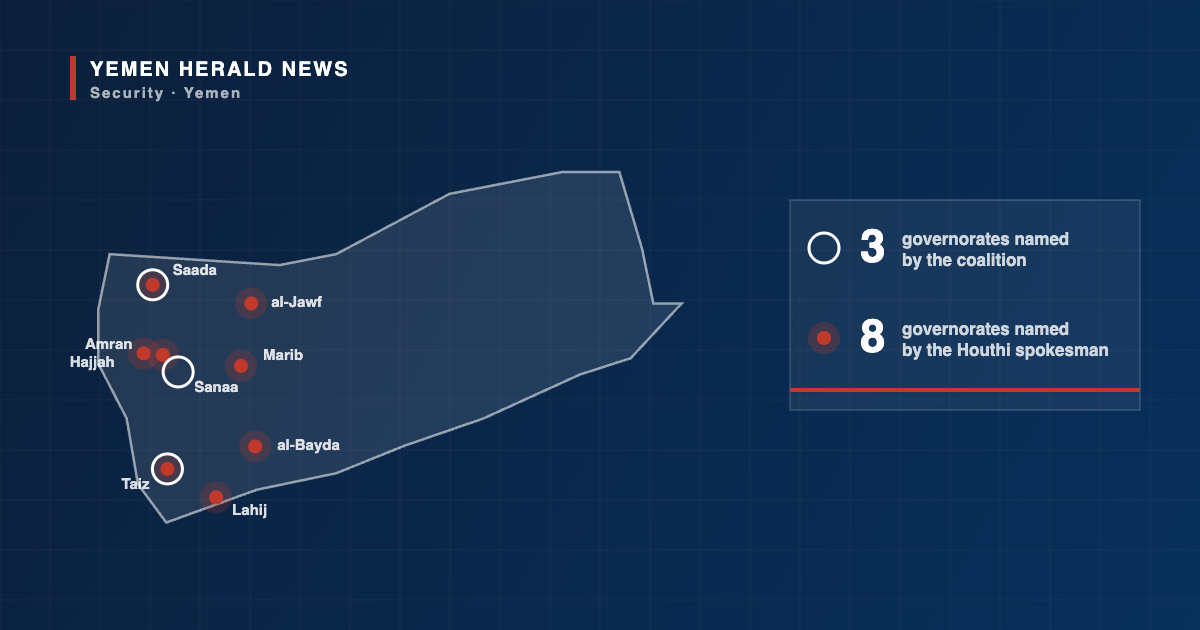
The coalition names three governorates. Its opponent names eight.
The Coalition to Support Legitimacy in Yemen announced what it called a qualitative military operation on Friday, the Yemeni news site Yemen Monitor reported. A coalition spokesman said it was aimed at the sources of threat the Houthis use against civilians in Yemen and Saudi Arabia, and at the group’s military and ballistic capabilities.
Maj. Gen. Turki al-Malki, the coalition spokesman, said operations were continuing against military and ballistic missile capabilities in Sanaa, Saada and Taiz, The National reported.
That is the coalition’s own account of where it is working.
On Saturday, Houthi military spokesman Yahya Saree said the coalition had carried out 71 strikes in the previous 24 hours, Middle East Eye reported.
Saree said those strikes hit civilian sites in al-Bayda, Amran, Hajjah, Saada, Lahij, Taiz, al-Jawf and Marib.
Two names appear on both lists. They are Saada and Taiz.
Sanaa, which al-Malki named, is absent from Saree’s account. Six governorates in Saree’s account — al-Bayda, Amran, Hajjah, Lahij, al-Jawf and Marib — have not been acknowledged by the coalition.
Yemen Herald could not independently verify either list.
Saree said the strikes caused civilian casualties. He gave no figure. The coalition has published no strike tally and no casualty assessment.
Al-Malki said a dawn attack on Sanaa destroyed seven military targets and six workshops used to build missile launcher and drone structures, according to The National.
He said the strike on Hodeidah port was directed at operational capabilities used in smuggling and in moving weapons and ballistic missiles.
The coalition’s Joint Forces Command asked civilians to leave the port area before that strike.
In Taiz, the coalition’s Military Axis Command said it repelled two Houthi attacks, on the al-Aqroudh and Kuhlan fronts, Yemen Monitor reported. It said dozens of Houthi fighters were killed or wounded.
That claim rests on the coalition alone. Yemen Herald found no second origin for it.
Al-Malki said Saudi air defences destroyed two ballistic missiles fired toward the Jazan region, with debris falling near al-Shuqaiq.
Saree has also named a power station at al-Shuqaiq in southern Saudi Arabia as a target, and has urged people to leave Riyadh’s financial district.
Houthi forces struck an office tower in Riyadh on Thursday. The National identified the building as the headquarters of Saudi Arabia’s sovereign wealth fund.
Saree’s list spans territory the Houthis have held for years and ground where the front has moved this year. Saada is the movement’s home governorate.
Lahij lies between that front and Aden. Reuters and The National both reported this month that Houthi forces had taken ground near Bab al-Mandab, on Yemen’s south-western coast, and placed them about 100 kilometres from Aden.
Marib and al-Jawf sit in Yemen’s interior, east and north-east of Sanaa.
The coalition’s three named governorates take in the Houthi seat of government and the movement’s birthplace.
Farhan Haq, deputy spokesman for the UN secretary-general, told reporters in New York on Friday that the United Nations was deeply concerned about the escalation in and around Yemen.
Haq said Yemen’s Red Sea ports had to stay operational because millions of people depend on supplies arriving through them.
He urged all parties to observe international humanitarian law, including the prohibition on attacks against civilians and civilian infrastructure.
There is no military solution to the conflict, Haq said, calling for a return to political negotiations.
An earlier strike on Hodeidah on Tuesday killed at least 14 people, according to the Houthis. The coalition has not commented on that toll.
Yemen Herald reported on Wednesday that the coalition said it had struck 60 Houthi sites and that the Houthi health ministry reported 17 people killed. Neither figure was independently confirmed.
Saudi Arabia issued a danger alert for Mecca province on Friday and lifted it within minutes. Saree said afterwards that there was no threat to the city.
The Houthis have held Hodeidah port since October 2014. The coalition blockaded it in 2015, though humanitarian cargo continued to arrive under a United Nations verification arrangement.
Coalition-backed forces advanced on the city in 2018. A ceasefire brokered by the United Nations halted that offensive.
Israel struck the port in July 2024, and again in 2024 and 2025, saying its infrastructure served military purposes.
Fighting in Yemen resumed in July alongside the wider war involving Iran, Reuters reported.
Last month the coalition ordered people away from the area around the Yemen Petroleum Company’s al-Sabahah station in Sanaa, The National reported.
Strikes on Riyadh’s main airport last month led to the cancellation of most international flights, Reuters reported. Saudi Arabia postponed or cancelled public events after those attacks, among them the AFC Asian Cup.
The UN Security Council renewed its Yemen sanctions regime for a year this month and deferred a decision on controls covering weapons components, Yemen Herald reported on 18 November.
Yemen Herald reported on 17 November that Saudi Arabia had replaced its coalition commander in Yemen.
Saree issues his statements through a Telegram account.
Reports of the coalition spokesman’s name render it both as al-Malki and al-Maliki.
The coalition has not said how long its operation will run.
Yemen Monitor dated the announcement to Friday in its text and to Saturday in its page byline.
About the Author