FEWS NET flags famine risk in besieged Taiz city for February to May
 Adel Haddad
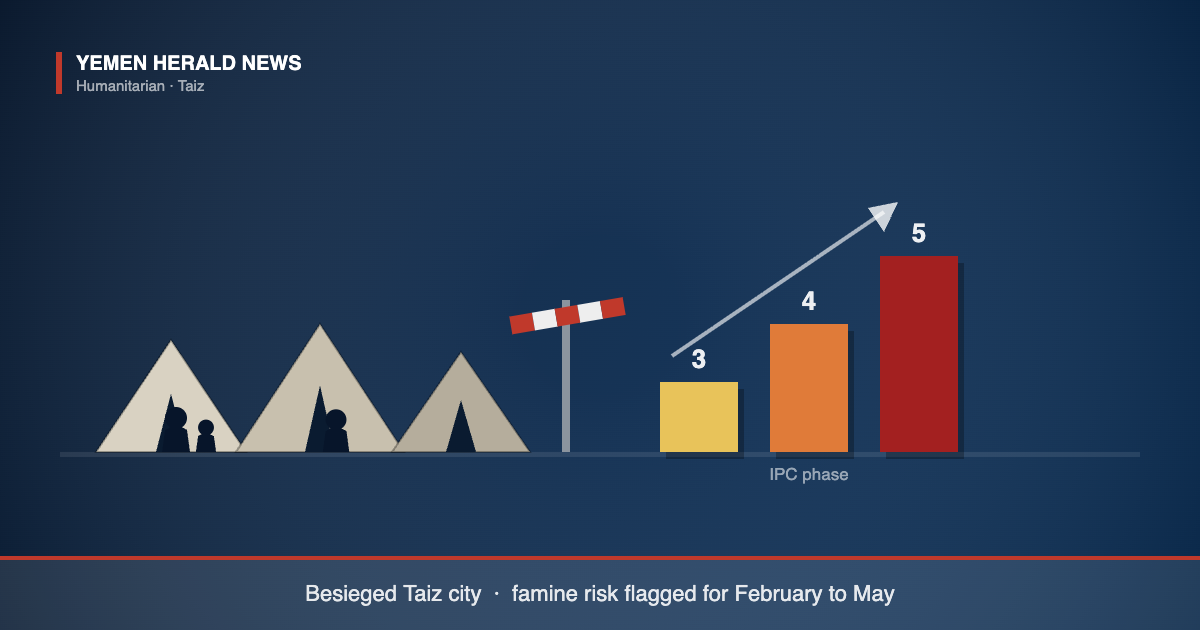
TAIZ, Yemen — A prolonged and tightened siege of Taiz city would likely cause famine there between February and May, the Famine Early Warning Systems Network said in an alert on Nov. 17.
The network, known as FEWS NET, did not classify the city as being in famine. It described a credible risk, conditional on the siege lasting and restrictions deepening.
Taiz city holds an estimated 600,000 to 750,000 people, many of them displaced there from elsewhere, according to the alert.
Sanaa-based authorities captured the last major road linking the city to government-held areas on Oct. 4, FEWS NET said. The city has been under a de facto siege since.
On Oct. 18 those forces destroyed portions of the city’s remaining commercial supply route, according to the network’s food security outlook covering October to May.
Nineteen roads leading to Taiz are closed or sit on active front lines, the outlook said.
Prices for essential food and fuel inside the city are about three times their level before the escalation, according to the same assessment.
The minimum food basket in Taiz governorate rose 33 percent between August and September and stood 11 percent above its five-year average, FEWS NET said, citing FAO data.
Cooking gas on the parallel market costs about twice the official price in Aden and more than three times in Taiz city.
Fresh food reaches the city only intermittently. Wheat grain and flour stocks are well below average, and hospitals report shortages of medicine, the outlook said.
FEWS NET set out three conditions that together would amount to famine: at least 20 percent of the population facing extreme food consumption deficits, acute malnutrition rising past the famine threshold, and hunger- and disease-related deaths rising past it.
Its most likely scenario does not reach those levels. Limited quantities of food continue to enter by small mountain routes, which the network said prevents total collapse while keeping prices high.
Under that scenario, Emergency conditions persist and a growing share of the worst-affected households fall into Catastrophe, the most extreme classification the scale applies to a household.
FEWS NET said current restrictions are less restrictive than at the peak of the 2015 siege of the city.
The baseline was already poor. Post-harvest data collected in late 2025 showed at least 20 percent of surveyed households with a poor food consumption score, and at least 20 percent reporting moderate to severe hunger.
The Yemen Nutrition Cluster modelled acute malnutrition among children under five in the city at 15 to 29.9 percent before the siege began. No representative survey of the city exists, FEWS NET said.
The lean season peaked in September, a month before the roads closed.
Conflict data point the same way. ACLED recorded 712 clashes nationwide through Oct. 30, up 10.2 percent on September, with 361 ground-fighting incidents in Taiz.
ACLED also recorded 771 Saudi airstrike events, 398 of them on the Taiz-Lahij axis.
Taiz recorded 53 stand-off attacks over the same period. Lahij recorded 95 ground-fighting incidents and 30 stand-off attacks.
The World Health Organization counted 7,395 people killed and 1,677 injured through Oct. 25. Yemen Herald could not independently verify either figure.
The International Organization for Migration’s Displacement Tracking Matrix put the number displaced since the escalation began in June at 287,767 as of Oct. 27. Taiz governorate hosts 128,484 of them and is the origin of 69 percent of displaced households.
Lahij hosts 71,100 displaced people and Aden 53,016, the matrix recorded.
Disease is spreading alongside. Yemen has recorded 8,034 suspected cholera cases and 27 deaths this year, with Abyan, Lahij, Al-Dhali’, Taiz and Aden accounting for 92 percent of cases, and 22,800 suspected measles cases with 128 deaths.
Routine vaccination coverage runs at about 45 percent in government-held areas and is close to nil in areas held by the Sanaa authorities.
FEWS NET expects Emergency conditions to persist in Al-Hudaydah, Hajjah, Taiz and Lahij governorates through May. Crisis conditions remain widespread elsewhere.
The number of people needing humanitarian food assistance is peaking at 16 million to 17 million, and more than 40 percent of the population will still need it through May, the outlook said.
Aid is contracting as need rises. Food assistance has been suspended in areas held by the Sanaa authorities since September 2025.
The escalation has cut access to about 800,000 people, left at least 49 distribution points in Al-Mukha unreachable, and ended assistance for about 350,000 people across eight districts of Taiz and Al-Hudaydah.
A separate assessment reached similar conclusions earlier in the year. The Integrated Food Security Phase Classification found 47 percent of people in government-held areas facing high acute food insecurity, FAO, the World Food Programme and UNICEF said on June 3.
That analysis put about 5 million people in Crisis or worse, including 1.4 million in Emergency, and projected the Emergency figure would rise to 1.8 million between October and December.
It was completed before the October road closures and does not account for them.
UNICEF-supported teams screened 14,933 children across eight governorates between September and early October and found 4,771 cases of acute malnutrition, 1,766 of them severe.
Imports cover about 85 percent of Yemen’s food supply, according to FAO figures cited by FEWS NET. Real income per person has fallen by more than 58 percent since 2015, on World Bank estimates.
About the Author