Taiz governor asks EU for more pressure on Houthi siege weeks after bloc set out demands
 Adel Haddad
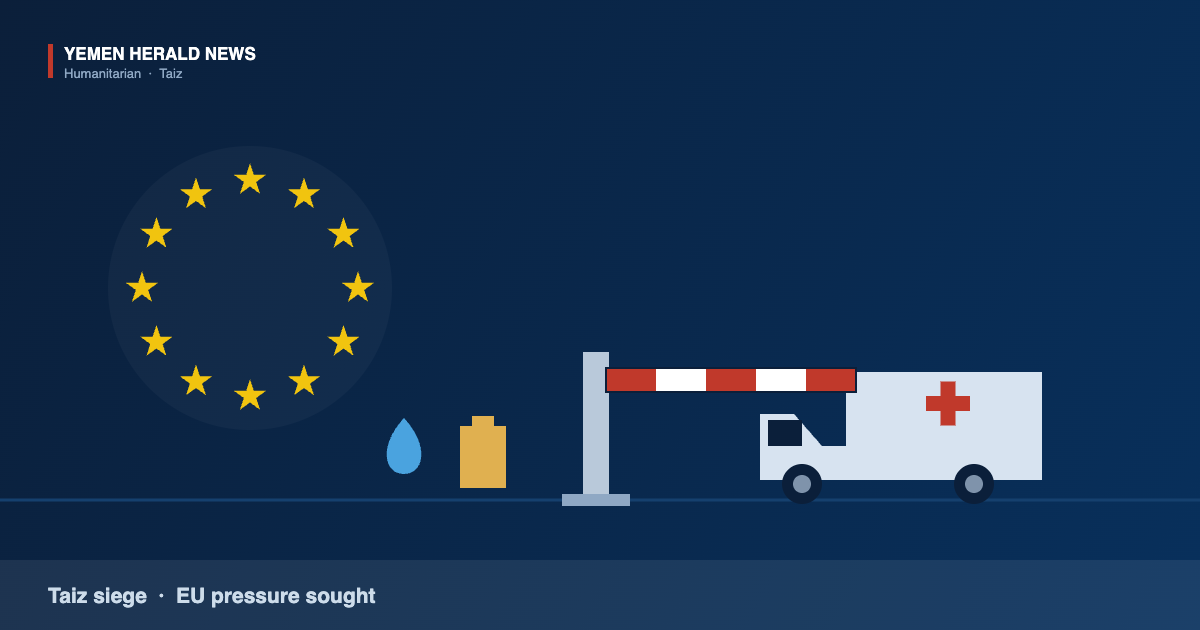
TAIZ, Yemen — Taiz’s governor asked the European Union on Thursday to increase pressure on the Houthis to lift the siege of the city and reopen its roads.
Governor Nabil Shamsan made the request in a virtual meeting with Patrick Simonnet, the European Union’s ambassador to Yemen, the state news agency Saba reported.
The two discussed shortages of food, medicine, fuel and water in the city, according to Saba.
Shamsan asked the European Union and the United Nations to press for safe passage for civilians and aid supplies, the agency said.
Simonnet said he was concerned about falling food and medical stocks and a worsening water crisis, according to the same report. He said monitoring and international action would continue.
Both sides called for stronger international coordination to open a humanitarian corridor into Taiz, Saba reported.
The request came 17 days after the European Union set out its own demands on the city.
Kaja Kallas, the bloc’s high representative for foreign affairs and security policy, issued a statement on behalf of its 27 member states on Nov. 2.
The statement said all Houthi military action must end immediately, according to the Brussels outlet Eunews, which reported it the day it was issued.
It called on the Houthis to open a humanitarian corridor in Taiz, which it described as under prolonged siege, Eunews reported.
Kallas urged all parties, including Iran, to end military support to the Houthis, which the statement said breached several Security Council resolutions, according to the same report.
She said there could be no military solution to the conflict, Eunews reported. The bloc reaffirmed its support for United Nations-led diplomacy, according to the same report.
The statement condemned attacks on the al-Maashiq building in Aden and attacks on Saudi Arabia, and referred to military operations on Yemen’s western coast, according to Eunews.
The statement condemned attacks on Saudi Arabia that struck civilians and civilian infrastructure, Eunews reported.
It put the number of people in Yemen needing assistance at more than 22 million.
Between 800,000 and 950,000 civilians, including displaced people, live in Taiz, the statement said, according to Eunews.
The bloc allocated a further 25 million euros in emergency humanitarian aid, taking its 2026 total to 110 million euros, Eunews reported. European support for Yemen since 2015 has reached almost 2 billion euros, according to the same report.
The statement also called for the release of 70 United Nations staff it said were still held in Sanaa.
Yemen’s Ministry of Foreign Affairs and Expatriates welcomed the text the following day, the Yemeni outlet Yemen Monitor reported on Nov. 3.
The ministry praised the call to halt military support to the Houthis and singled out Iranian backing, according to Yemen Monitor.
It welcomed the demand for a humanitarian corridor in Taiz and for the release of detained United Nations personnel and relief workers, the outlet reported.
The ministry also praised the bloc’s position against the use of starvation as a method of warfare, Yemen Monitor reported.
The ministry urged the international community to cut the group’s weapons supply lines and funding, according to the same report.
It said ending what it called the Houthi coup was a precondition for freedom of navigation in the Red Sea and the Bab al-Mandab Strait, Yemen Monitor reported.
The Houthis have not published a response to the European statement. Yemen Herald found no comment from the group on the Nov. 2 text or on the governor’s request.
Simonnet set out his own assessment in late October.
He told the outlet The National that de-escalation could not wait for weeks, in an interview Yemen Monitor reported on Oct. 28.
Renewed fighting threatened years of diplomatic work, he said, according to that report.
Military operations alone would not end the conflict, he said. Military developments could shift the balance of power without resolving political differences.
Regional de-escalation on its own would not be enough, he said, according to Yemen Monitor. Regional and domestic tracks had to run at the same time.
Attention to maritime security and missiles risked coming at the expense of the humanitarian file, he said, the outlet reported.
Simonnet said he was concerned about Houthi attacks in Aden, and called on the group to lift the Taiz siege and allow in food, water, medicine and fuel, according to the same report.
The European Union had condemned attacks on the presidential palace at al-Maashiq and on Aden airport, Yemen Monitor reported.
Yemen’s foreign minister, Afrah al-Zouba, addressed international support for state institutions this week.
She told a session of the 12th Mediterranean Dialogues forum in Naples, Italy, that lasting stability required restoring the authority of the state, Saba reported on Nov. 20.
Houthi escalation, the undermining of state institutions and support from Tehran had prolonged the crisis, she said, according to the agency.
The escalation had cost opportunities for a political settlement and extended the threat to neighbouring countries and international shipping routes, she said, according to the agency.
She called on Iran to end its military support for the group and to respect Security Council resolutions, Saba reported.
Protecting international shipping required strengthening Yemen’s coast guard, securing ports and supporting economic recovery, she said.
The Nov. 2 statement also mentioned the European Union naval operation Aspides, Eunews reported.
About the Author