Saudi Arabia presses EU to list Houthis as Yemen enacts its own terrorism law
 Adel Haddad
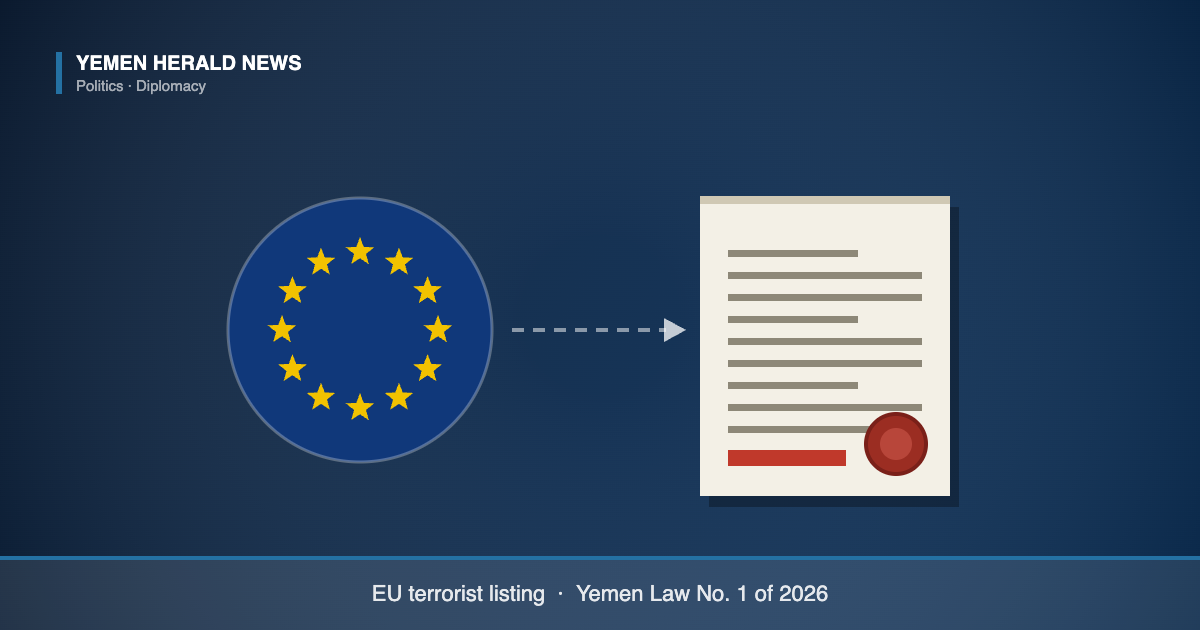
BRUSSELS, Belgium — Saudi Arabia is pressing the European Union to designate Yemen’s Houthis a terrorist organisation, Reuters reported on Nov. 12, citing six European officials.
The officials spoke on condition of anonymity. One declined to name the member states backing a designation because the discussions were private.
The bloc has not taken the step. European concerns that a listing could undermine a future Yemen peace process have not been overcome, Reuters said.
Anouar El Anouni, the EU foreign policy spokesperson, said the bloc is in regular contact with Riyadh on a range of issues. He declined to comment on specific discussions.
Saudi Arabia’s government communications office did not respond to a request for comment, according to the report.
The Houthis are already under EU sanctions. The measures include an arms embargo and asset freezes on 12 commanders.
The bloc has designated Iran’s Islamic Revolutionary Guard Corps a terrorist organisation. It has not designated the Houthis. The United States, Australia and Canada have.
A designation would require the unanimous agreement of all 27 member states. Support is limited to a small number of them, according to the officials cited by Reuters.
The report set out four European objections. A listing could close the limited channels European governments retain to the group, prompt retaliation against European vessels near Yemen, and complicate aid work in Houthi-held areas. It would also be hard to undo, because lifting a designation requires unanimity too.
The European Parliament has already asked for the step. On Oct. 22 it adopted a resolution on the implication of Houthi attacks for regional security, approved by a show of hands after weeks of negotiations.
The text calls on the Council to place the Houthi movement on the EU list of terrorist organisations, including its military and political wings, its leadership and its military and security apparatus. Members said no distinction should be drawn between armed and unarmed wings.
The resolution calls for all channels of financing for the movement to be dismantled and for the bloc to freeze its funds.
It condemns what it described as the destabilising role of the Iranian government, which it said supplies the Houthis with weapons, missile and drone technology, training and financing. It also condemns coordination between the Houthis, Hezbollah and other Iran-backed armed groups.
Parliament resolutions of this kind do not bind the Council. EU sanctions require approval by the European Council, where the 27 governments are represented.
Hana Jalloul, the lead negotiator and a member of the Socialists and Democrats group, said she extended full solidarity with the people of Yemen and of Gulf countries. At the debate two days before the vote she said Europe could not stand idly by.
Jalloul said the Houthi blockade of the Bab al-Mandab Strait, alongside the closure of the Strait of Hormuz, had disrupted the global food supply. She called for political and financial support for victims.
Antonio Lopez-Isturiz White, a member from the European People’s Party, said Europe’s credibility was on the line. “The EPP demands clearly and without ambiguity that the Houthis belong and have to be on the European list of terror now,” he said.
Kaja Kallas, the EU’s foreign affairs and security policy chief, said the group was being financed, equipped and trained by Iran. She said the 27 states would need to be brought on board for a designation.
Kallas said about a fifth of the bloc’s trade passes through the Red Sea. She said Houthi attacks had forced the postponement of an EU-Gulf Cooperation Council leaders’ summit planned for Riyadh that month.
The resolution also asks member states to supply additional naval and air assets to Aspides, the EU’s Red Sea naval operation, and welcomes the extension of its mandate.
Yemen’s own designation arrived four weeks later. Rashad al-Alimi, chairman of the Presidential Leadership Council, issued Law No. 1 of 2026 on Nov. 18, after approval by the Cabinet and by parliament, Asharq Al-Awsat reported.
Article 4 designates the group, which calls itself Ansar Allah, in all its structures. Affiliated entities are covered where the Houthis created, manage or control them, or where they operate in the group’s name.
The law sets penalties of 20 to 30 years or death for terrorist offences, and death where a listed offence causes death or permanent disability. Membership carries 10 to 15 years. Effective leadership carries the death penalty, as do weapons supply and the recruitment of children.
A permanent technical unit inside the Prosecutor General’s office is to prepare listings, and the Prosecutor General issues the decisions. Freezing assets is treated separately from confiscation, which requires a final court ruling.
Designation is not a conviction, and listings can be appealed in court. It does not extend automatically to people doing business with the group or living in its areas.
Legitimate commerce, including the transport of food, medicine and fuel, is not an offence in itself. United Nations, International Committee of the Red Cross and licensed humanitarian operations are exempt.
The law directs the Public Prosecution, with the foreign affairs and interior ministries, to pursue suspects abroad through arrest and extradition requests, Interpol coordination and asset tracing, and to activate the Arab Convention on the Suppression of Terrorism.
It bars future political settlements from granting criminal immunity. Official peace, ceasefire, prisoner-exchange and humanitarian negotiations are excluded from that bar.
Yemen’s parliament approved the law on Nov. 17, Al Jazeera reported.
About the Author