UAE Refers 13 People and Six Companies to Trial Over Alleged Arms Trafficking to Sudan
 Yemen Herald News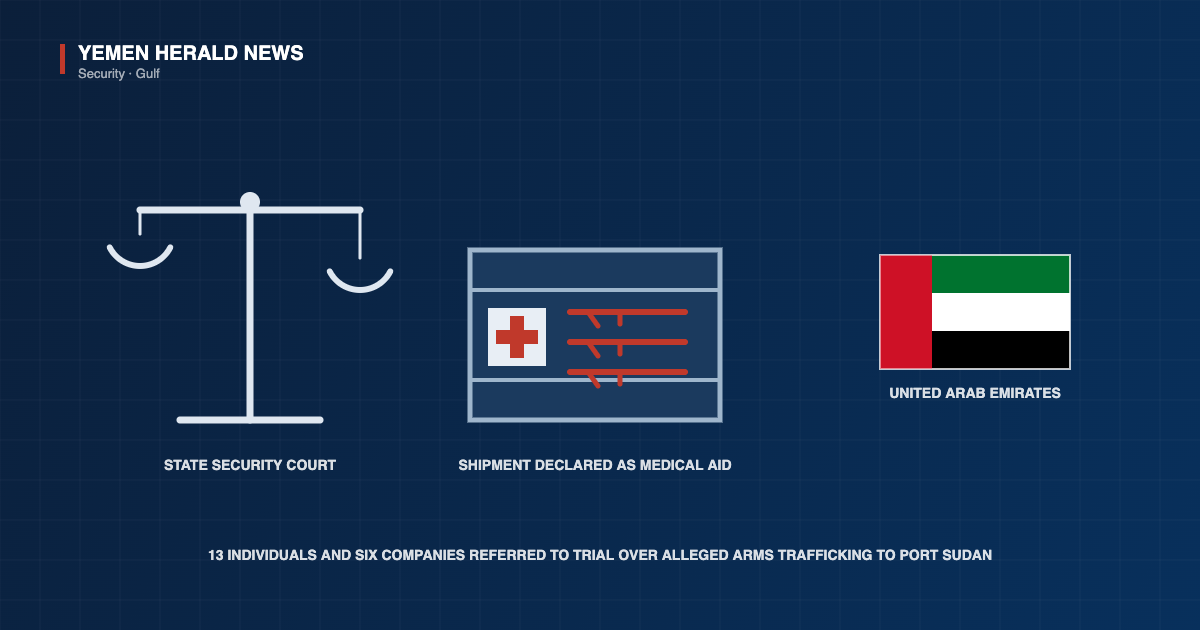
The United Arab Emirates’ attorney general announced at the end of April 2026 that 13 individuals and six UAE-registered companies had been referred to the Abu Dhabi Federal Court of Appeal, sitting in its capacity as the State Security Court, on charges of illicit trafficking in military materiel, forgery and money laundering. Emirati authorities said the defendants had attempted to move a consignment of ammunition through UAE territory to the Port Sudan Authority in breach of the laws in force in the country.
The referral, carried by Emirati state media and Gulf newspapers at the time, closed an investigation that had first been made public a year earlier, in April 2025. Prosecutors said the earliest of the transactions under examination had been concluded outside the Emirates and was worth roughly $13 million, covering Kalashnikov rifles, machine guns and grenades. According to the case file described in those reports, the cargo was declared as humanitarian and medical supplies, with the consignee recorded as the Federal Ministry of Health of the Republic of Sudan, while the aircraft in question was carrying weapons.
The accused were described in Emirati accounts as a mix of Sudanese politicians, former intelligence officers and businessmen, whom investigators linked to Sudan’s Islamic Movement and the Muslim Brotherhood. Prosecutors further alleged that the deals had been arranged at the direct request of the armament committee of the Port Sudan Authority, chaired by Abdel Fattah al-Burhan with his deputy Yasser al-Atta, and that coordination ran through an individual named in the referral as Othman Mohammed al-Zubair Mohammed. These are the prosecution’s contentions; the responses of the defendants were not set out in the reporting that circulated when the referral was announced.
The scale of the alleged transaction is modest by the standards of state arms procurement but substantial for an irregular supply chain. Thirteen million dollars buys a great deal of small-arms ammunition, and rifles, machine guns and grenades are the weapons that actually do the killing in Sudan’s war, rather than the heavier systems that attract more attention. Illicit consignments of that type are typically assembled from surplus stock, routed through several jurisdictions, and papered over at each transfer, which is why the forgery counts sat alongside the trafficking ones.
The case did not arrive in a neutral setting. Sudan’s army-aligned authorities in Port Sudan have accused the Emirates repeatedly and publicly of supplying weapons to the paramilitary Rapid Support Forces, the army’s opponent in the war that has convulsed Sudan since 2023. Abu Dhabi has consistently rejected that accusation. A prosecution in an Emirati court alleging that figures connected to the Port Sudan authorities were the ones running weapons through UAE territory therefore had an obvious political dimension as well as a legal one, and each side read the file to suit its own case.
Set against that, the technical substance of the charges is the part with the widest consequences. Mislabelling a weapons shipment as medical aid is not merely a customs offence. Humanitarian consignments move on trust, through corridors and clearances built specifically to let relief reach civilians quickly. Every instance in which that channel is used as cover for something else makes the next genuine convoy slower to clear and easier to obstruct, and gives any party inclined to block aid a ready justification. Relief agencies working across the Red Sea basin, Yemen included, have complained about exactly that dynamic for years.
The venue matters too. The Abu Dhabi Federal Court of Appeal handles state security matters, and the charge sheet paired the trafficking counts with forgery and money laundering rather than treating the shipment in isolation. That framing tracks a broader tightening of Emirati financial enforcement. The UAE was placed on the Financial Action Task Force’s list of jurisdictions under increased monitoring, the so-called grey list, in 2022, and was removed in 2024 after overhauling its anti-money-laundering and counter-terrorist-financing regime. Cases that combine trade-based laundering with export-control breaches are the kind the country has since had a strong institutional interest in being seen to prosecute.
For readers in Yemen the file is worth following for reasons beyond Sudan. The Emirates is a significant actor in both theatres, and the two conflicts share a maritime basin: Port Sudan sits on the same stretch of Red Sea coast that Yemeni ports face across the water, and the corridor running down to the Bab al-Mandab Strait carries the shipping on which both economies depend. Arms that move by air and sea into that basin rarely stay confined to one buyer or one border, and the enforcement capacity of the transit states along it shapes what reaches whom.
What the referral did not settle is how the case ends. A referral to trial establishes the prosecution’s version of events, not a verdict, and the reports circulating in the spring of 2026 gave no timetable for proceedings and no indication of how the defendants intended to plead.
What the episode did demonstrate is that the Red Sea arms trade has become dense enough, and lucrative enough, to be worth building shell companies and forged paperwork around, and that at least one transit state was prepared to bring the machinery into open court rather than handle it quietly. For a region where such shipments have more often been dealt with through diplomatic channels or not at all, that in itself marked a departure worth recording.
About the Author