
Yemen’s Prime Minister Chairs Aden Meeting on Fiscal Reform and Revenue Priorities
 Yemen Herald News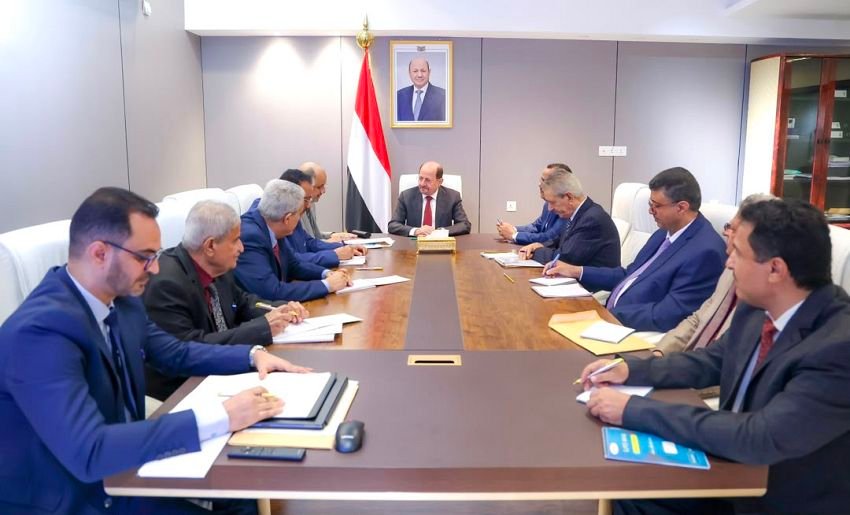
The economic challenges facing Yemen were brought into focus during a meeting in Aden chaired by the Prime Minister and Minister of Foreign Affairs, Dr. Shaya al-Zindani, with senior figures from the Ministry of Finance and its associated revenue bodies. The gathering was convened to assess the government’s priorities for the coming period, with particular emphasis on increasing public revenues, stabilising the country’s fiscal position and pressing ahead with reforms regarded as essential to economic recovery.
The meeting brought together the leadership of the Finance Ministry, together with the heads of the Tax Authority and the Customs Authority, reflecting the central role these institutions play in mobilising state income. By assembling the officials responsible for collecting revenue, the government signalled its intention to tackle one of the most pressing weaknesses in Yemen’s public finances: the difficulty of generating reliable income after years of conflict have eroded the tax base and disrupted trade.
The discussions formed part of a wider reform programme that the government has been advancing since taking office. Al-Zindani’s administration has placed economic and financial stabilisation near the top of its agenda, framing reform not as an abstract technical exercise but as a precondition for restoring services, paying salaries and rebuilding confidence in state institutions. The priorities reviewed in Aden were presented as the next stage in that effort.
One of the most significant milestones in the government’s reform drive has been the approval of a national budget for the 2026 fiscal year, the first such budget the country has passed in seven years, following the last one adopted in 2019. The long absence of an approved budget had complicated financial planning and weakened oversight of public spending, so its return is seen as an important step toward more orderly management of state finances and greater accountability.
Alongside the budget, the government has endorsed a short-term strategic plan covering 2026 and 2027 that is designed to increase government revenues, achieve greater economic stability and strengthen the financial system. The plan provides a framework within which the measures discussed at the Aden meeting are intended to operate, linking day-to-day revenue collection to longer-term goals for the public finances. Officials have described it as a roadmap for putting the country’s fiscal house in better order.
The backdrop to these efforts is a deeply strained economy. Years of war have battered Yemen’s currency, fuelled inflation and undermined the purchasing power of ordinary citizens, while the division of economic institutions between rival authorities has further complicated matters. Government revenues have been squeezed by the disruption of oil exports, a traditional mainstay of the budget, leaving the authorities increasingly reliant on taxes, customs duties and external support to meet their obligations. The volatility of the local currency has been among the most visible symptoms of this strain, eroding household incomes and complicating the government’s efforts to plan its spending with any certainty.
Strengthening the Tax and Customs authorities is therefore central to the government’s strategy. Improving collection, curbing leakage and modernising procedures at ports and border crossings can yield significant additional revenue without necessarily raising rates, an attractive prospect for a government wary of placing further burdens on a population already struggling with high prices. Officials have stressed the importance of transparency and governance in these institutions, both to maximise income and to reassure citizens and partners that funds are being handled responsibly.
Yemen’s reform agenda has also unfolded under close international scrutiny. International partners have pressed the government to deliver on financial reforms, linking continued support to tangible progress, and have at times warned of consequences for those seen to be obstructing change. This external pressure has added urgency to the government’s efforts, while also providing a degree of technical and financial backing for the reform process. As part of the broader push, the authorities have announced steps such as conducting a comprehensive inventory of state property, intended to give the government a clearer picture of the assets at its disposal and to close avenues for mismanagement, a measure that complements the revenue-focused priorities discussed in Aden.
For officials, the meeting in Aden represented an attempt to translate broad commitments into concrete priorities. Setting clear targets for revenue, identifying obstacles to collection and coordinating among the relevant institutions are the kinds of practical steps on which the success of the wider programme will ultimately depend. The challenge lies in implementing such measures consistently in an environment marked by insecurity, institutional fragmentation and competing demands on limited resources.
Looking ahead, the government faces the difficult task of sustaining momentum on reform while managing the immediate pressures of a humanitarian crisis and an unstable economy. Approving a budget and adopting a strategic plan mark important milestones, but their value will be determined by how effectively they are put into practice. For Yemen’s leadership, the meeting underscored both the scale of the fiscal challenge and a determination to confront it, as the authorities seek to lay firmer financial foundations for a country still struggling to emerge from years of conflict and to give its citizens reason to believe that a more stable economic future is achievable.
About the Author




