Bielsa Says His Uruguay Tenure ‘Left Nothing’ After World Cup Exit to Spain
 Yemen Herald News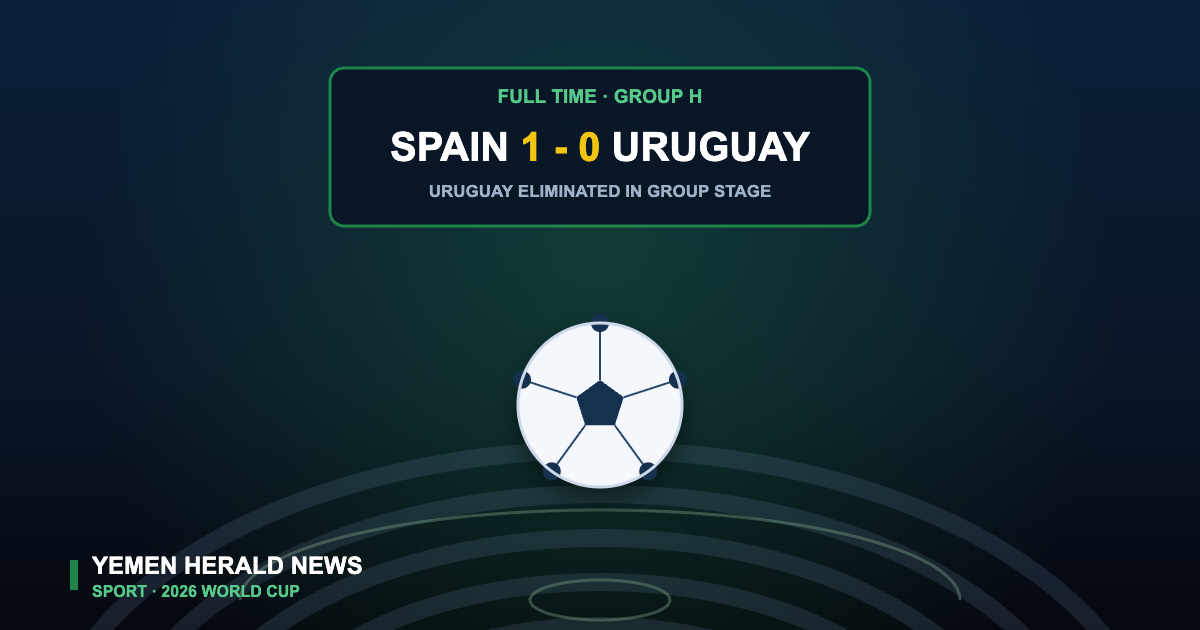
Uruguay’s 2026 World Cup ended in disappointment and self-reproach, as Marcelo Bielsa’s side were eliminated in the group stage and the veteran Argentine coach responded with an unusually bleak assessment of his own legacy. Drawn into Group H alongside Spain, Cape Verde and Saudi Arabia, the two-time world champions failed to win a single match and bowed out after a narrow defeat to the team that finished top of the section.
The decisive game came against Spain in Guadalajara, where a single goal settled a tight contest. Álex Baena struck in the 42nd minute, controlling a low cross from Marcos Llorente before firing toward goal. Fernando Muslera, the experienced Uruguay goalkeeper, could not hold the effort and the ball squirmed into the far corner, handing Spain a lead they would not relinquish. That 1-0 result, combined with events elsewhere in the group, confirmed Uruguay’s elimination on 26 June and brought a premature end to a campaign that had begun with considerable hope.
Uruguay actually finished third in Group H rather than bottom, but in the expanded 48-team format that was not enough to survive. Two goalless draws, against Saudi Arabia and Cape Verde, left them on just two points, and their standing meant they could not be ranked among the eight best third-placed teams who progress to the round of 32. Cape Verde, by contrast, drew all three of their matches to reach three points and edge above Uruguay, securing a place in the knockout rounds on the West African archipelago’s World Cup debut. It was a historic achievement that made Cape Verde the first debutant nation to reach the knockouts since Slovakia in 2010, and it underlined the unpredictability that the larger tournament has produced.
The Muslera episode added a further twist to a painful night. The goalkeeper was withdrawn at half-time, but Bielsa was careful to explain that the change had not been his decision. He said it was Muslera himself who asked to come off and that the two had not spoken during the interval. It later emerged that the goalkeeper had been playing while unwell, struggling with a fever he had not disclosed, a detail that cast both his error and his early withdrawal in a more sympathetic light. One of the most experienced figures in the squad and a long-serving presence in the Uruguayan goal, Muslera endured a wretched evening through no lack of commitment.
Bielsa’s post-match reflections were notably severe, and they centred on his own contribution rather than on his players. Asked how his time in charge would be remembered, he offered a blunt judgement, saying his spell would be recalled as one that left nothing. He elaborated that whatever a coach might contribute over several years is rendered futile in the absence of a positive outcome, framing the lack of silverware and the early exit as the measure by which his tenure would inevitably be judged.
The remarks were striking for their candour, even by the standards of a coach long known for his intense and idiosyncratic approach. Rather than deflecting blame or pointing to mitigating circumstances, Bielsa accepted responsibility for the team’s underwhelming performances, shouldering the burden of a campaign that had failed to deliver. For a figure who commands deep respect across the sport, the willingness to describe his own work in such stark terms was a measure of how heavily the elimination weighed on him.
Bielsa took charge of Uruguay in 2023, inheriting a national side with a proud footballing tradition and a generation of talented players. His appointment had been greeted with optimism, given his reputation for transforming teams and his distinctive, high-energy style. The hope was that he could blend Uruguay’s traditional resilience with a more expansive approach, and there were encouraging signs early in his tenure that the project might bear fruit on the biggest stage.
The reality at the World Cup proved far more sobering. Uruguay struggled to turn possession into clear chances and lacked the cutting edge needed to break down well-organised opponents, a shortcoming that ran through their group campaign. A run of matches without a win heading into the tournament had already raised questions about the team’s form, and those doubts were only reinforced by the manner of their performances in a group they had been expected to navigate more comfortably.
For Uruguayan football, the early exit represents a significant setback and is likely to prompt renewed debate about the direction of the national team. Expectations around the side remain high, shaped by past glories and the quality of players available, and a group-stage departure inevitably invites scrutiny of the choices that led to it. How the federation responds, and whether Bielsa continues in his role, will be among the questions to dominate the discussion in the aftermath.
For Cape Verde, meanwhile, the same group delivered a moment of history that will be celebrated long after the tournament ends. As one footballing nation marked an unprecedented achievement, another was left to reckon with failure and with a coach’s unsparing verdict on his own work. Uruguay’s task now is to rebuild and to restore the standards their supporters expect, while reflecting on a campaign that fell well short of its ambitions.
About the Author