IOM says 1,628 Ethiopian migrants returned from Yemen to Djibouti in August
 Yemen Herald News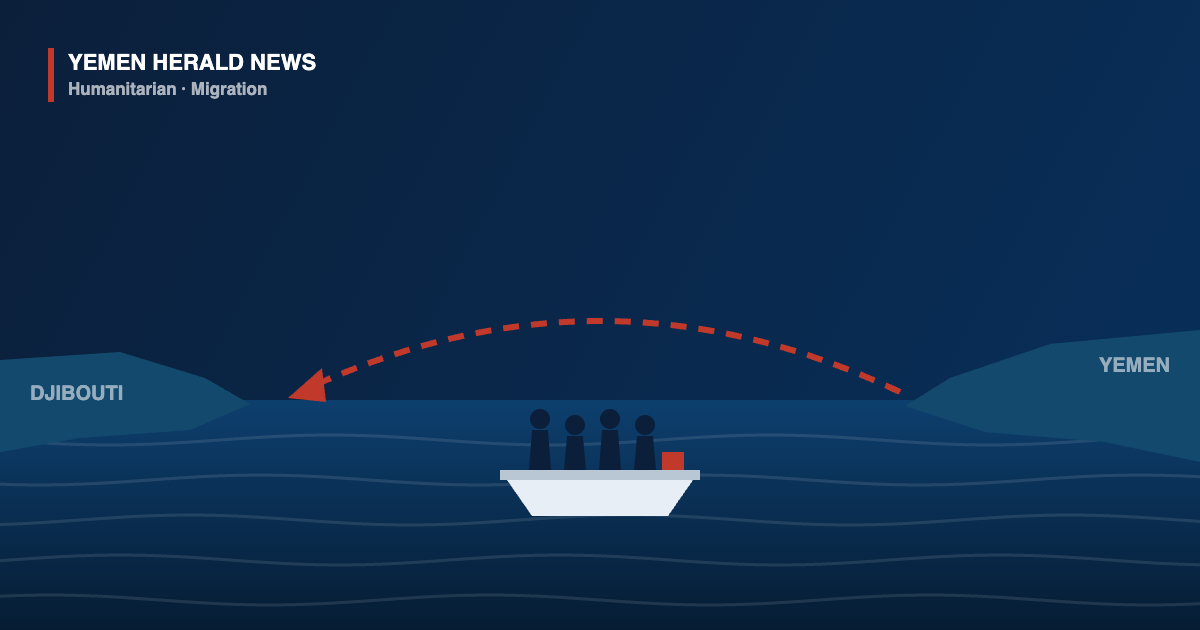
ADEN, Yemen — More than 1,600 Ethiopian migrants left Yemen for the Horn of Africa in August, the International Organization for Migration said, most crossing the Gulf of Aden by boat.
The agency put the number who reached Djibouti at 1,628, up from 1,345 in July.
A further 38 migrants travelled from Yemen’s eastern al-Mahra governorate into Dhofar, in neighbouring Oman. That brought total tracked departures for the month to 1,666.
The figures come from IOM’s Displacement Tracking Matrix, the agency’s own monitoring system. Yemen Herald found no independent confirmation of the August totals.
Every migrant who reached Djibouti last month departed from Ras al-Ara, a stretch of coast in Lahj governorate, and landed at Obock, according to the matrix. IOM described the crossing as a dangerous sea journey.
Some returned voluntarily. Others were deported by Yemeni authorities, the agency said. It did not break the total into the two categories.
In July the agency tracked 1,649 departures from Yemen in all. Of those, 1,345 left Lahj for Obock.
Ras al-Ara has served as the main exit point for Ethiopians leaving Yemen throughout the year. IOM recorded 5,128 departures for Djibouti in the first quarter of 2026. Of those, 5,081 left from Ras al-Ara and 47 from Abyan.
Departures for the year to date now stand at 12,545, the agency said. Djibouti received 11,898 of them. The remaining 647 continued to Oman.
IOM assists returnees who land at Obock, where it runs reception support on the Djiboutian coast.
Movement in the other direction remains far heavier.
IOM has recorded 83,835 African migrants arriving in Yemen since the start of 2026. Most land in Taiz and Abyan governorates after crossing from the Horn of Africa.
Djibouti accounted for 66 percent of arrivals in one recent reporting period, the agency said. Somalia accounted for 28 percent and Oman for 6 percent.
Ethiopians make up the overwhelming majority of people using the route. In one recent monthly cohort IOM counted 11,176 Ethiopians against 411 Somalis, a share of 96 percent.
Arrivals fluctuate month to month. The agency logged 11,587 in May, down 22 percent from 14,834 in April.
The longer trend has run upward. IOM recorded 57,340 arrivals in Yemen in the last three months of 2025, a 28 percent increase on the same period a year earlier. It logged 40,387 in January and February this year, up 30 percent on the same two months of 2025.
Migration agencies call the corridor the Eastern Route. It runs from Ethiopia through Djibouti or Somalia, across the Gulf of Aden into Yemen, and overland toward Saudi Arabia.
IOM has warned repeatedly that people on the route face conflict, exploitation, detention and hazardous crossings. UN data published in August recorded an increase in migrant deaths worldwide during 2026.
Migrants who reach Yemen often find the onward journey to Saudi Arabia blocked. Many are left in coastal governorates without the money to continue or to return. The agency’s voluntary return programme from Yemen to the Horn of Africa runs through Djibouti.
IOM runs Migration Response Centres in Yemen, Djibouti and Somalia. They provide food, clean water and emergency medical care, along with psychological first aid, legal referrals and support for survivors of gender based violence.
The agency has sought 91 million dollars under its 2026 migrant response plan for the Horn of Africa and Yemen. The plan is designed to reach about 1.2 million migrants and members of host communities.
IOM tracked more than 21,000 migrants entering Yemen in January alone, most of them through the coastal areas of Lahj and Shabwa.
The agency says the route carries indicators of trafficking, among them deception, coercion, restriction of movement and forced labour.
The August movements were recorded before the fighting that reshaped Yemen’s Red Sea coast this month.
Houthi forces took the port city of Mocha on 10 September after government units withdrew. They reached Perim Island, also known as Mayun, in the Bab al-Mandab strait two days later, again after a government withdrawal.
IOM said on Friday that at least 46,000 people had been displaced across Taiz and Hodeidah governorates by that fighting. Joe Lowry, the agency’s spokesman for the Middle East and North Africa, said the scale of displacement was increasing rapidly.
Hans Grundberg, the UN special envoy for Yemen, told the Security Council last week that Yemen faced what he called a new and more dangerous phase of war.
The Yemeni government says the Houthis bear responsibility for the escalation. The Houthis say their advance answers government and Saudi operations. Neither account has been independently established.
Ras al-Ara lies in Lahj, south of the districts where the heaviest fighting has been reported. IOM has not said whether the offensive changed traffic on the departure route.
Yemen has been both a destination and a corridor for Horn of Africa migration for decades. The country’s own displacement crisis runs alongside it. IOM recorded 30,378 Yemenis displaced inside the country during 2026 before this month’s fighting began.
The agency’s Yemen crisis response plan for 2026 covers both populations.
The August report did not give a figure for the number of migrants currently stranded in Yemen.
About the Author