Yemen’s Prime Minister and ICRC Review Final Steps of Detainee Exchange in Aden
 Yemen Herald News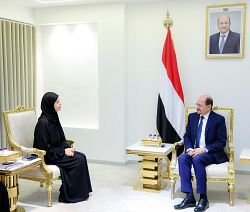
Yemen’s Prime Minister and Foreign Minister, Dr. Shaya Mohsen al-Zindani, received Christine Cipolla, head of the International Committee of the Red Cross delegation to Yemen, in Aden in late June 2026 for talks on the final steps required to carry out the detainee exchange agreed between the parties to the conflict. The state news agency Saba reported at the time that the two reviewed the procedures the ICRC was completing before transfers could begin, and that the Prime Minister used the meeting to restate the government’s position that the release of prisoners, detainees and forcibly disappeared civilians is at once a humanitarian obligation and a national priority.
According to that report, al-Zindani thanked the ICRC for the role it plays as a neutral intermediary in Yemen, singling out its work on detention files and its access to people held by both sides. He also argued that sustained international pressure remained necessary to keep the Houthi movement engaged in the humanitarian track, a characterisation that reflects the government’s own reading of the negotiations rather than an independently established fact. Talks on detainees have stalled repeatedly over the past decade, usually over the composition of the lists each side is willing to accept.
Cipolla, for her part, briefed the Prime Minister on where the ICRC’s preparations stood. The organisation had already said publicly that it was ready to move once the parties gave the word. “We are ready and determined to carry out the release, transfer and repatriation of detainees so that people separated from their families can be reunited in a safe and dignified manner,” Cipolla said in a statement issued by the ICRC after the agreement was reached.
That agreement was concluded in Amman in May 2026 and provides for the release of more than 1,600 detainees held by the internationally recognised government and by the Houthi authorities. If implemented in full it would be the largest single exchange since the war began, exceeding the roughly 900 detainees freed in the exchange carried out in April 2023 under arrangements brokered with United Nations and ICRC involvement. The Amman round was the product of months of indirect negotiation, and the number of names involved is one reason the logistics have taken time to settle.
The ICRC’s role in operations of this kind is procedural rather than political. It does not negotiate the lists, but it is the body the parties trust to verify identities, carry out medical checks, register those being freed and organise the flights and road convoys that move them between areas under opposing control. Every detainee is asked to confirm, in private, that they wish to be transferred. That sequence is deliberately slow, and it explains why an agreement announced in one month may not produce departures for several more.
For Yemeni families, the practical consequence is measured in years. Many of those covered by the agreement were captured early in the war and have had little or no contact with relatives since. The ICRC’s family-links service, which relays messages between detainees and their households across front lines, has for long stretches been the only channel available. Officials on both sides have periodically published partial lists, but there is no comprehensive public register of who is held where, and independent verification of the totals is not possible.
The meeting also came at a moment of transition in the Yemeni government itself. The Presidential Leadership Council accepted the resignation of Prime Minister Salem Saleh bin Braik on 15 January 2026 and named al-Zindani in his place; he took office the following month while retaining the foreign affairs portfolio he had held since March 2024. Combining the two posts has concentrated the humanitarian file, which is negotiated largely through foreign governments and international organisations, in a single office.
The backdrop against which the exchange is being arranged has continued to deteriorate. The United Nations Office for the Coordination of Humanitarian Affairs estimated that 22.3 million people in Yemen would need humanitarian assistance or protection during 2026, and aid agencies appealed for 2.16 billion dollars to reach a prioritised caseload of about 12 million. By early May 2026 that appeal was only around 12.7 per cent funded, a shortfall the agencies said was already forcing them to narrow programmes rather than expand them. Detention work is a small line within that budget, but it depends on the same logistical footprint as food and medical operations.
Alongside its detention visits, the ICRC in Yemen supports hospitals and primary health facilities, repairs urban water and sanitation systems damaged by fighting, and provides support to people displaced by front-line movement. Access is negotiated separately in each area of control, and the organisation’s willingness to describe that access publicly is limited by the neutrality that makes it useful to both sides in the first place.
None of this guarantees delivery. Previous exchanges in Yemen have been announced, delayed, partially executed and renegotiated, and the government and the Houthis have each accused the other of adding or withdrawing names late in the process. What the Aden meeting established was narrower and more concrete: that the technical preparations were largely complete, and that the remaining decisions rested with the parties rather than with the intermediary.
About the Author