Morocco Stuns the Netherlands on Penalties to Reach World Cup Last 16
 Yemen Herald News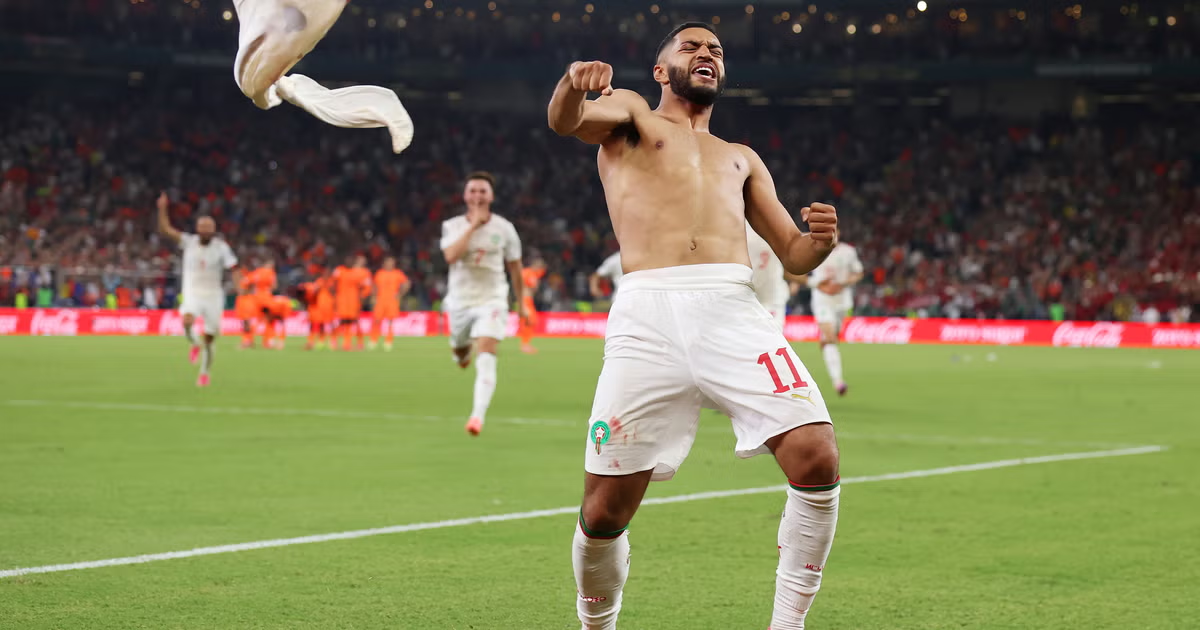
Monterrey, Mexico — Morocco produced one of the most dramatic results of the 2026 FIFA World Cup on Monday night, recovering from a goal down deep into stoppage time to defeat the Netherlands 3-2 on penalties and book their place in the round of 16. The round-of-32 tie at Estadio Monterrey finished 1-1 after extra time, but it was the Atlas Lions who held their nerve from the spot to send one of European football’s most storied sides home at the earliest knockout stage of the tournament.
For long stretches it had looked as though the Netherlands would advance with relative comfort. Ronald Koeman’s side controlled possession and territory through the middle of the second half, and their pressure was rewarded in the 72nd minute when Cody Gakpo found space inside the area and finished low past Yassine Bounou. With less than twenty minutes remaining and the Dutch defence looking secure, the favourites appeared to be cruising toward the last 16.
Morocco, however, have built their recent reputation on refusing to accept defeat. Coach Mohamed Ouahbi turned to his bench in search of a spark, and the changes paid off in the most dramatic fashion imaginable. In the first minute of stoppage time, substitute Chemsdine Talbi swung a deep, hanging cross toward the far post, and centre-back Issa Diop rose highest to power a header beyond the Dutch goalkeeper. The 91st-minute equaliser stunned the Netherlands and forced the match into an additional thirty minutes.
Extra time produced nervous moments at both ends but no breakthrough, and the tie moved to a penalty shootout — a stage at which Morocco have written some of the proudest chapters in their footballing history. Bounou, who had already kept his side level with a series of important saves, once again proved to be the difference. With the shootout finely balanced, the goalkeeper dived to his right to keep out Crysencio Summerville’s effort, the Netherlands’ fourth penalty, and handed his country the decisive advantage.
That left Ismael Saibari with the opportunity to settle it. The striker stepped forward and drove his penalty low into the corner, sealing a 3-2 shootout victory and sparking jubilant celebrations among the Moroccan players and the large contingent of supporters inside Estadio Monterrey. For the Netherlands, the defeat marked their earliest exit from a World Cup in the nation’s history, a sobering outcome for a country that has contested three finals and long counted itself among the game’s elite.
For Bounou, the save carried strong echoes of the recent past. At the 2022 World Cup in Qatar, the goalkeeper was the hero of Morocco’s round-of-16 shootout win over Spain, saving two penalties as the Atlas Lions advanced to the quarter-finals. His latest intervention only reinforced his standing as one of the modern game’s most reliable goalkeepers in high-pressure situations, and underlined why Morocco have become so difficult to eliminate once a knockout tie is level and the tension begins to build.
That 2022 campaign, guided by then-coach Walid Regragui, transformed the perception of Moroccan and African football. The team became the first African and the first Arab nation to reach a World Cup semi-final, defeating Belgium in the group stage, Spain in the round of 16 and Portugal in the quarter-finals before falling to eventual finalists France. Morocco ultimately finished fourth in Qatar, but the run reshaped expectations for a side that now arrives at major tournaments genuinely believing it can compete with, and beat, anyone.
Monday’s victory suggested that belief has survived a significant change on the touchline. Ouahbi, a Belgium-born coach, succeeded Regragui only in March 2026, just a few months before the finals began. He arrived with considerable momentum of his own, having guided Morocco’s under-20 side to the FIFA U-20 World Cup title in 2025 with a 2-0 win over Argentina in the final. Tasked with preserving the standards set in Qatar, he has now overseen one of the senior team’s most significant knockout results, and done so in his first World Cup as the man in charge.
The result also arrived in a tournament unlike any that preceded it. The 2026 World Cup, co-hosted by Canada, Mexico and the United States, is the first to feature 48 teams, expanded from 32, with twelve groups of four and an additional knockout round in the form of the round of 32. The new structure means the eventual champions will need to win more matches than ever before to lift the trophy. Morocco’s progress through that longer and more demanding path is a measure of their durability as much as their undoubted quality.
The win is likely to resonate well beyond the stadium. Morocco’s deep tournament runs have become a source of pride across Africa and the Arab world, drawing huge audiences from Rabat to Sanaa and turning the Atlas Lions into one of international football’s most widely supported sides. Each victory over a European heavyweight adds weight to the argument that the historic gap between the traditional powers and the rest of the world has narrowed considerably, and that the balance of the global game is continuing to shift.
Attention now turns to the round of 16, where Morocco will face co-hosts Canada in front of what is certain to be a partisan crowd. The Atlas Lions will carry the momentum of a remarkable comeback and the confidence of a team that has, once again, found a way to win when the margins were at their very finest. Having eliminated the Netherlands, they will fear no one as the tournament narrows toward its latter stages.
For the Netherlands, there is only the long journey home and the difficult task of explaining how a campaign that promised so much unravelled so suddenly. Koeman’s players will reflect on a night when they led with under twenty minutes to play and still could not see it through, undone by a stoppage-time header and a goalkeeper who has made the penalty shootout his own. In Monterrey, on a charged Monday night, Morocco once again proved that they belong on football’s biggest stage — and that, for opponents who underestimate them, the consequences can be severe.
About the Author