Yemen and Jordan Review Bilateral Ties and Regional Developments in Amman Talks
 Yemen Herald News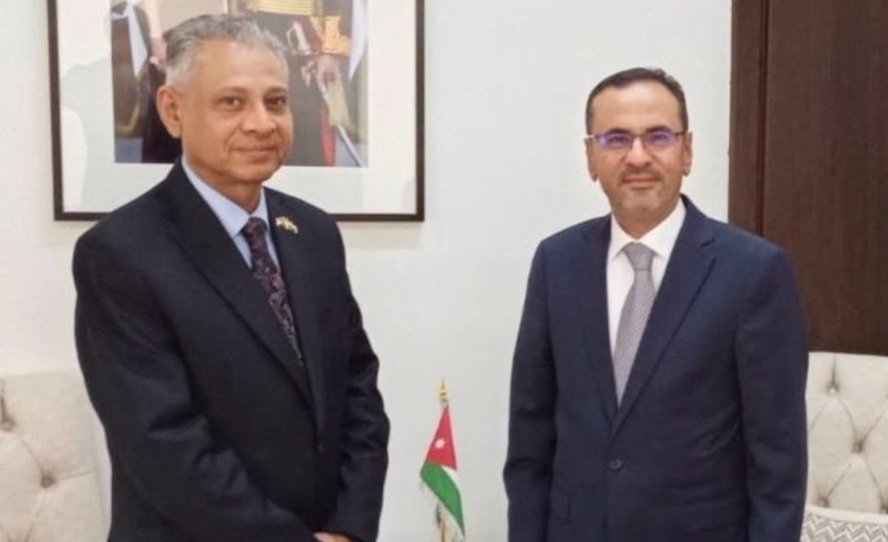
Senior diplomats from Yemen and Jordan met in Amman on Sunday to review the state of bilateral relations, discuss regional developments and explore initiatives aimed at supporting peace and stability in Yemen. The talks brought together Yemen’s Ambassador to Jordan, Dr. Jalal Faqira, and Shaker Al-Amoush, who heads the Arab and Middle East Department at Jordan’s Ministry of Foreign Affairs and Expatriates, continuing a series of exchanges between the two governments in recent months.
Ambassador Faqira briefed his Jordanian counterpart on the situation inside Yemen, focusing on what the government describes as Iranian interference in the country’s affairs. Yemeni officials assert that Tehran’s support for the Houthi movement undermines national sovereignty and poses a threat to both regional and global security, a concern that has sharpened as confrontation between Iran and its adversaries has spread across the region’s waterways in recent weeks.
A significant portion of the dialogue concerned humanitarian issues. Faqira expressed the government’s support for Jordan’s proposal to reinstate humanitarian flights between Sanaa and Amman, an initiative viewed as a practical way to ease travel for Yemeni citizens, particularly those needing urgent medical treatment abroad. The route, when it has operated, has served as a lifeline for patients, students and families separated by the conflict, and its resumption has taken on added urgency as Yemen’s economy deteriorates.
Faqira said, however, that the Houthi militia, which controls Sanaa and much of northern Yemen, has consistently rebuffed proposals designed to relieve humanitarian distress, including measures intended to improve civilian mobility and ease hardship in areas under its control. The government argues that this pattern of refusal prolongs the suffering of ordinary Yemenis and casts doubt on the group’s willingness to engage constructively in peace efforts. The Houthis, for their part, have blamed restrictions imposed by the Saudi-led coalition for the country’s isolation.
In response, Al-Amoush reiterated Jordan’s steadfast support for Yemen’s Presidential Leadership Council, the executive body that has led the internationally recognized government since 2022, and for the government based in Aden. He emphasized the importance of preserving Yemen’s unity, sovereignty and territorial integrity, and said Jordan’s backing extends beyond diplomatic statements to active participation in regional and international efforts to reach a lasting political resolution.
The meeting fits a pattern of steady engagement between Amman and the Yemeni government. Ambassador Faqira has held a series of talks with Jordanian officials covering cooperation in energy, health, industry and capacity building, reflecting a relationship that both sides describe as brotherly and that Jordan has maintained throughout the years of Yemen’s conflict.
Jordan has also positioned itself as a host and facilitator for Yemen-related diplomacy over the years, welcoming rounds of talks among Yemeni factions and serving as a base for international organizations working on the crisis. Amman’s geographic distance from the front lines, combined with its ties to both Gulf capitals and Western partners, has made it a convenient meeting ground, and Jordanian officials have repeatedly stressed their readiness to support any process that could end the war through negotiation rather than force.
Yemen has been mired in civil war since 2015, when a Saudi-led coalition intervened after the Houthis seized the capital. The conflict has devastated the economy, split the country’s institutions and produced one of the world’s most severe humanitarian crises. More than 18 million people are estimated to need humanitarian assistance, and over 4.5 million Yemenis are displaced within the country. Recurrent outbreaks of cholera and measles have compounded the emergency, straining a health system that functions only partially after years of war.
The stakes extend well beyond Yemen’s borders. The country sits astride the Bab al-Mandeb Strait, the maritime chokepoint linking the Red Sea to the Gulf of Aden and one of the world’s most important trade corridors. Instability in Yemen therefore reverberates through global shipping and energy markets, a reality underscored this week when the Houthis declared a maritime blockade of Saudi shipping in the Red Sea amid the widening confrontation between the United States and Iran. For Jordan, whose port of Aqaba depends on safe Red Sea navigation, the security of these waters is a direct national interest.
Iran’s role as the Houthis’ principal backer complicates every dimension of the crisis. Neighboring states have repeatedly raised alarms about the transfer of weapons and expertise to the group, and global powers invested in Middle Eastern stability have taken a closer interest as attacks on shipping have multiplied. Diplomatic engagement among Arab states, of the kind on display in Amman, is partly an effort to coordinate responses to that shared challenge.
The outlook for Yemen remains precarious as stakeholders navigate the intersection of local governance and international rivalry. Diplomats caution that lasting peace will depend on the willingness of all parties, including the Houthis, to engage in dialogue and accept arrangements that prioritize humanitarian relief and open a path to a political settlement under United Nations auspices.
Sunday’s meeting nonetheless represents a positive step in sustaining regional attention on Yemen’s plight. Continued dialogue between Sanaa’s internationally recognized representatives and their Arab partners keeps humanitarian initiatives such as the Amman flights proposal alive, and it reinforces the diplomatic scaffolding that any future settlement will require. For millions of Yemenis enduring the daily consequences of war, the value of such engagement will ultimately be measured by whether it eases their hardship and brings a stable, peaceful future closer.
About the Author