
Yemen’s Water Minister and the OECD Explore Cooperation on Water and Climate Resilience
 Yemen Herald News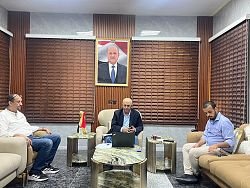
Yemen’s Minister of Water and Environment, Engineer Tawfiq al-Sharjabi, held a virtual meeting with representatives of the Organisation for Economic Co-operation and Development to discuss ways of strengthening cooperation on water resource management and climate adaptation. He was joined in the conversation by Mohamed Baraka, who oversees an OECD project on enhancing economic resilience in Yemen, and by policy analyst Seema Farah. The talks centred on how international expertise might help Yemen confront a deepening water crisis that has become inseparable from the country’s wider humanitarian emergency.
During the meeting, al-Sharjabi outlined the scale of the difficulties facing Yemen’s water sector. The country depends heavily on groundwater as its main source of supply, and those reserves are under mounting pressure from overextraction and prolonged drought. The minister noted that deteriorating infrastructure, the high operating costs of water facilities and a shortage of reliable energy to run them had combined to push an already fragile system toward breaking point.
Among the priorities he identified were expanding the use of renewable energy to power water facilities, which would reduce dependence on costly and unreliable fuel supplies, and introducing measures to improve water-use efficiency. Such steps, he argued, are essential to slowing the advance of water scarcity, a problem that threatens livelihoods, agriculture and public health across much of the country.
Al-Sharjabi also emphasised that water and environmental considerations must be woven into Yemen’s broader plans for economic recovery rather than treated as separate concerns. He described a comprehensive approach in which water infrastructure is designed both to meet the population’s immediate needs and to withstand the long-term effects of climate change. Partnerships with international organisations, he said, would be central to building the technical capacity and institutional resilience the sector requires after years of neglect and disruption.
For their part, the OECD representatives expressed interest in exploring how their organisation’s analytical tools and policy experience might support Yemen’s efforts, framing the exchange as an early step toward more structured collaboration. The OECD’s involvement in Yemen has centred on economic resilience, and officials indicated that safeguarding water resources fits naturally within that agenda, given how closely the resource is tied to food production, health and livelihoods.
The dialogue unfolds against a humanitarian backdrop that remains among the most severe in the world. Aid agencies estimate that roughly 19.5 million people in Yemen need some form of assistance in 2025, an increase over the previous year, while around 17.4 million lack adequate access to safe water, sanitation and hygiene services. Years of conflict have displaced millions internally, and the collapse of essential services has left families struggling to secure even the most basic necessities, including clean drinking water.
The consequences of that breakdown are visible in public health. Yemen has endured repeated outbreaks of cholera and other waterborne diseases, with tens of thousands of suspected cases reported in recent monitoring periods and scores of associated deaths. Children are especially vulnerable, as contaminated water and damaged sanitation systems create conditions in which illness spreads rapidly. The link between failing water services and preventable disease has made the water sector a frontline concern for humanitarian agencies as much as for the government. Yemen’s cholera epidemic that began in 2016 grew into one of the largest ever documented, with well over a million suspected cases, a stark warning of what can happen when clean water and sanitation collapse.
That intertwining of crises helps explain why the minister framed water security not merely as a technical challenge but as a foundation for stability. The war has fragmented institutions and stretched budgets, making coordinated, internationally supported initiatives harder to deliver even as the need for them grows. In this context, effective water management amounts to more than the distribution of a scarce resource; it is closely tied to questions of public health, economic revival and social cohesion.
The complexity of the Yemeni situation demands innovative and adaptable approaches, and engagement with bodies such as the OECD offers one avenue for bringing outside expertise to bear. Whether such cooperation can translate into tangible improvements will depend on sustained commitment and financing, but the meeting signalled an intent to treat water security as a cornerstone of Yemen’s longer-term recovery rather than a problem to be addressed only in emergencies.
Yemen ranks among the most water-stressed countries in the world, a reality that predates the current conflict but has been sharply worsened by it. Decades of intensive groundwater extraction, much of it for agriculture, including the widespread cultivation of the mild stimulant qat, have drawn down aquifers faster than they can recharge. The country’s limited rainfall offers little natural replenishment, and rising temperatures linked to climate change threaten to accelerate the depletion of reserves on which millions depend.
For a nation where the capital and other cities have long been cited as among the first in the world at risk of running critically short of water, the stakes of the discussion could hardly be higher. The meeting with the OECD will not, by itself, reverse those trends, but it reflects a recognition within the government that outside partnerships and modern management practices will be indispensable if Yemen is to slow the crisis and begin, however gradually, to build a more resilient and sustainable water future.
About the Author




