Yemen’s planning minister and British Ambassador Abda Sharif discuss humanitarian cooperation
 Yemen Herald News
ADEN, Yemen — Yemen’s planning minister discussed humanitarian and development cooperation with Britain’s ambassador in a video call on Thursday, the state news agency Saba said.
Mohammed al-Faqmi, the minister of planning and international cooperation, spoke with Abda Sharif, Britain’s ambassador to Yemen, according to the agency.
Al-Faqmi set out what he described as the humanitarian consequences of the recent military escalation, Saba reported.
The account of the call rests on that report. Yemen Herald found no independent confirmation of it, and neither the ministry nor the British embassy has published its own readout.
The Houthis made no public comment on the call.
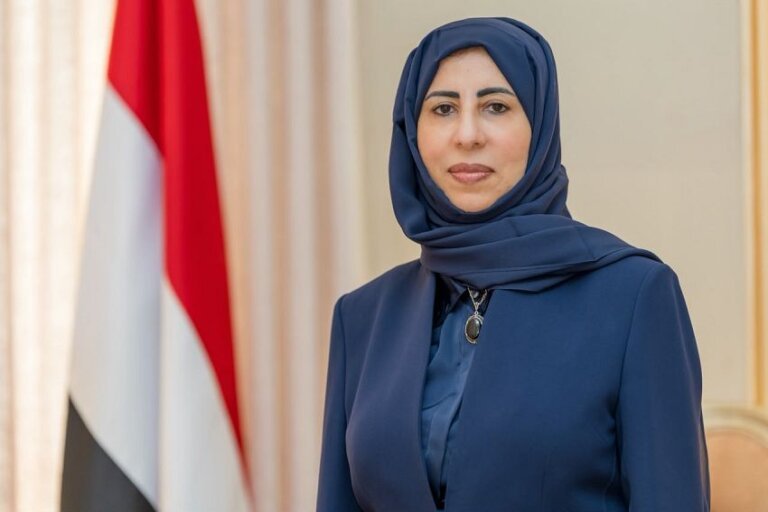
Sharif, a lawyer by training, was named Britain’s ambassador to Yemen by the Foreign, Commonwealth and Development Office.
Al-Faqmi is also Yemen’s governor at the Islamic Development Bank. He met the bank’s chairman, Muhammad Al Jasser, on the sidelines of the 2026 World Bank Group meetings, the bank said.
Britain announced 10 million pounds in humanitarian funding for Yemen on Sept. 25.
The Foreign, Commonwealth and Development Office said the money would be channelled through the United Nations emergency appeal for Yemen.
It allocated 5.5 million pounds to the World Food Programme, 3.5 million pounds to UNICEF and 1 million pounds to the International Organization for Migration.
The department said the package was intended to reach 30,000 children with nutrition support, 35,000 women and children with emergency health care, and 10,000 children with vaccines.
It said the money would support civilians displaced by the fighting in areas held by the government, and estimated at the time that more than 130,000 Yemenis had been displaced.
“The Houthis’ decision to escalate the conflict in Yemen is having a devastating impact,” Stephen Doughty, the minister for the Middle East, said in that announcement.
Doughty said Britain condemned what he called the Houthis’ resumption of hostilities after years of efforts to secure progress through dialogue.
Britain and Bahrain called for an urgent meeting of the Security Council, the department said.
The department said the funding formed part of a 104 million pound aid allocation for Yemen announced in June.
Britain told the Security Council in June that it had provided more than 190 million dollars toward the humanitarian response in Yemen.
The call came as United Nations agencies reported that supplies were not reaching Taiz.
The World Food Programme said more than 800,000 people in the city had been cut off from assistance, among them 600,000 who depend on aid and 200,000 women and children.
“We’re desperately trying to regain access to Taiz,” said Azfar Deen, a regional communications officer for the World Food Programme.
“It’s 20 days and counting since Taiz has been cut off,” Jens Laerke, a spokesperson for the UN aid coordination office, said on Oct. 23.
Laerke said access roads were closed and that little fuel, food or other supplies had reached the city.
He said water production in Taiz had fallen by about half and that the cost of trucked water had roughly tripled.
The current closure dates to the first week of October, after Houthi forces advanced in the countryside around the city, Al Jazeera reported.
Amnesty International called on the Houthis to reopen the main road between Taiz and Aden.
The World Health Organization said on Oct. 22 that 42 health facilities in Taiz city reported severe shortages of essential supplies.
It said hospitals and ambulances in the city need at least 156,000 litres of fuel a month.
The Taiz health office said on Oct. 12 that 1,110 kidney failure patients in the governorate depend on dialysis, and that its hospitals provide about 210 sessions a day.
The dialysis centre at the Republican Hospital serves 270 regular patients. Essam Mahyoub Dahan, who directs it, said sessions had been cut from four hours to two and a half.
Shaheed al-Ameri, a deputy director-general at the hospital, said diesel stocks ran out early in the closure and that fuel is now bought on the black market at about five times its earlier price.
Taiz was under a complete Houthi siege from 2015 to 2016.
UNICEF said it had screened more than 168,000 children in Taiz this year and found more than 52,000 acutely malnourished, including more than 11,500 with severe acute malnutrition.
The agency said it had pre-positioned nearly 8,000 cartons of ready-to-use therapeutic food, about three months of supply.
Ricardo Pires, a UNICEF spokesperson, said access constraints and disruptions to supply routes could make it harder for partners to move supplies and for families to reach treatment.
The International Organization for Migration recorded about 258,679 people displaced between June 7 and Oct. 19, mostly in Taiz and Lahj governorates.
It said 3,836 Yemeni nationals had arrived in Djibouti as of Oct. 17.
United Nations reporting put the toll since August at at least 1,574 people killed and 6,939 injured.
The humanitarian response plan published in March estimated that more than 22 million people in Yemen needed assistance and that 18.3 million were acutely food insecure.
The plan recorded 5.2 million people displaced inside the country and sought 2.16 billion dollars to reach 12 million of them.
Yemen’s internationally recognised government operates from Aden. The Houthis have administered Sanaa since 2014.
Al-Faqmi took the constitutional oath before the president after a presidential decree appointed him to the planning post.
About the Author