
Yemen’s Prime Minister and UNOPS Review Projects to Restore Electricity, Water and Health Services
 Yemen Herald News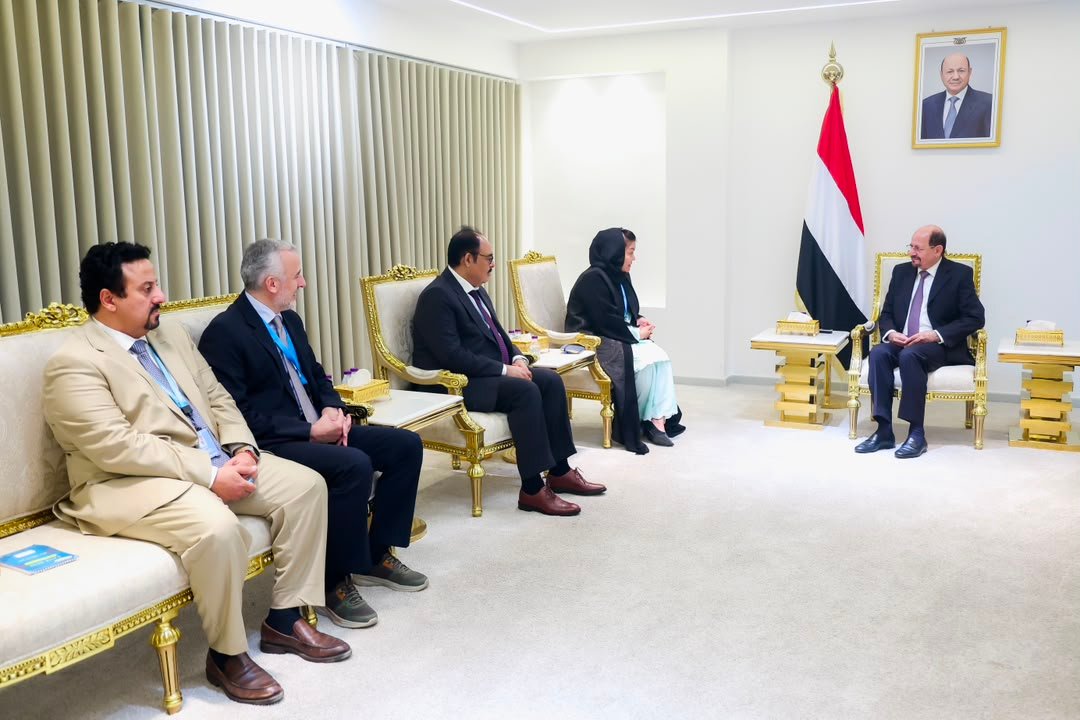
Yemen’s Prime Minister and Foreign Minister, Shaya Mohsin al-Zindani, met the head of the United Nations Office for Project Services (UNOPS) in Yemen in the interim capital of Aden to review development projects aimed at restoring the country’s battered infrastructure and essential services. The talks, held as Yemen continues to grapple with the effects of a war that has raged since 2015, centred on current and planned initiatives across electricity, water, health and education, sectors that officials on both sides described as vital to any meaningful recovery.
The meeting reflected the priorities of a government reconstituted in early 2026 under a cabinet led by al-Zindani, who retained the foreign affairs portfolio when he took office. The administration, which is internationally recognised and backed by a Saudi-led coalition, has been working to establish itself in Aden while contending with a deep economic crisis and fragmented control over the country’s territory. Rebuilding basic services is central to its claim to govern effectively.
UNOPS has become one of the more visible United Nations actors in Yemen’s reconstruction, implementing projects funded largely by the World Bank and other international donors. Its work spans two broad emergency programmes: one focused on restoring urban services such as water and sanitation, solid waste management and electricity, and another aimed at extending electricity access to rural and peri-urban communities that lie beyond the reach of the national grid.
The results of that work have been substantial in a country where public services have all but collapsed in many areas. Through its emergency electricity programme, funded by the World Bank’s International Development Association, UNOPS says it has powered 235 health centres, 59 hospitals, 62 schools and 88 water wells using renewable energy, reaching communities that had gone years without a reliable supply. Solar systems in particular have allowed clinics to refrigerate vaccines and medicines, run essential equipment and keep operating theatres functioning after dark.
The agency estimates that more than 4.8 million people in rural and peri-urban areas have benefited from improved access to essential services through the programme, while the shift to renewable energy prevents over 15,000 tonnes of carbon dioxide emissions each year. More than 110 solar water-pumping systems have also been installed, helping supply clean water to communities that had relied on costly and erratic alternatives. In Aden, rehabilitated roads have cut travel times and eased access to services and humanitarian aid.
During the meeting, al-Zindani welcomed the results achieved so far and aligned them with the government’s own recovery priorities. He expressed a determination to strengthen cooperation with UNOPS and other bodies so that aid is channelled toward the projects Yemenis need most urgently, singling out electricity, water supply, health facilities and education as priorities for the next phase of work. Coordinated planning, he suggested, would help ensure that limited resources produce lasting results.
The head of the UNOPS office, for her part, stressed the importance of close coordination between the government and the agency to ensure that funding is allocated to projects capable of delivering durable benefits. Both sides framed the challenge as one of not merely meeting immediate needs but of building sustainable systems that can support longer-term development. Reliable electricity and clean water, they argued, are prerequisites for functioning hospitals and schools and for any broader effort to stabilise the country.
The government has also cast institutional reform as part of the effort, arguing that stronger state capacity is needed to absorb international assistance efficiently and to maintain the infrastructure that donors help build. Without functioning institutions to operate and repair new systems, officials warned, even well-funded projects risk falling into disrepair once external support recedes, repeating a cycle that has undermined earlier interventions.
Those ambitions are set against a punishing economic backdrop. Years of conflict have shattered the economy, weakened the currency and driven up the cost of food, fuel and other essentials, eroding the ability of many families to afford basic goods. Public-sector salaries have gone unpaid or been paid only irregularly in parts of the country, adding to the strain on the very services that UNOPS and other agencies are trying to shore up.
The stakes are considerable. The United Nations has repeatedly described Yemen as one of the world’s gravest humanitarian crises, with a large share of the population requiring assistance and millions displaced from their homes. Damaged power plants, degraded water networks and overstretched hospitals have left communities dependent on emergency support, and restoring these systems is widely seen as essential to reducing that dependence over time.
Looking ahead, UNOPS has set out expanded targets for its solar programme, aiming eventually to bring renewable power to some 250 health centres, 100 schools, 200 water wells and around 200,000 households across the country. Meeting those goals would extend reliable electricity to a far larger share of the population, but it depends on sustained donor financing and on a security environment stable enough to allow engineers and contractors to work safely in contested areas.
For a government trying to demonstrate that it can deliver tangible improvements to daily life, partnerships such as the one with UNOPS offer both practical benefits and political value. Whether the projects discussed in Aden can be scaled up quickly enough to keep pace with the country’s needs remains uncertain, but officials on both sides presented continued cooperation as one of the more promising avenues for turning international support into durable gains for ordinary Yemenis.
About the Author




