
Aden University and Germany’s University of Rostock Explore Academic Ties
 Yemen Herald News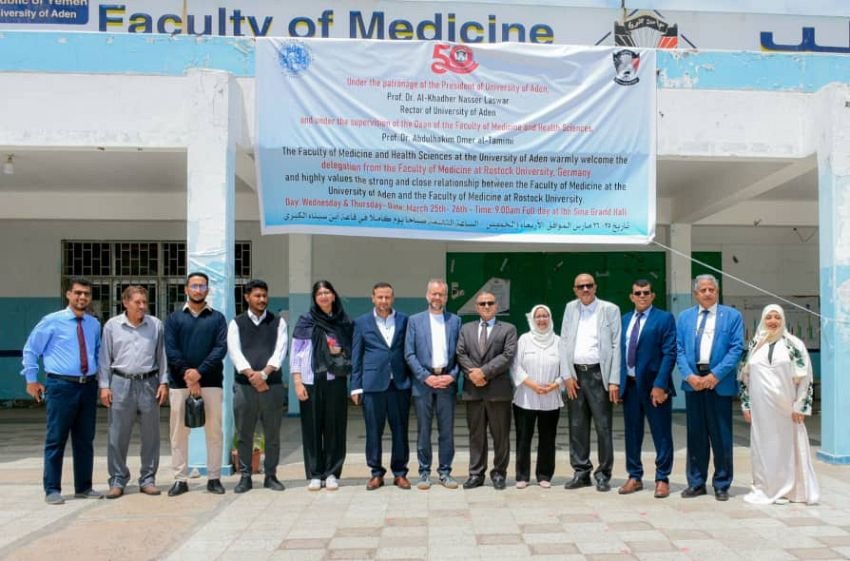
The University of Aden has opened discussions with a visiting delegation from Germany’s University of Rostock to explore academic cooperation between the two institutions. The meeting, held on Tuesday, was led by the President of the University of Aden, Dr. al-Khadr Lasour, and included Dr. Mark Philipp, a consultant in gastrointestinal surgery from the University Hospital of Rostock, signalling a particular interest in cooperation in the medical field.
The talks focused on establishing internship programmes and strengthening academic collaboration between the universities. Among the possibilities discussed were the exchange of academic visits, the implementation of joint research projects and the development of training and skills programmes designed to benefit students and staff at both institutions, laying the groundwork for a durable partnership.
Dr. Lasour underlined the University of Aden’s commitment to building partnerships with reputable institutions such as the University of Rostock. He expressed a strong interest in developing academic cooperation and internship opportunities that would enrich the educational experience of students, offering them exposure to international expertise and practice at a difficult moment for Yemeni higher education.
The German delegation, for its part, signalled openness to collaboration, reflecting a willingness among some international institutions to engage with Yemeni counterparts despite the challenges posed by the country’s circumstances. Such engagement can provide Yemeni universities with valuable links to the wider academic world at a time when isolation has been one of the many costs of the conflict.
The University of Aden is one of Yemen’s most important institutions of higher learning, serving large numbers of students across a range of disciplines. As the principal university in the interim capital, it occupies a central place in the country’s academic life, and its health and development carry implications for the education of a generation whose prospects have been shaped by years of war.
Yemen’s higher education sector has suffered considerably during the conflict. Universities have contended with damaged facilities, strained budgets, interrupted studies and the departure of qualified academics, while students have faced disrupted schedules and diminished opportunities. Against this backdrop, partnerships with foreign institutions offer a means of sustaining standards and reconnecting with international scholarship.
The focus on medical cooperation, underscored by the participation of a surgeon from Rostock’s university hospital, is particularly significant. Yemen’s health system has been devastated by the war, and strengthening medical education and training is essential to rebuilding the country’s capacity to care for its population. Academic links in this field can help train the doctors and specialists Yemen urgently needs.
The University of Rostock, one of the oldest universities in the Baltic region, brings considerable academic and medical expertise to any such partnership. Its involvement offers the University of Aden access to established research capacity and clinical experience, resources that could support the development of Yemeni programmes in medicine and other fields over time.
Internship programmes, a central theme of the discussions, offer practical benefits for students. Placements and exchanges allow young Yemenis to gain experience, develop skills and broaden their horizons, while exposure to international standards can raise the quality of education at home. Such opportunities are especially valuable in a context where local prospects have been constrained by conflict.
Joint research projects, another avenue explored in the talks, could enable scholars from both institutions to collaborate on questions of mutual interest, pooling expertise and resources. Research partnerships not only advance knowledge but also help build the reputation and capacity of participating universities, contributing to the longer-term revitalisation of Yemeni academic life.
The exchange of academic visits, meanwhile, can foster the personal relationships and institutional ties on which lasting cooperation depends. Bringing scholars and administrators together helps build mutual understanding and trust, creating the foundations for collaboration that can endure and expand beyond initial contacts and formal agreements.
For Yemen, engagement of this kind forms part of a broader effort to maintain the country’s connections with the outside world despite the disruptions of war. Cultivating relationships with international institutions, whether in education, health or other fields, helps counter the isolation that conflict imposes and keeps open channels through which knowledge, expertise and support can flow.
The development of training and skills programmes, also discussed, speaks to the practical needs of a country seeking to rebuild. Equipping students and professionals with relevant skills is essential to recovery, and cooperation with experienced foreign institutions can help ensure that such training meets international standards and addresses the country’s requirements.
Whether the discussions translate into concrete programmes will depend on follow-through and on the ability of both sides to navigate the practical challenges involved. Academic partnerships require sustained commitment, funding and coordination, and the circumstances in Yemen add further complexity. Nonetheless, the willingness to engage represents an encouraging starting point.
The prospective partnership also carries a symbolic dimension, signalling that Yemeni academic institutions remain active participants in the international scholarly community despite the strains of conflict. For students weighing their futures amid uncertainty, evidence that their university is forging ties with respected foreign institutions can offer a measure of encouragement, suggesting that avenues for advancement and exchange endure even in difficult times.
For now, the talks between the University of Aden and the University of Rostock reflected a shared interest in building bridges between Yemeni and German higher education. As Yemen looks toward eventual recovery, investments in education and in international academic cooperation may prove among the more valuable, helping to prepare the skilled graduates on whom the country’s future will ultimately depend.
About the Author




