Aid agencies say Taiz water output has halved as cholera cases triple
 Yemen Herald News
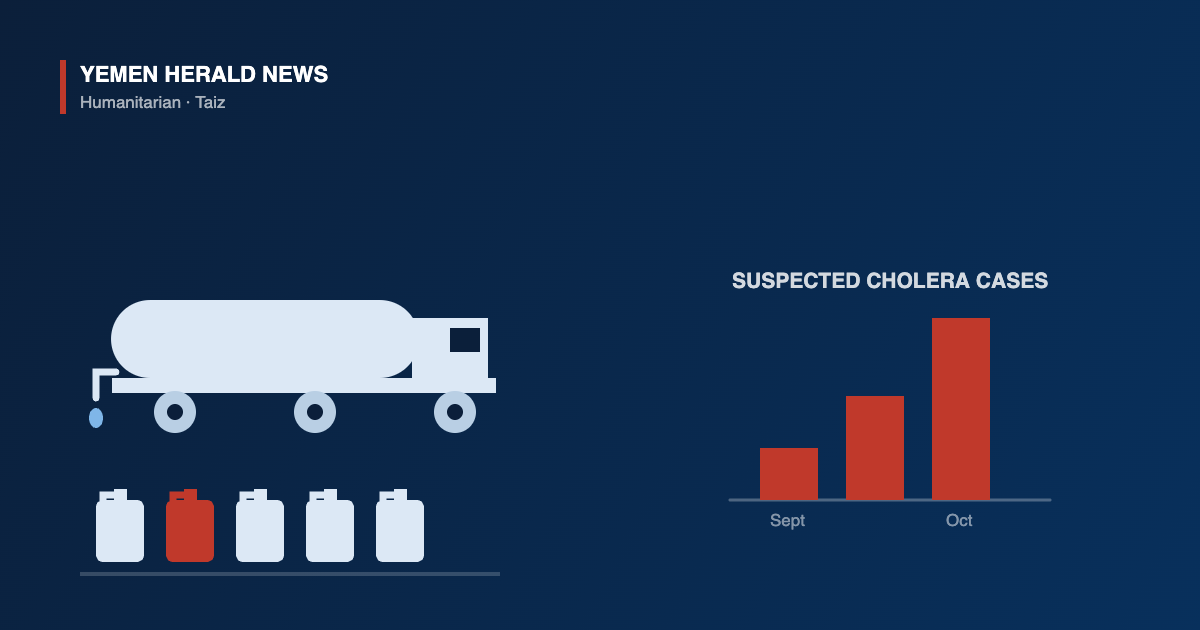
TAIZ, Yemen — Water production in Yemen’s third-largest city has dropped by about half and sanitation workers are burning rubbish in the streets, aid agencies said Wednesday.
Save the Children reported the fall in water production in Taiz, which Houthi forces have encircled since fighting escalated in September.
Akhil Iyer, UNICEF’s representative in Yemen, said diesel shortages had disabled pumping stations and sanitation systems across the governorate.
Most residents now depend on water delivered by truck.
The cost of a water truck has risen from about 23,000 rials, or $14.80, before the escalation to about 70,000 rials, or $45, according to UNICEF.
Wathiq Aghbari, director general of the Local Water and Sanitation Authority in Taiz governorate, said access to the Al-Dhubab aquifer had been restricted. The aquifer is a main source of trucked water for the city.
Aid groups are examining a shallow aquifer west of Taiz as an alternative, Reuters reported.
Alaa Khalil, a resident, described waiting for a turn at a distribution point. “I get the water with difficulty. We wait in queues from the morning until our turn comes,” she said.
Rubbish has piled up along roads through the city.
Ali Ahmed, a sanitation worker, said crews could no longer reach the main dumping site because of clashes, and were burning waste in the streets instead.
“The state of the rubbish in the city is very wretched, and the build-up is terrible, like nothing before,” said Abdelbari al-Qadi, another resident.
Abdulrahman al-Sabri, director of the Taiz Governorate Health Office, said dengue fever and cholera were spreading.
“The build-up of rubbish is very harmful and will cause diseases, whether respiratory or otherwise,” al-Sabri said.
The World Health Organization said suspected cholera cases in Taiz rose from 221 in early September to 683 in October.
The agency said hospitals were short of medicines, and that 12 facilities had about four days of fuel left.
Some families cannot reach health facilities because of the fighting, according to a doctor in the city who spoke on condition of anonymity, citing security concerns.
UNICEF said it had identified 52,000 acutely malnourished children in Taiz governorate so far this year.
Road closures have halted the agency’s deliveries of therapeutic food for severely malnourished children.
Rishana Haniffa, Save the Children’s country director for Yemen, said children were going without basic necessities. “We find children in an extremely dangerous situation where they are not able to have their basic needs satisfied,” she said.
Iman Abdullahi, CARE’s country director in Yemen, said the situation was slipping beyond control unless aid agencies could negotiate access for water tankers.
CARE said cash assistance was buying less food and water as prices rose.
Fatma Jaffar, Oxfam’s Yemen-based advocacy manager, said local staff had described an almost total siege, with the main entrances to the city blocked.
Jaffar said no fuel had entered Taiz for two or three weeks, and that Oxfam’s own staff were struggling to buy drinking water.
She said hospitals lacked medicines and that wounded people could not be moved out of the city.
Jaffar said residents were burning rubbish because it could not be taken out, and that cholera was a near-term risk.
Oxfam described the crisis as becoming unmanageable. The charity’s UK office called on Britain to increase humanitarian funding for Yemen.
Oxfam said Houthi forces had largely encircled the city, which it put at more than 900,000 people.
Fighting this week around the old airport caused damage in a densely populated residential district, the charity said.
Yemen Herald found no Houthi response to the aid agencies’ accounts. The warring parties give conflicting accounts of conditions around the city.
A 20-litre container of petrol that sold for about $20 before the escalation was going for about $80 on the black market, the Guardian reported. Potato prices have doubled.
The World Food Programme said wheat flour reserves in the city were close to exhausted in mid-October.
Fighting since September has cut supply routes into Taiz, including the corridor from Aden, according to aid groups and UN agencies.
Those agencies said the fighting had disrupted fuel supplies and access to water systems serving about 3 million people.
The UN refugee agency said more than 250,000 people have been displaced across Yemen since August.
Aid groups said Taiz governorate is hosting nearly half of them.
The Danish Refugee Council said water and sanitation problems could spread beyond the city, and that resources were strained at crowded displacement sites in Taiz, Lahj, Abyan and Aden.
Airstrikes by the internationally recognised government and the Saudi-led coalition on the Houthi-held airport in Sanaa in July broke a ceasefire agreed in 2022, according to the Guardian.
Donors have funded 23% of the United Nations humanitarian response plan for Yemen this year.
Germany has halved its aid programme for the country, and United States assistance has been cut to almost nothing.
Oxfam has moved resources out of development work and into emergency aid, including cash transfers.
UN diplomats are mediating between the two sides. Neither has signalled readiness for a ceasefire.
The United Nations has asked for aid workers to be given access to Taiz.
The Halo Trust, a landmine clearance charity, said 30 of its staff were among the civilians trapped in the city.
About the Author