Al-Alimi condemns airport attacks as he receives credentials of eight ambassadors
 Yemen Herald News
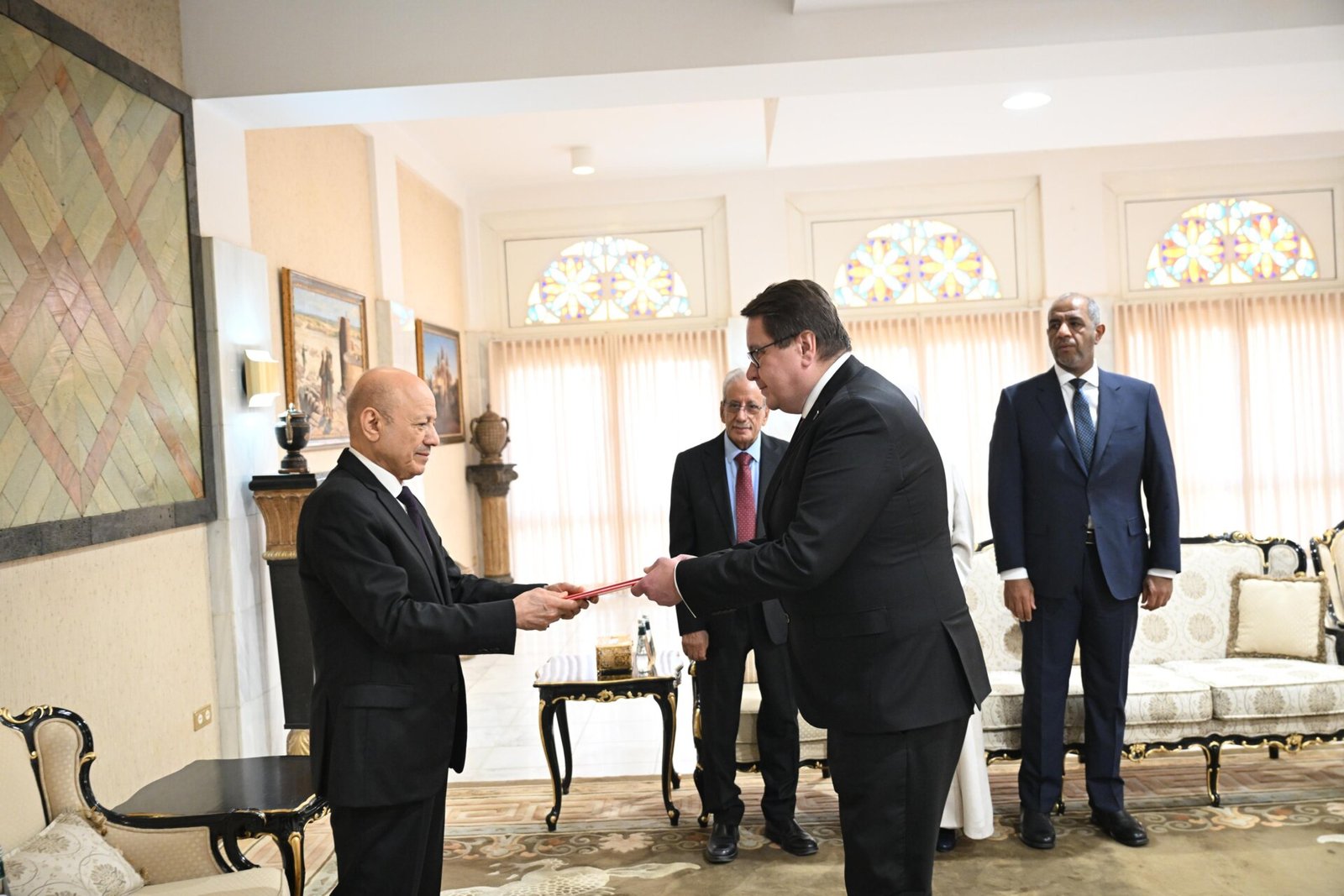
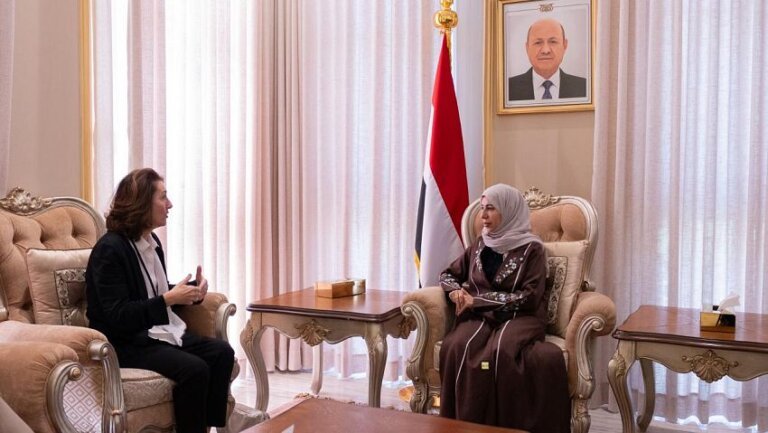
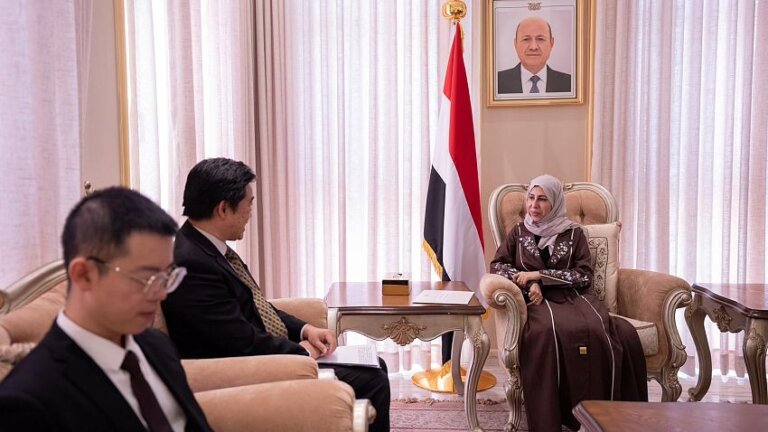
RIYADH, Saudi Arabia — Yemen’s Presidential Leadership Council chairman Rashad al-Alimi received the credentials of eight newly appointed ambassadors on Wednesday, the state news agency Saba reported.
He used the ceremony to condemn attacks on two airports in Yemen reported the same day.
Al-Alimi named Aden International Airport and al-Rayyan airport in Mukalla. He said striking civilian airports and residential areas “reveals the nature of this terrorist organization.”
He asked the envoys’ governments to back efforts to designate the Houthi movement a terrorist organization internationally.
The world came together earlier against the Islamic State group, al-Qaeda and Boko Haram, al-Alimi said. He said it should now take a single position on the Houthis.
He said the group acted with the support of the Iranian regime. The Houthis reject that characterisation, and Iran denies arming them.
Accounts of what was hit on Wednesday differ in important respects.
Col. Majed Abdullah al-Nazili, spokesman for the Yemeni armed forces, said one ballistic missile targeted Aden International Airport, according to Al Jazeera. He said three missiles hit al-Rayyan airport.
Al-Arabiya reported an explosion and smoke at Aden airport. The channel’s correspondent said the missile hit the runway.
A police official said smoke rose near the airport on Wednesday.
Two Yemeni military officials gave AFP a different description of the Mukalla attack. They said the target was a military base at al-Rayyan airport.
“The Houthis used missiles and drones to target a military base housing forces from the coalition at al-Rayyan airport,” one of the officials said. He spoke on condition of anonymity.
Yahya Saree, the Houthi military spokesman, said the group had not struck the Aden airport. He said it targeted “the Saudi enemy’s operations room in the Badr camp in Aden” with a ballistic missile.
No casualties were reported at either airport.
Neither the government nor the Saudi-led coalition had responded to the Houthi account by the time Al Jazeera published its report.
Al-Nazili said a separate attack struck a sponge factory in Beir Basha, in Taiz.
Turki al-Malki, spokesman for the Saudi-led coalition, said four drones were intercepted and destroyed. A fifth was reported intercepted in Saudi Arabia’s Eastern Province.
The Houthis denied targeting Saudi territory. Saree said the group had carried out no “deep” operations there.
Aden International Airport is the main gateway to government-held southern Yemen. Al-Rayyan airport serves Mukalla, the capital of Hadramout.
Aden airport has been struck before. Two missiles landed inside its perimeter on Friday, in an attack the Houthis claimed.
A missile strike on the presidential palace in Aden followed. Yemen’s government asked the Security Council to condemn that attack.
The ambassadors who presented credentials on Wednesday represent the Czech Republic, the Philippines, Spain, Nigeria, South Korea, France, Denmark and Cuba, Saba said.
The agency named the Czech envoy as Pavel Kafka. Kafka is the Czech Republic’s ambassador to Saudi Arabia and is accredited to Yemen from Riyadh.
Saba’s English and Arabic texts give different spellings for several of the other envoys. Yemen Herald has not reproduced those spellings.
Al-Alimi welcomed the ambassadors and asked them to convey his greetings to their heads of state, Saba said. He promised them support in carrying out their duties.
He thanked Saudi Arabia and the Saudi-led Coalition to Restore Legitimacy for backing the government’s “Yemen Dawn” operation.
The account of the ceremony rests on Saba, the government’s news agency. No independent confirmation of it has been published.
The government has pressed the designation case with several governments this month. Al-Alimi raised it with the United Nations secretary-general on October 19, Saba said.
The current escalation began on September 3, when the Houthis opened an offensive against the internationally recognised government.
Fighting has since run across Taiz, Hodeidah, al-Jawf, al-Bayda, Dhale, Marib and Lahj.
The Houthis named their September offensive “Operation God is Stronger in Might and More Severe in Punishment.”
Saudi airstrikes have hit Hodeidah, Taiz, Marib and al-Jawf. More than 100 US advisers in Saudi Arabia have provided intelligence support, CNN reported.
The Houthis say they hold the Red Sea coast except for Midi district. The government disputes that account.
Saudi-backed Yemeni forces opened an offensive near the Bab al-Mandab shipping route in early October, CNN reported.
A Houthi attack on a government training camp in Shabwa killed at least 53 people on October 19, Al Jazeera and The Washington Times reported.
The Houthis declared a naval blockade on Saudi Arabia on July 20 and went on to strike Saudi oil tankers.
Later strikes hit the Jizan refinery and Yanbu, and reached Khamis Mushait, Abha, Najran, Taif and Riyadh.
Saudi officials said 73 people were wounded in attacks on September 8.
Saudi Arabia proposed a two-week ceasefire mediated by Oman. No agreement has been announced.
The United Kingdom agreed in September to send military advisers and to help refuel Saudi jets, the BBC reported. France announced defensive support for the Red Sea shipping route, according to Reuters.
The International Organization for Migration counted about 125,000 people internally displaced by September 15. More than 2,700 had crossed to Djibouti by September 19, Al Jazeera reported.
Kafka presented copies of his letters of credence to Yemen’s foreign minister in January 2024.
About the Author