Al-Alimi asks EU states to act on European Parliament’s Houthi listing call
 Yemen Herald News
ADEN, Yemen — Yemen’s president asked European Union governments on Tuesday to act on a European Parliament call to place the Houthi movement on the bloc’s terrorist list.
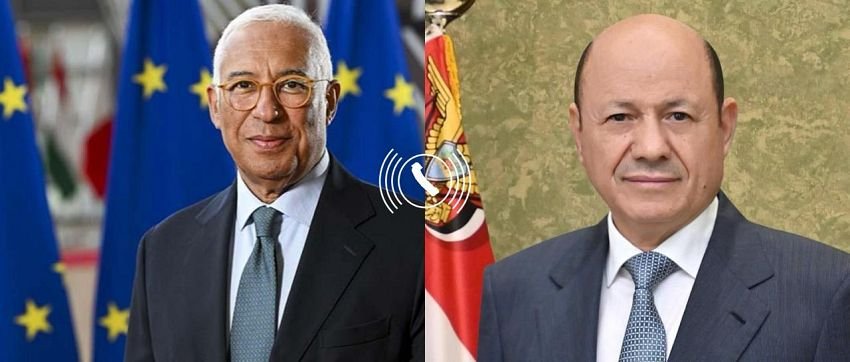
Rashad al-Alimi, chairman of the Presidential Leadership Council, made the request in a telephone call with António Costa, president of the European Council, the state news agency Saba reported.
The account of the call rests on that Saba report. Yemen Herald found no readout of the call published by the European Council, and no independent confirmation of it has been published.
Al-Alimi asked member states to adopt the Parliament’s decision promptly, the agency said.
The listing he sought would cover the movement’s political and military wings, its leadership and its security apparatus.
He said the Yemeni government was counting on the Council to rally member states behind the step, and to use legal, economic and diplomatic tools to stop Houthi attacks.
European action would cut the funding behind those attacks and give civilians, regional security and European interests more protection, he said.
Delay carries a cost, he added.
Al-Alimi listed conduct he attributed to the group: attacks on civilians, airports and vital facilities, the recruitment of children, the siege of cities, attacks on commercial shipping and the detention of United Nations and humanitarian staff.
The Houthis dispute government accounts of the war. Yemen Herald found no response from the group to the appeal.
He raised conditions in Taiz, where he said access to water, fuel and basic goods is restricted.
Al-Alimi also said state forces and allied popular resistance units were advancing in an operation the government calls Yemen Dawn.
He said the operation was intended to end what he called the terrorist threat and to restore state institutions.
Costa reaffirmed European Union support for the Presidential Leadership Council and the government, according to the agency.
The bloc wants to widen humanitarian aid to Yemen, Costa said. He pledged continued coordination with the government and with partners on priority needs.
The resolution al-Alimi referred to was adopted in Strasbourg on Oct. 22. Members approved it by a show of hands, and no vote figures were published.
It asks the Council of the European Union to add the Houthi movement to the bloc’s list of terrorist organisations, covering its political and military wings, its leadership and its military and security structures.
The step follows a proposal from Kaja Kallas, the European Union’s high representative for foreign affairs and security policy.
The text also calls for every financing channel supporting the group to be dismantled, and for funds and economic resources held by the Houthis and by those facilitating their activities to be frozen.
It asks the Houthis to halt hostilities inside and beyond Yemen’s borders and to abandon territorial ambitions.
Lasting regional stability depends on disarming and demobilising militias and other non-state armed groups, the resolution says.
Member states should contribute more naval and air assets to Operation Aspides, it says, and it welcomes the expansion of that mission’s mandate.
Aspides is the European Union’s naval mission in the Red Sea and the Gulf of Aden. It was launched in February 2024 to escort and protect commercial shipping.
The resolution condemns Iran’s supply of weapons, missile and drone technology, training and financing to the group, and coordination between the Houthis, Hezbollah and other armed groups Iran backs.
It condemns what it calls a Houthi naval blockade of Saudi Arabia, and attacks on energy facilities and commercial vessels in the Red Sea and the Bab al-Mandab Strait.
Members said disruption at Bab al-Mandab and the Strait of Hormuz was raising energy prices for European households and companies.
The text asks for more European humanitarian aid to Yemen, including through the planned Global Europe instrument, with oversight of how European money is spent.
It also asks the European Union to work more closely with Gulf partners on defence and security, and it recognised air-defence support that member states and the United Kingdom have provided to the region.
Parliament expressed solidarity with Saudi Arabia and support for Yemen’s internationally recognised government.
Parliament resolutions of this kind do not bind governments. Adding a group to the European Union’s terrorist list is a decision for the Council, taken by member states acting unanimously.
The Houthi movement claimed attacks on airports and oil facilities across Saudi Arabia on Oct. 24. Saudi authorities reported earlier strikes during the month on Dammam airport and on energy infrastructure.
Houthi forces seized Sanaa, the capital, in 2014. The internationally recognised government has been based in Aden since the following year.
The Presidential Leadership Council was formed in April 2022, when President Abd Rabbu Mansour Hadi transferred his powers to it. Al-Alimi has chaired it since.
The United Nations humanitarian response plan for Yemen, issued in March, put the number of people needing assistance at more than 22 million. It recorded 18.3 million people as acutely food insecure and 5.2 million as internally displaced.
More than 2.2 million children under five were acutely malnourished, the plan said. Of those, 516,157 were severely malnourished.
The appeal sought 2.16 billion dollars to reach 12 million people.
Costa has led the European Council since December 2024. He was prime minister of Portugal before that.
About the Author