Yemen asks COP17 to put conflict-affected countries first in biodiversity funding
 Yemen Herald News
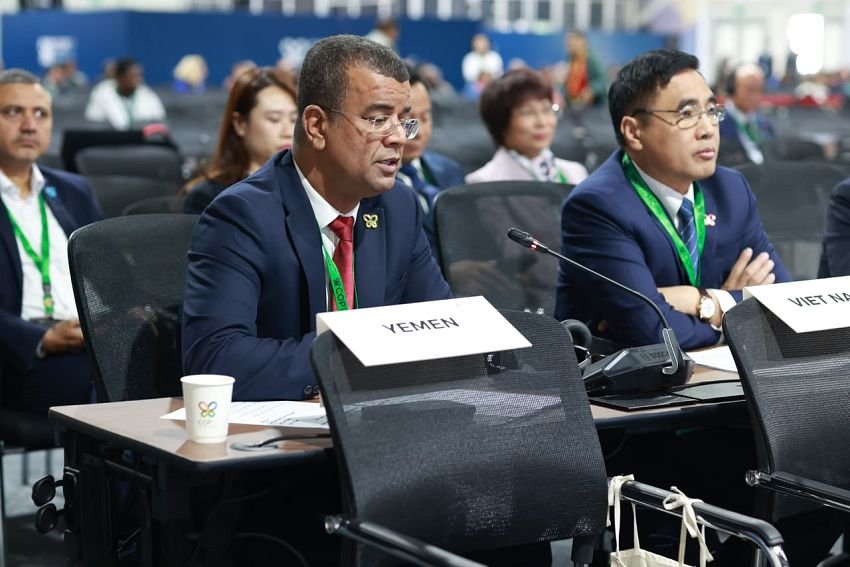
YEREVAN, Armenia — Yemen asked governments on Wednesday to put least developed and conflict-affected countries first in biodiversity funding, in a national statement to the UN biodiversity conference here.
Fahmi Abdulhadi bin Shubraq, chairman of Yemen’s Environment Protection Authority, delivered the statement at the high-level segment of the 17th Conference of the Parties to the Convention on Biological Diversity.
He said the main challenge is turning international commitments into practical action backed by sufficient resources.
He asked for access to adequate funding, transfers of technology and support for building national capacity.
He also asked that international funding be made easier to reach.
Bin Shubraq called for stronger protection of land and marine ecosystems, and for benefits from genetic resources and digital sequence information to be shared fairly.
He said the Socotra Archipelago faces threats from climate change, degradation of its ecosystems, unsustainable use of resources and the continuing conflict.
He said Yemen has completed its third national biodiversity strategy and action plan, covering 2025 to 2030 and aligned with the Global Biodiversity Framework.
The account of Yemen’s statement rests on a report by Saba, the state news agency of Yemen’s internationally recognised government. Yemen Herald found no second independent origin for it and no transcript published by the conference secretariat.
The high-level segment opened on Oct. 27 and the plenary continued on Oct. 28 with national statements, the Armenian state news agency Armenpress reported.
Armenpress put attendance at about 150 high-level participants from the parties to the convention and about 50 from international organisations.
The segment carried two panel discussions, one on conservation policy and one on financing, according to Armenpress.
Negotiations at the conference began on Oct. 19, according to Carbon Brief, which reported that finance has been a point of contention.
The Global Biodiversity Framework, agreed in Kunming and Montreal, sets a goal of closing a $700 billion annual biodiversity finance gap by 2030.
One of its targets asks for at least $200 billion a year from all sources by 2030. The framework numbers its finance commitments as targets 18 and 19.
Within that, developed countries are to provide at least $20 billion a year in public biodiversity funding to developing countries by 2025, rising to at least $30 billion a year by 2030.
A stocktake published by the convention’s secretariat on Sept. 10 found that reporting countries provided $17.7 billion in international public biodiversity funding between 2020 and 2023, an average of $4.4 billion a year.
The stocktake said the $20 billion milestone for 2025 was likely not achieved, Carbon Brief reported.
It put total mobilisation at $186.4 billion over the same four years, under $50 billion a year on average.
The Global Biodiversity Framework Fund has received $387.2 million in signed commitments from 11 countries and one subnational government, Quebec, between August 2023 and June 30 this year.
The Cali Fund, which companies pay into for the use of genetic data, has received two contributions totalling $6,000.
Figures from the Organisation for Economic Co-operation and Development put global biodiversity finance at between $74.9 billion and $92.4 billion a year from 2023 to 2025.
International public finance within that averaged about $16.1 billion a year, nearly $4 billion below the 2025 goal.
Biodiversity-specific funding was $7.9 billion in 2023 and $8.5 billion in 2024, with the rest coming from funds where biodiversity was a secondary aim.
Another target asks governments to identify subsidies harmful to biodiversity by 2025 and to cut them by at least $500 billion a year by 2030.
Lim Li Ching of the Third World Network said developed countries have not met their legal obligations, and that the shortfall should not be used to shift toward private-sector or market-based finance, Carbon Brief reported.
June Rubis, a member of the Cali Fund steering committee, asked developed countries to deliver the $20 billion and donors to make funding for the framework fund predictable, according to the same report.
The Armenian presidency of the conference has put more than 50 documents to delegates and held more than 400 side events, dozens of parallel events and four initiatives, Armenpress reported. Ministers also joined side events.
A draft decision includes a text called the Yerevan Call for Action, described as a roadmap for future work.
Organisers announced a biodiversity technology hub on Oct. 27, and launched an initiative on Oct. 26 to replace incentives that harm biodiversity with ones that do not.
Armenia has started work with partners on using technology and artificial intelligence to collect the data countries need for their progress reports, Armenpress reported. It linked the effort to the first review of the Global Biodiversity Framework.
Robert Abisoghomonyan, Armenia’s deputy minister of foreign affairs and international trade, spoke to reporters at the segment.
Georgia was represented by its minister of environmental protection and agriculture and Turkey by a deputy environment minister, Armenpress reported.
The United Nations humanitarian plan for 2026 counts more than 22 million people in Yemen in need of assistance and 5.2 million displaced inside the country.
The Socotra Archipelago was inscribed on UNESCO’s World Heritage list in 2008.
The Socotra Archipelago lies off Yemen’s southern coast in the Arabian Sea.
About the Author