Al-Alimi Demands International Response After Iranian Flight Lands in Houthi-Held Sana’a
 Yemen Herald News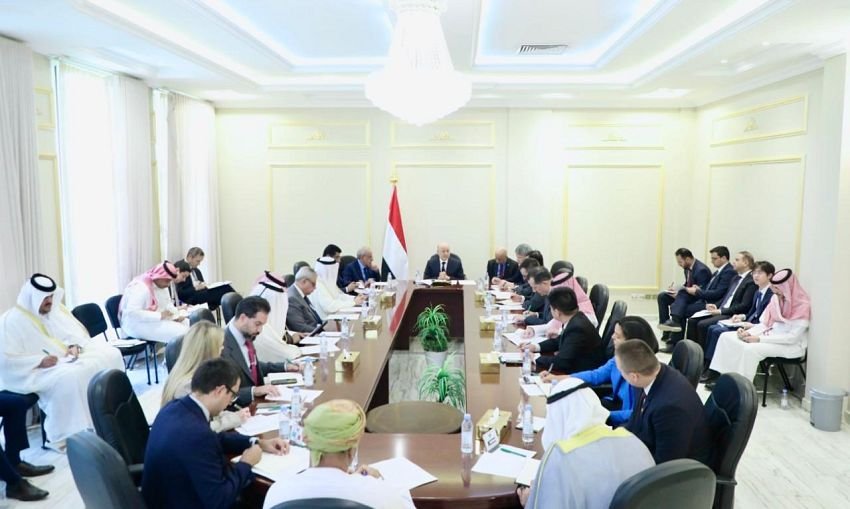
President Rashad al-Alimi, chairman of Yemen’s internationally recognized Presidential Leadership Council, has demanded a firmer international response to what he called Iran’s blatant interference in Yemen after an Iranian aircraft landed at Sana’a International Airport, which remains under Houthi control. Al-Alimi described the flight as a flagrant violation of Yemeni sovereignty and a breach of international law and United Nations Security Council resolutions intended to preserve stability in the country and the wider region.
The controversy centers on a direct flight from Tehran to Sana’a, the first such air link in years, after more than a decade during which the capital’s airport operated under tight restrictions. Reports indicated the plane, operated by an Iranian carrier, carried patients and stranded Yemeni citizens on its inbound leg before departing with a delegation of senior Houthi officials bound for Iran to attend the funeral of Supreme Leader Ali Khamenei, who was killed in a United States and Israeli strike in late February during the 2026 conflict between Iran and its adversaries.
The Presidential Leadership Council convened an emergency session to address the flight, which it characterized as a dangerous new escalation. Meeting with ambassadors from countries involved in the Yemeni political process, al-Alimi pressed the international community to enforce existing resolutions and sanctions rigorously and to prevent the use of civilian aircraft, airports, and seaports to move military expertise, personnel, and equipment into Houthi-held territory.
Al-Alimi voiced open skepticism about Houthi assertions that the flight was purely humanitarian. Early accounts, he said, suggested the aircraft was instead carrying Iranian military and security personnel, specialists in drone and missile technology, and electronic and communications equipment with potential command-and-control applications, alongside Yemeni operatives who had undergone security training in Iran. If accurate, he argued, such cargo would represent a direct injection of Iranian military capability into the conflict.
Adding to those concerns, the aircraft reportedly disabled its tracking systems while crossing Yemeni airspace, disappearing from public flight monitors for stretches of the journey. Al-Alimi said that behavior cast further doubt on the Houthi narrative and warranted an independent international inquiry to establish the full nature of the flight, its passengers, and its freight, rather than allowing the incident to pass without scrutiny.
The president renewed his call for stricter measures against the Houthi movement, framing tighter sanctions as essential to reinforcing international legitimacy and compliance with UN Security Council Resolution 2216, which underpins the recognized government’s position. He argued that stronger political and economic backing for that government is necessary to rebuild state institutions, restore basic services, and create the conditions for a durable peace.
Al-Alimi went further, contending that Yemen’s crisis can no longer be treated as a purely internal conflict. In his telling, it has become a challenge to the international order and to the global economy, given the country’s position beside vital shipping lanes. He warned that permitting such violations to go unchecked would entrench defiance of international law and steadily erode the authority of the Security Council and its mandates.
For their part, the Houthis presented the flight in starkly different terms, portraying it as a breakthrough that punctured a years-long blockade on Sana’a airport and staging public celebrations to mark the aircraft’s arrival. Houthi authorities announced their intention to continue flights between Sana’a and Tehran, and an Iranian envoy visited Yemen around the same time, signaling a deepening of ties that the recognized government views with alarm.
The airport’s recent history heightens the symbolism of the flight. Sana’a International Airport spent years under a tight air blockade imposed during the Saudi-led coalition’s campaign against the Houthis, and only a United Nations-brokered truce in 2022 reopened limited commercial service, chiefly to the Jordanian capital, Amman. A direct connection to Tehran therefore represents a striking break from that pattern.
The episode has also sharpened rhetoric on the ground. A spokesman for Yemen’s armed forces aligned with the recognized government warned that continued Iranian flights would not go unanswered, hinting at the risk of renewed military friction after a period of relative calm. The warning underscored how a single flight reverberated far beyond the runway.
The diplomatic clash unfolds against the backdrop of one of the world’s gravest humanitarian emergencies. Years of war have left an estimated 18 million Yemenis in need of assistance, and more than four and a half million people have been displaced from their homes. Aid agencies continue to warn of hunger, disease, and collapsing public services, conditions that any renewed escalation between the recognized government and the Houthis threatens to worsen.
The stakes also extend well beyond Yemen’s borders. The country sits alongside the Bab al-Mandab strait and the southern Red Sea, a corridor through which a significant share of global trade passes. Disruptions there ripple outward to shipping costs and energy markets, which is part of why al-Alimi has sought to frame the airport episode as a matter of international, not merely national, security.
How governments respond to the Sana’a flight may shape the next phase of the conflict. Al-Alimi urged the global community to reassess its approach to Yemen in light of what he described as intensifying Iranian involvement, arguing that a firmer, more coordinated stance is needed to protect regional stability, safeguard freedom of navigation, and prevent the fighting from entering a more dangerous chapter.
About the Author