Al-Alimi announces start of military operations to retake Houthi-held territory
 Yemen Herald News
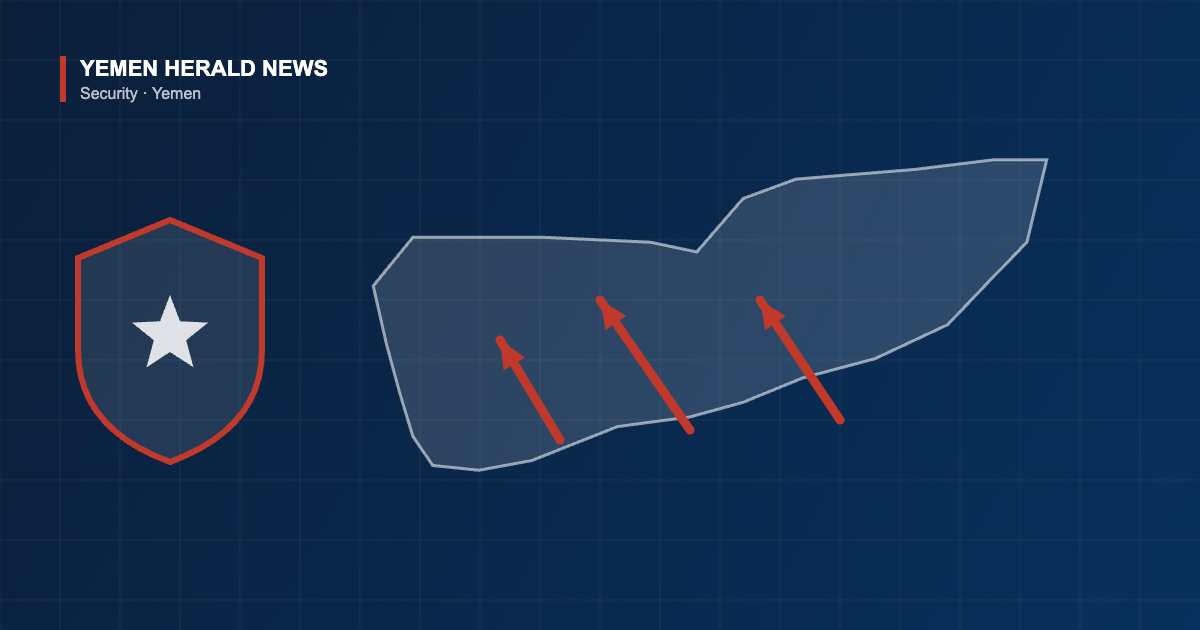
ADEN, Yemen — Yemen’s Presidential Leadership Council chairman announced the start of military operations on Sunday to retake territory held by the Houthi movement.
Rashad al-Alimi said the government had moved from a phase of preparation and mobilisation to open military action, after what he described as the exhaustion of efforts to de-escalate.
“I announce today the launch of military operations to retake the remaining territory,” al-Alimi said.
He said he had instructed the armed forces, the security forces and all military formations to begin their assigned missions, and that the orders stood “until the country is liberated from the grip of the terrorist militia.”
“Today we are embarking on a decisive phase in the history of our nation,” he said.
Al-Alimi said the campaign was not a war against residents of Sanaa, Hodeidah and Saada.
“You are not the target of these operations,” he said. “Your security, rights and dignity are among their most important reasons.”
He said there would be “no revenge, no retaliation, no attacks on innocent people.”
Al-Alimi urged people living in Houthi-held areas to keep away from gathering places used by the group’s fighters. He said children should be kept out of the fighting.
He referred to Sanaa, Saada, Hodeidah, Amran, Dhamar and Ibb among the provinces outside government control.
The chairman said the door remained open to fighters who laid down their weapons, and renewed earlier commitments on amnesty and on what the government calls safe return.
He said cities retaken by government forces would enter a period of “stability, recovery and reconstruction.”
Al-Alimi directed the government to prepare a parallel civilian plan. He said it covers the resumption of state salaries with retroactive dues, repairs to roads and utilities, and conditions for displaced families to go home.
He said the state had chosen peace and had made what he called great sacrifices in pursuing it.
Asharq Al-Awsat named Defence Minister Lt. Gen. Taher al-Aqili and Chief of the General Staff Lt. Gen. Sagheer bin Aziz among the commanders directing the campaign.
The newspaper reported that the armed forces said they carried out 257 strikes in a single day across several fronts, put about 700 Houthi fighters out of action and destroyed 170 combat vehicles.
The same account reported 97 strikes on the Tor al-Baha and Taiz axis, with 260 fighters put out of action there.
It put losses over the previous week at nearly 6,000 killed and wounded. Yemen Herald could not independently verify those tallies, and the Houthis have not confirmed them.
Casualty figures issued by either side in Yemen’s war are routinely disputed by the other.
The announcement follows Houthi gains on the Red Sea coast. Houthi forces seized the port city of Mokha on Sept. 10 and 11 and then took Perim Island in the Bab al-Mandab Strait, according to Security Council Report, a research group that tracks the UN body.
Accounts cited by that group said Iranian Revolutionary Guard advisers supported the advance. Iran has denied arming the Houthis.
Government forces said they retook highland positions and Mount Qarfan in Taiz governorate on Sept. 21 and 22, the same record states. Fighting around Taiz city intensified.
Hans Grundberg, the UN special envoy for Yemen, told the Security Council in September that the war had entered a “dangerous phase.”
He briefed an emergency council meeting on Sept. 10. Assistant Secretary-General Mohamed Khaled Khiari briefed a second on Sept. 15.
The council issued a press statement on Sept. 18 condemning Houthi attacks and the military escalation.
Volker Türk, the UN High Commissioner for Human Rights, said on Sept. 24 that at least 125 civilians had been killed and wounded and 125,000 people displaced since early August.
The UN refugee agency recorded about 3,000 people crossing to Djibouti.
Houthi missile and drone attacks on southern Saudi Arabia on Sept. 8 injured 73 people and damaged energy facilities, according to Security Council Report. Strikes on Sept. 15 and 16 caused a fire at King Khalid International Airport in Riyadh.
Saudi air defences intercepted a drone reported to be heading toward Mecca during those strikes, the same record states.
The UN humanitarian plan for Yemen, issued in March, put more than 22 million people in need of aid and 18.3 million as acutely food insecure.
It recorded 5.2 million people displaced inside the country and sought $2.16 billion to reach 12 million of them.
More than 2.2 million children under five are acutely malnourished, 516,157 of them severely, the plan states.
Asharq Al-Awsat also named field commanders Yousef al-Sharaji, Khaled Fadel and Abdulaziz al-Majidi in its account of the operations.
Arab News identified Col. Majid al-Nuzaili as the spokesman for the armed forces and referred to the Saudi-led coalition to restore legitimacy in Yemen.
The Mokha and Perim operations gave Houthi forces control of Yemen’s west coast, the research group’s record states.
The Presidential Leadership Council was formed in April 2022, when Abd Rabbu Mansour Hadi transferred his powers to it. Al-Alimi has chaired the eight-member body since.
Türk renewed a demand on Sept. 24 for the release of 73 UN staff detained in Houthi-held areas.
About the Author