Al-Alimi Receives Credentials of New Ambassadors from Italy, Norway, Albania, Greece and Kuwait
 Yemen Herald News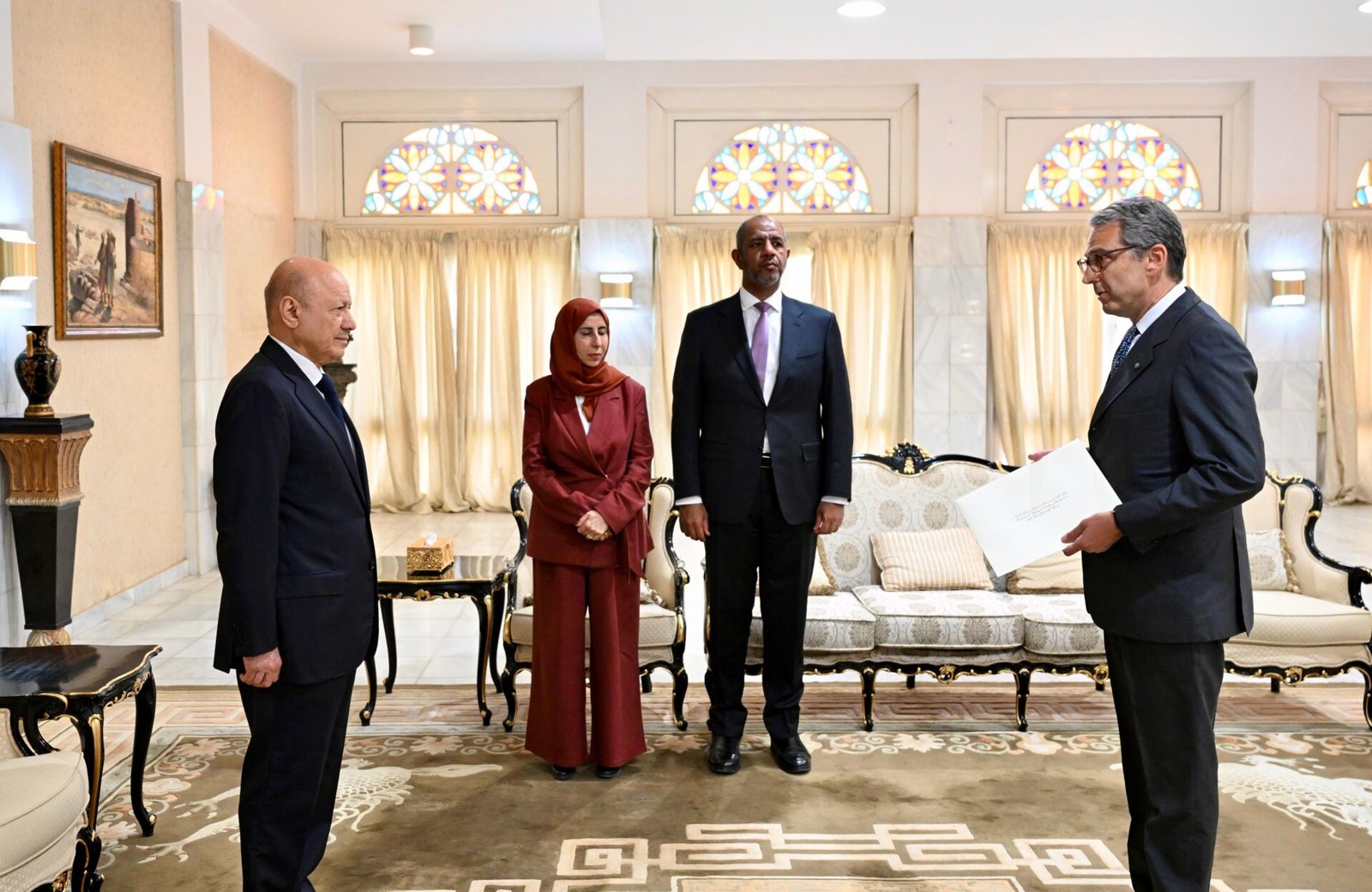
President Rashad al-Alimi, chairman of Yemen’s Presidential Leadership Council, has received the credentials of newly appointed ambassadors from Italy, Norway, Albania, Greece and Kuwait during a ceremony in the Saudi capital. The envoys presented their letters in a series of separate meetings, each conveying greetings from their respective heads of state along with wishes for peace and stability in Yemen. Al-Alimi welcomed them and said his government would provide whatever assistance their missions required to strengthen bilateral relations.
The newly accredited diplomats include Carlo Baldocchi of Italy, Kjersti Tromsdal of Norway, Saimir Bala of Albania and Falah al-Mutairi of Kuwait, together with the incoming Greek ambassador. Foreign Minister Afrah al-Zouba, the first woman to hold that office in Yemen’s history, took part in the proceedings. The accreditations were conducted in Riyadh, where the Presidential Leadership Council has been headquartered since it was formed in April 2022 to bring the anti-Houthi camp under a single executive body.
That location says a good deal about the current state of Yemeni statecraft. The Houthi movement has held Sanaa since late 2014, and the internationally recognised government’s temporary capital in Aden has contended with prolonged power shortages, a collapsing currency and recurring unrest. Most foreign missions accredited to Yemen now operate out of Riyadh, so credential ceremonies that would once have taken place in the capital are held on Saudi soil instead.
The five countries bring different kinds of weight to the relationship. Italy, Norway, Greece and Albania are European states with a direct stake in Red Sea security, while Kuwait has been a consistent financial donor to Yemen and hosted a lengthy round of United Nations-mediated peace talks in 2016.
In his remarks, al-Alimi told the ambassadors that sustained international engagement matters during what he called a decisive period for the country. He argued that the stakes reach well beyond Yemen’s borders, pointing to regional security and the safety of international shipping lanes, and framed the conflict as a test of whether state sovereignty and international law still carry weight in the region.
The president described the recent escalation by Houthi forces as something his government had anticipated, and said it formed part of a broader regional strategy directed by Iran’s Islamic Revolutionary Guard Corps. The group, in his account, serves as an instrument of Tehran’s interests and becomes most active when Iran itself is under international pressure. The Houthi leadership rejects that characterisation and presents its military operations as independent decisions taken in response to what it calls foreign aggression.
Al-Alimi also restated the government’s commitment to a negotiated settlement while accusing Houthi factions of repeatedly undercutting those efforts. He said that each time a credible opening for de-escalation appeared, the group answered with fresh offensives or attacks that raised risks for commercial shipping and for neighbouring states. United Nations special envoy Hans Grundberg has spent much of the past two years trying to secure agreement on a roadmap covering a nationwide ceasefire, the payment of public salaries and a return to political talks, so far without a breakthrough.
The humanitarian backdrop remains severe by any measure. The United Nations estimates that more than 22 million people in Yemen will need humanitarian assistance and protection during 2026. Aid agencies have appealed for 2.16 billion dollars to fund the response, but the plan was only around 13 percent financed by the middle of the year. Some 18.3 million people are classified as acutely food insecure, and more than 2.2 million children under five are acutely malnourished.
Al-Alimi attributed that emergency not to geography or to external shocks but to what he called the destructive policies of the coup leadership and the continuation of the war. He criticised the diversion of state resources into military campaigns and pointed to the length of time ordinary Yemenis have now spent living with shortages, displacement and disrupted public services.
On the aid question itself, the president argued that relief alone is not a sufficient response. He called for humanitarian assistance to be delivered alongside deliberate efforts to rebuild state institutions, warning that support detached from any attempt to restore functioning government risks entrenching dependency rather than resolving the crisis.
He used the meetings to brief the incoming ambassadors on the government’s economic agenda, which centres on repairing public financial management, stabilising the rial and creating conditions transparent enough to attract foreign investment. Strengthening the recognised government, he told them, is a prerequisite for both Yemeni recovery and wider regional stability.
The president returned to Iran’s role in the region, and in particular to what he described as the militarisation of Yemeni communities, arguing that it undermines local prospects for peace while threatening freedom of navigation. He acknowledged Saudi Arabia’s role in supporting Yemen’s economy and its humanitarian response, and said regional cooperation would be indispensable to any durable settlement.
He closed by describing the present moment as a narrow window in which the region could address the entrenched presence of armed groups operating outside state authority. Yemen, he said, would not allow itself to be used as an arena for external pressure campaigns, and his government intends to keep working with international partners to secure shipping routes and to counter terrorism and organised crime. The presence of Foreign Minister al-Zouba at the ceremony underlined the leadership’s effort to present a unified diplomatic front as it seeks to convert international sympathy into concrete political and financial support.
About the Author