
Al-Alimi Tells Governors and Security Chiefs the State Will Advance to Safeguard Yemen’s Sovereignty
 Yemen Herald News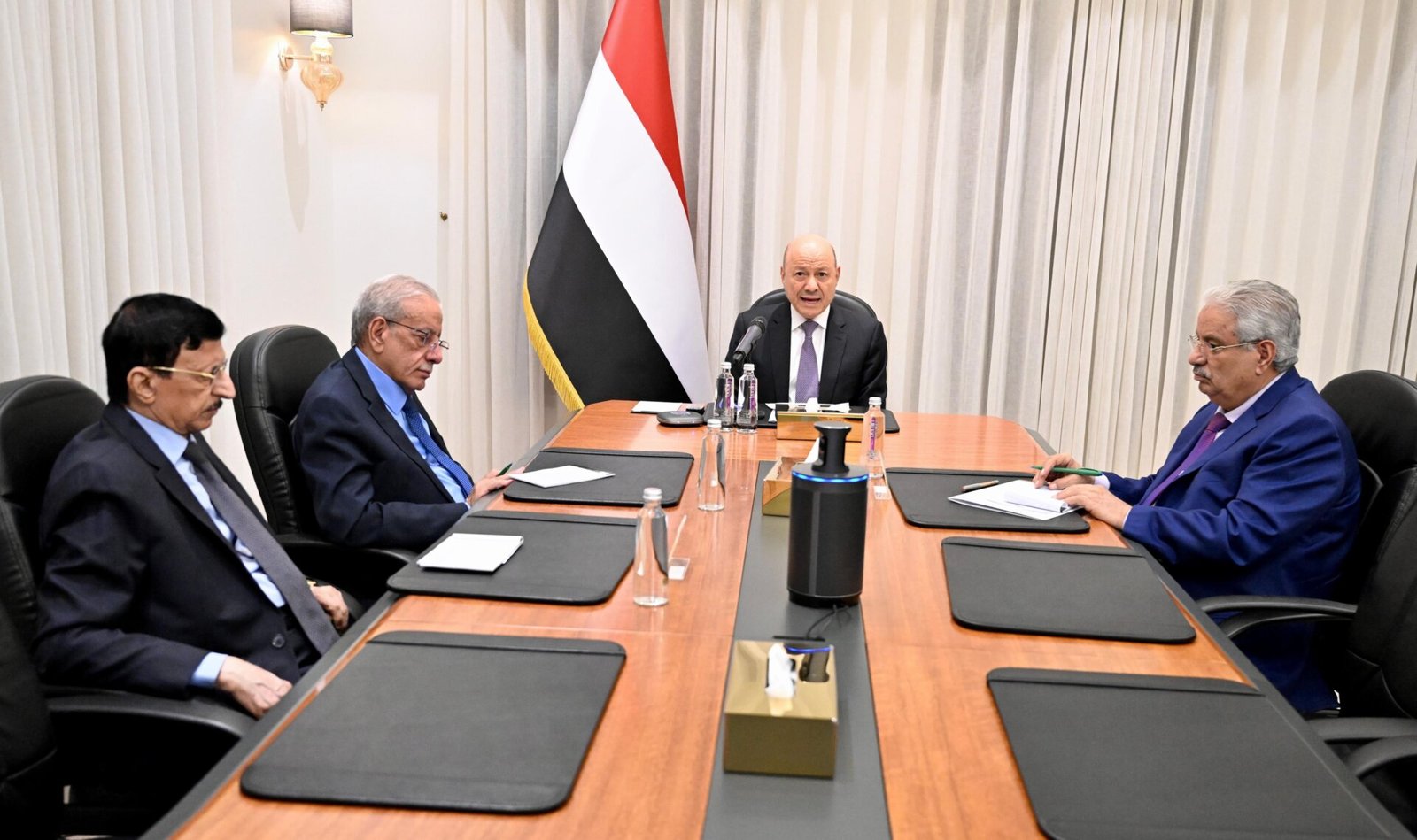
President Dr. Rashad Mohammed al-Alimi, chairman of Yemen’s Presidential Leadership Council, chaired a meeting in Riyadh on Friday that brought together provincial governors and the members of the Supreme Security Committee, with Prime Minister and Foreign Minister Dr. Shaya Zindani also taking part. The talks focused on the national situation, the urgent need to improve living standards, and ways of strengthening state institutions and security arrangements across government-held areas of Yemen.
The agenda also covered what the government condemns as continuing violations of Yemen’s sovereignty by Iran, most recently through direct flights between Tehran and Houthi-held Sana’a that were launched without the approval of the internationally recognized authorities. Officials at the meeting argued that the Houthi movement is seeking to distract Yemenis from its internal difficulties by stoking renewed confrontation, behaviour they said serves the interests of the group’s Iranian backers rather than the Yemeni people.
Addressing the governors, al-Alimi stressed the weight of responsibility that local leaders carry at what he described as a pivotal moment in the country’s history. He called for intensified efforts to confront emerging challenges and to foster unity among citizens in all regions, and he urged close collaboration with military and security agencies as the surest way of building public trust in state institutions.
The president directed local officials to tighten security, consolidate the authority of the state and press ahead with the fight against corruption and terrorism. He placed particular emphasis on securing ports and border crossings, which provide much of the government’s customs revenue and, officials say, remain vulnerable to smuggling networks, and on improving the delivery of basic services such as electricity, water and health care to citizens in the provinces. These duties, the president argued, are not separate from the war effort but are inseparable from the preservation of national stability and public confidence in the state.
Al-Alimi also reviewed the measures the state has taken in response to recent Houthi provocations. He told the meeting that the government’s conduct reflects the behaviour expected of a legitimate state rather than an armed faction: it has concentrated on defending sovereignty and mobilizing regional and international support instead of being drawn into confrontations that, in his view, would allow the insurgents to escape their mounting internal problems.
At the same time, the president reaffirmed that the government has not abandoned its central objective, which it defines as ending the Houthi takeover that began when the group seized Sana’a in 2014. Reinforcing stability, he said, does not mean any lessening of resolve, and the state remains prepared to make whatever sacrifices are required to restore its institutions throughout the country.
One of the more notable passages of the meeting concerned Jordan’s humanitarian initiative to resume commercial flights between Sana’a and Amman. Al-Alimi expressed support for the proposal, which Saudi Arabia has also publicly welcomed, while insisting that the government’s readiness to ease civilian suffering should not be misread as a retreat from national goals or as acceptance of any violation of Yemeni sovereignty.
He framed the government’s position as a responsible approach centred on the needs of ordinary Yemenis: any initiative that promotes peace and reduces hardship is welcome, but the state will not surrender its legal authority over the country’s airspace and airports, and humanitarian arrangements cannot be allowed to override the framework of state governance. Sana’a airport has operated only limited commercial services since the UN-brokered truce of 2022, and the question of who authorizes flights there has become one of the most sensitive issues in the current escalation.
The Riyadh gathering took place against a backdrop of acute hardship inside Yemen. United Nations agencies estimate that more than eighteen million people need some form of humanitarian assistance, over half the population, and health authorities continue to battle outbreaks of cholera and measles in a country whose hospitals, water networks and power grids have been degraded by more than a decade of conflict.
The economic dimension weighs just as heavily on the government’s agenda. The currency in government-held areas has lost much of its value over the course of the war, eroding salaries and pushing the price of food beyond the reach of many families. Improving living standards, the stated priority of Friday’s meeting, depends in large part on stabilizing revenues from ports and crossings and on continued financial support from Yemen’s partners in the region.
The Presidential Leadership Council that al-Alimi chairs was formed in April 2022, when presidential powers were transferred to an eight-member body drawn from the main political and military currents opposed to the Houthis. Holding that coalition together while projecting a unified state presence in the provinces has been one of the council’s persistent challenges, which lends meetings between the president and the governors a significance beyond routine administration.
Whether the directives issued in Riyadh translate into changes on the ground will depend on funding, security conditions and the cohesion of the government’s own ranks. But the message of the meeting was unambiguous: the state intends to keep advancing, to defend its sovereignty with confidence, and to pursue both humanitarian relief and the restoration of its institutions at the same time, however difficult the balance between the two may prove.
About the Author




