Al-Alimi Tells New US Envoy Mokha Port Strike Shows Houthi Campaign Against Yemen’s Economy
 Yemen Herald News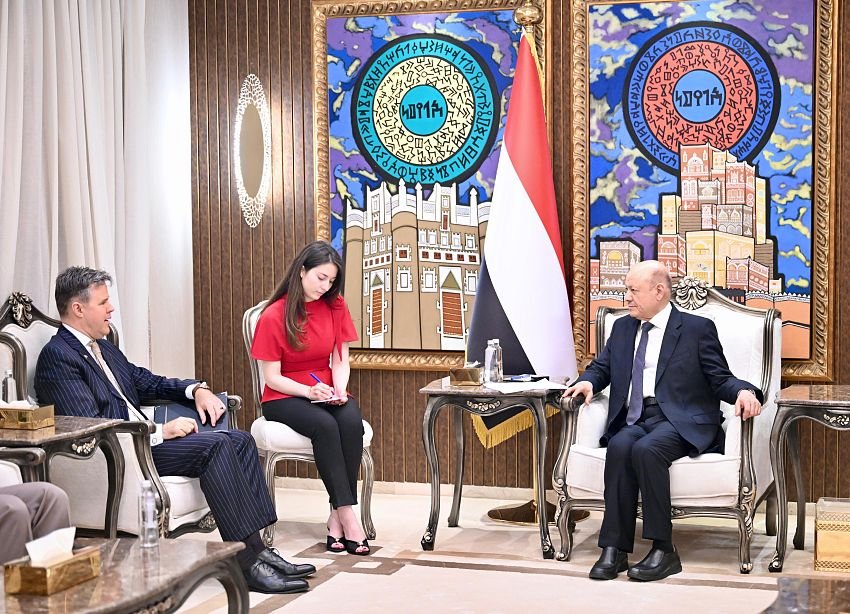
President Rashad al-Alimi, Chairman of Yemen’s Presidential Leadership Council, received Neil Hop, the newly arrived Charge d’Affaires of the United States Embassy to Yemen, for talks dominated by the weekend assault on the Red Sea port of Mokha. The Yemeni leader used the meeting to argue that the strike was not an isolated act of retaliation but evidence of a sustained campaign by the Houthi group against the economic infrastructure ordinary Yemenis depend on, and he tied it to what the government describes as a wider Iranian effort to extend influence along the region’s shipping lanes.
Missiles and drones struck the port and nearby residential districts west of Taiz province early on Sunday. The National Resistance Forces, a Yemeni government-allied formation that holds the western coast, said seven people were killed, four of them soldiers and three civilians, and that at least fifteen civilians were wounded. Some local accounts put the number of injured considerably higher, and casualty tallies from the coastline have not been independently verified. Fayed al-Noman, assistant undersecretary at the Ministry of Information, said port buildings and piers were badly damaged along with commercial cargo and stocks of food.
The Houthi military spokesman, Yahya Saree, confirmed that the group had targeted Mokha, saying the operation answered Saudi drones that he accused of breaching Yemeni airspace over Hajjah and Saada. That justification could not be independently confirmed, and the Yemeni government rejects it outright.
Mokha’s significance is out of proportion to its size. The port sits on the Red Sea coast a short distance north of the Bab al-Mandab strait, the choke point through which a substantial share of Europe-Asia trade passes. It is one of the few sizeable harbours under the control of the internationally recognised government, and it has been progressively rehabilitated over recent years so that shipping lines can discharge cargo without calling at Houthi-held Hodeidah. Damage to its piers therefore falls not only on the local economy but on the import route that feeds government-held provinces.
Al-Alimi told the American envoy that the attack fitted a pattern he traced through earlier strikes on military positions and on camps sheltering displaced families. In the government’s account, the targets share a common characteristic: they are the points at which the state still delivers something to civilians. He said the Houthis’ description of themselves as a besieged party is contradicted by their own choice of targets, arguing that a movement under siege does not spend its munitions on ports, airports and food warehouses.
He also warned that the strikes carry risks beyond Yemen’s shoreline. Commercial vessels calling at Mokha operate in the same waters that have seen repeated attacks on international shipping since 2023, and the government contends that each strike on a working port raises insurance costs and lengthens the queue of carriers unwilling to enter the southern Red Sea at all. The practical effect, in that reading, is measured in the price and availability of imported wheat, fuel and medicine.
The President pressed Washington to treat the protection of Yemen’s ports and airports as a matter of the country’s sovereign rights rather than a secondary concern within maritime security policy. He argued that international engagement has concentrated on containing Houthi capability at sea while leaving the causes of the conflict untouched, and he asked the United States to support the construction of Yemeni state institutions capable of holding territory, paying salaries and enforcing the law. Without that, he said, any reduction in attacks would be temporary.
Al-Alimi returned to a theme he has raised repeatedly with foreign interlocutors: that regional or international agreements which leave the armament and financing of Iranian-backed groups unaddressed will not hold. He asked that the capabilities of such groups, and the channels that supply them, be treated as a substantive element of any settlement rather than a matter to be deferred.
For Hop, the meeting was an early test of a posting he took up this month. A career member of the Senior Foreign Service with the rank of Counselor, he has spent more than two decades in State Department and interagency assignments, including as director of the Office of Israel and Palestinian Affairs and as acting deputy assistant secretary for Pakistan. He succeeds Jonathan Pecha and has already signalled that Red Sea and maritime security will sit at the centre of his brief, having raised the same subject when he congratulated Foreign Minister Afrah al-Zouba on her appointment.
The American mission to Yemen has operated from outside the country since the embassy in Sanaa suspended operations in 2015. That arrangement places unusual weight on meetings of the kind held on Sunday, which serve as a main channel through which the Presidential Leadership Council puts its case directly to Washington.
Al-Alimi opened the discussion by thanking the United States for its assistance to the Yemeni government, singling out its role in regional security, in keeping sea lanes open and in counterterrorism operations. Both sides described the exchange as a foundation for closer coordination in the period ahead, and the President offered the new envoy help in establishing his mission.
No independent damage assessment has yet been published, and it remains unclear how quickly the port’s berths can return to normal operation. Mokha’s rehabilitation has been one of the few visible economic gains in the government-held west, and officials fear that repeated strikes will undo it.
About the Author